Nearly one in three Canadian exporters plans to enter European markets within two years. Canada–EU trade already exceeds €130 billion annually in goods and services. As the October summit approaches, the test is whether businesses can turn political momentum into customers, investment and lasting competitive advantage.
By Dr Brian O’Donnell | Aurex Insights

A tariff can change overnight. Building a new customer base can take years.
That mismatch is reshaping the decisions facing Canadian businesses. A company can retain its customers, its production capacity and a competitive product, yet find the economics of an established market altered by a political decision. Diversification offers a response – but only if the next market can support a viable business.
Europe is moving to the centre of that calculation. Export Development Canada’s (EDC’s) 2026 Trade Confidence Index finds that 31% of Canadian exporters plan to enter Europe within the next two years. This is evidence of intention, not completed expansion, but it suggests that diversification is becoming a boardroom decision rather than simply a government aspiration.
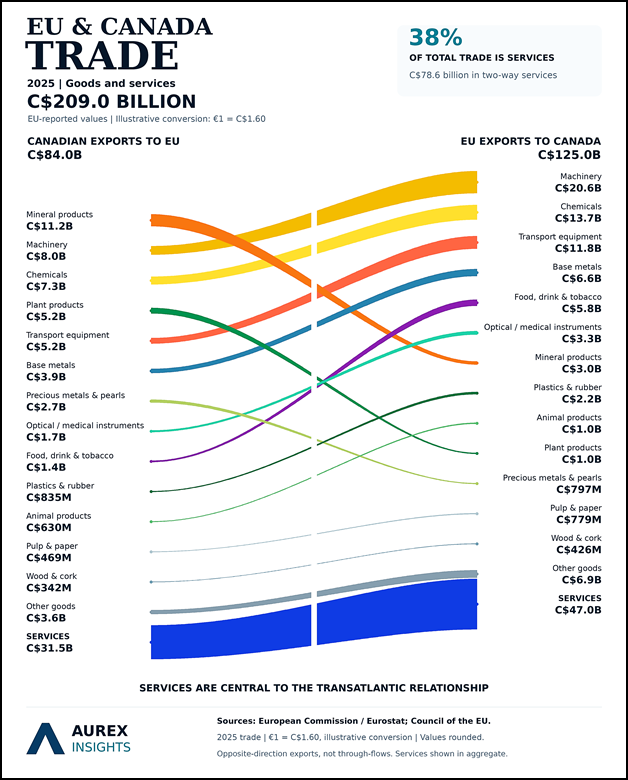
There is already a substantial relationship to build upon. European statistics put Canada–EU goods-and-services trade above €130 billion (C$209) in 2025. Services contributed approximately €49 billion, accounting for about 38% of the combined relationship. Europe is therefore not merely a destination for Canadian resources and manufactured products: services are central to the commercial opportunity.
The Canada–EU summit scheduled for October 29–30 provides the next political milestone. Its significance, however, should be judged by more than the ambition of its communiqué. The business question is whether a stronger partnership will make investment, procurement, supply-chain development and market entry easier to execute.
Canada does not need another reason to take Europe seriously. It needs more businesses capable of turning that seriousness into contracts, productive capacity and recurring revenues.
The trade shock has changed the investment calculation
The deterioration in Canada’s American trading relationship has made market concentration harder to treat as a background risk.
On August 22, Prime Minister Mark Carney suspended trade negotiations with the United States, describing the proposed terms as unfair and uneconomic. Canada subsequently introduced countermeasures on C$27.6 billion of American goods, effective September 8, in response to new U.S. Section 338 tariffs. These are targeted measures affecting specified products, not a uniform tariff on all bilateral trade.
The immediate consequences are visible at the border. The deeper consequences emerge in investment decisions.
A manufacturer considering new equipment must assess whether its principal market will remain commercially accessible. A supplier developing a customer-specific product must decide whether future orders justify the commitment. A smaller business must determine how much working capital it can expose to a relationship whose terms may change.
Diversification has economic value because it can reduce the extent to which one policy decision determines a company’s future.
But resilience is not free. Additional markets bring acquisition costs, regulatory requirements, distribution arrangements and management demands. A company can diversify its revenues while weakening its profitability if expansion is poorly chosen.
The objective should therefore be neither to abandon viable American customers nor to pursue Europe at any price. It should be to build a portfolio of commercially sound relationships that leaves the business less vulnerable to decisions it cannot control.
A substantial relationship – and a larger implementation challenge
Canada and Europe are not starting from zero.
CETA has applied provisionally since September 2017. At the outset, Canada and the EU abolished duties on 98% of tariff lines and agreed to eliminate almost all remaining lines gradually. Between 2016 and 2025, the value of bilateral goods trade increased by more than 76%, services trade by around 90%, and goods and services combined by more than 81%, according to the Council of the EU.
These are increases in trade values, not measures of real volumes or estimates of growth caused entirely by the agreement. They nevertheless establish that the relationship has expanded substantially.
The challenge is to broaden the base of businesses participating in it.
Statistics Canada counted 47,948 goods-exporting enterprises in 2025, down slightly from the previous year. Only 34.8% served any destination outside the United States. The number exporting to non-U.S. destinations increased by 292; the number exporting to Europe increased by 131.
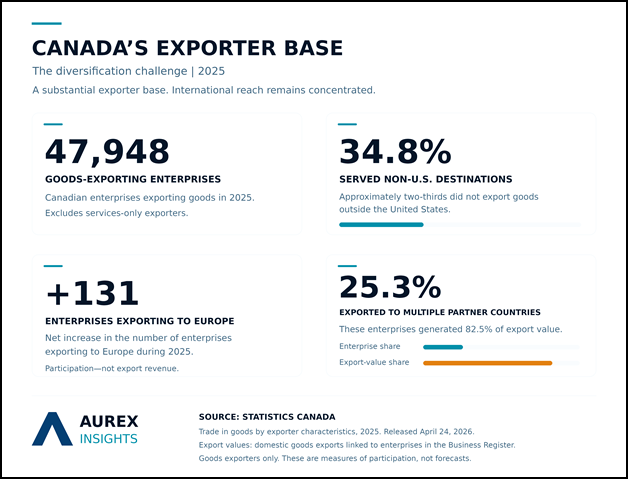
The concentration is striking. Just over one-quarter of goods exporters served multiple partner countries, yet they accounted for more than four-fifths of the export value covered by the dataset. That does not prove that diversification causes superior performance: larger enterprises are also more likely to operate across several markets. It does show how much export activity depends on businesses with the capacity to sustain international operations.
EDC’s 31% finding points towards future ambition. Statistics Canada’s figures describe existing participation. The populations and definitions differ, so they cannot be combined to calculate how many firms will enter Europe. Together, however, they identify the strategic task: moving from interest to capability.
What the two economies actually sell to each other
The product mix reveals both the strengths of the relationship and the opportunities to deepen it.
The European Commission’s detailed May 2026 snapshot records €32.814 billion in EU goods imports from Canada and €48.738 billion in EU goods exports to Canada during 2025. The tables below reproduce that reporting basis and provide Canadian-dollar equivalents at an illustrative conversion of €1 = C$1.60.
This conversion is a reader aid, not a claim about the exchange rates at which the transactions occurred. Services are reported separately from customs product categories.
Canadian exports to the European Union
Mineral products were the largest Canadian goods category, followed by machinery, chemicals, vegetable products and transport equipment. The complete breakdown shows that the relationship extends well beyond commodities
| Category, ranked by goods value | € million | CAD equivalent, C$ million |
| Mineral products, including fuels | 6,995 | 11,192.0 |
| Machinery and appliances | 4,999 | 7,998.4 |
| Chemicals and allied-industry products | 4,548 | 7,276.8 |
| Vegetable products | 3,261 | 5,217.6 |
| Transport equipment | 3,249 | 5,198.4 |
| Base metals and articles thereof | 2,437 | 3,899.2 |
| Not classified | 1,723 | 2,756.8 |
| Pearls, precious metals and articles thereof | 1,699 | 2,718.4 |
| Optical, photographic and other instruments* | 1,043 | 1,668.8 |
| Foodstuffs, beverages and tobacco | 883 | 1,412.8 |
| Plastics, rubber and articles thereof | 522 | 835.2 |
| Live animals and animal products | 394 | 630.4 |
| Pulp, paper and paperboard | 293 | 468.8 |
| Wood, charcoal, cork and articles thereof | 214 | 342.4 |
| Textiles and textile articles | 146 | 233.6 |
| Miscellaneous manufactured articles | 124 | 198.4 |
| Animal or vegetable fats and oils | 110 | 176.0 |
| Stone, glass and ceramic articles | 49 | 78.4 |
| Raw hides, skins and saddlery | 37 | 59.2 |
| Footwear, hats and other headgear | 32 | 51.2 |
| Arms and ammunition | 28 | 44.8 |
| Works of art and antiques | 27 | 43.2 |
| Goods subtotal | 32,814 | 52,502.4 |
| Services—all categories, rounded | 19,700 | 31,520.0 |
| Goods and services, approximately | 52,500 | 84,000 |
Goods source: European Commission, Eurostat Comext, May 20, 2026. Services source: Council of the EU, June 2026. Canadian exports are measured here as EU imports from Canada. Independently rounded goods rows differ from the published subtotal by €1 million; the official subtotal is retained. Combined totals are approximate because services are reported to €0.1 billion.
European Union exports to Canada
European exports are more heavily concentrated in industrial manufactures. Machinery alone accounted for €12.896 billion – 26.5% of EU goods exports to Canada – while chemicals and transport equipment were also substantial.
| Category, ranked by goods value | € million | CAD equivalent, C$ million |
| Machinery and appliances | 12,896 | 20,633.6 |
| Chemicals and allied-industry products | 8,557 | 13,691.2 |
| Transport equipment | 7,384 | 11,814.4 |
| Base metals and articles thereof | 4,099 | 6,558.4 |
| Foodstuffs, beverages and tobacco | 3,632 | 5,811.2 |
| Optical, photographic and other instruments* | 2,056 | 3,289.6 |
| Mineral products, including fuels | 1,879 | 3,006.4 |
| Plastics, rubber and articles thereof | 1,365 | 2,184.0 |
| Textiles and textile articles | 997 | 1,595.2 |
| Not classified | 895 | 1,432.0 |
| Miscellaneous manufactured articles | 856 | 1,369.6 |
| Live animals and animal products | 646 | 1,033.6 |
| Vegetable products | 633 | 1,012.8 |
| Stone, glass and ceramic articles | 567 | 907.2 |
| Pearls, precious metals and articles thereof | 498 | 796.8 |
| Pulp, paper and paperboard | 487 | 779.2 |
| Footwear, hats and other headgear | 371 | 593.6 |
| Raw hides, skins and saddlery | 292 | 467.2 |
| Wood, charcoal, cork and articles thereof | 266 | 425.6 |
| Animal or vegetable fats and oils | 261 | 417.6 |
| Works of art and antiques | 54 | 86.4 |
| Arms and ammunition | 46 | 73.6 |
| Goods subtotal | 48,738 | 77,980.8 |
| Services—all categories, rounded | 29,400 | 47,040.0 |
| Goods and services, approximately | 78,100 | 125,000 |
Sources and conversion basis as above. Independently rounded goods rows differ from the published subtotal by €1 million. “Optical, photographic and other instruments” abbreviates HS Section XVIII, which also includes medical instruments, clocks and watches, and musical instruments.
Read the flows as a map of capabilities
The familiar shorthand is that Europe sells machinery and Canada supplies resources. It captures part of the relationship, but misses a more useful interpretation.
Under the Commission’s separate SITC classification, manufactures represented 48.9% of EU goods imports from Canada in 2025. Canada already participates meaningfully in European industrial supply chains.
There was also important variation within the Canadian goods performance. EU imports of Canadian machinery rose 21.1% in 2025; transport equipment rose 27.4%; and base metals rose 62.9%. Mineral products, despite remaining the largest category, declined 3.6%, while chemicals declined 13.9%. These are nominal value changes and can reflect prices and composition as well as quantities.
That variation matters. There is no single “European export opportunity” moving uniformly upwards. The business case must be established at the level of the product, customer and market.
The strategic objective is to become useful within a customer’s operations: supplying material, technology, equipment or expertise that improves its performance or reduces a costly vulnerability.
Services change the opportunity – and the entry strategy
Services are not an addition at the margins. At approximately €49.1 billion, they account for about 38% of the combined trading relationship on the reporting basis used here. The EU exported €29.4 billion in services to Canada and imported €19.7 billion, giving it a services surplus of approximately €9.7 billion.
The Council identifies professional, scientific and technical services; travel; transport; and telecommunications, computer and information services among the leading services traded. A verified sector-by-sector value breakdown is not provided in the cited presentation, so the tables retain services as an aggregate.
This broadens the opportunity, but also cautions against treating the entire services total as a readily addressable market for any individual firm.
A merchandise exporter must establish the economics of production, shipment, distribution and support. A service provider must establish how it will acquire customers, deliver its expertise and satisfy the requirements applicable to its offering. Both must demonstrate a reason to displace or complement an existing supplier.
The question is therefore not simply what Canada can ship. It is where Canadian businesses can contribute to a European customer’s productivity, investment or operations – and how they can establish a position worth maintaining.
Investment makes the relationship deeper than annual trade
Trade measures what crosses borders during a period. Investment stocks show something different: the accumulated positions businesses have established in each other’s economies.
In 2024, EU foreign direct investment stocks in Canada stood at €244.7 billion, while Canadian FDI stocks in the EU-27 stood at €230 billion. These are investment positions, not annual flows or simply the sum of historical investment spending.
For companies, this suggests a wider set of entry routes than exporting alone: partnerships, acquisitions and local operations can form part of a European strategy.
EDC’s October announcement provides concrete examples. In 2026, it financed Laserax GmbH’s acquisition of a majority stake in German specialist SLCR Lasertechnik GmbH, supporting the Québec company’s expansion in industrial laser applications. In Poland, Northland Power’s 1.1-gigawatt Baltic Power project with ORLEN delivered its first offshore wind electricity to the national grid in June, supported by EDC project financing.
The examples are different, but the strategic lesson is shared. European growth can involve acquiring a capability, building an asset or joining an industrial network – not merely sending more products through a customs border.
The Council also cites an ex-post evaluation estimating that CETA raises EU GDP by €3.2 billion annually relative to a scenario without the agreement. This is an evaluation estimate, not a directly observable addition that can be isolated in annual GDP statistics.
Europe is a demanding customer, not a rescue market
EDC forecasts eurozone growth of 1.1% in 2026 and 1.5% in 2027. These forecasts describe moderate expansion, not a broad-based boom, and cover the eurozone rather than Europe as a whole.
Canadian exporters should consequently resist assuming that European demand will absorb whatever becomes harder to sell in the United States.
The stronger opportunity lies in specific problems European customers need to solve. EDC identifies energy security, defence modernisation, digital technologies, advanced manufacturing and supply-chain resilience as areas driving investment and demand.
Energy and cleantech: make the operating case
EDC highlights opportunities in smart grids, turbines and generators, geothermal heat pumps, and water and wastewater solutions.
A credible proposition connects those capabilities to a purchasing decision.
Does the product reduce energy use, improve reliability, limit downtime or help an asset owner meet a requirement?
Who approves the investment, and what evidence will justify it?
A broad sustainability claim may attract attention. A quantified operating benefit is more useful in establishing a business case.
Critical minerals: resources require a commercial route
Secure mineral supply is a European priority aligned with Canadian capabilities.
But resource potential is not the same as deliverable supply. Customers need confidence in specifications, processing, production timing, logistics and continuity. Investors need a credible project; offtake partners need obligations both sides can fulfil.
The opportunity extends along the value chain. The strongest strategy starts with the customer’s requirements and works backwards through the capacity needed to satisfy them.
Defence: distinguish spending ambition from eligibility
The EU Council formally concluded the agreement governing Canadian participation in SAFE-supported procurement in June 2026; it entered into force on August 1. Participation is subject to conditions relating to company establishment and control, facilities and security safeguards.
Spending headlines should therefore not be treated as an automatically accessible sales pipeline.
Companies must identify the covered procurement, determine their eligibility and establish where they can contribute – whether directly or through a contractor or consortium. Political alignment improves the setting. Eligibility and delivery capability determine access to a particular opportunity.
Agri-food: examine the production system as well as the product
EDC identifies opportunities not only in food exports, but in agricultural digitalisation, advanced manufacturing, sustainability and water management.
That broadens the prospective supplier base. An equipment manufacturer, software developer or specialist technology company may have an agricultural opportunity without exporting food.
Again, the discipline is to move from a sector label to a defined customer problem, purchasing route and sustainable margin.
Regulation belongs in the investment decision
CETA reduces tariffs. It does not eliminate the need to qualify for preferential treatment or comply with applicable market requirements. Its rules of origin depend on how and where a product is obtained or produced, not simply where it is shipped from.
For Canadian businesses using internationally sourced inputs, that can influence sourcing and production decisions – not just customs documentation.
Carbon requirements provide another example. The EU’s Carbon Border Adjustment Mechanism entered its definitive regime on January 1, 2026. It covers selected goods in cement, iron and steel, aluminium, fertilisers, electricity and hydrogen, with obligations for covered EU importers.
Affected Canadian suppliers need to determine what emissions information their customers require and how those obligations influence their offer.
Compliance should therefore be assessed before pricing, partner selection and substantial investment are settled. Otherwise, apparent market attractiveness may disappear when the full cost of delivery becomes clear.
Choose a market position, not a continent
Europe, the European Union and the eurozone are not interchangeable.
The EU has 27 member states. The United Kingdom is outside the EU and trades with Canada under a separate continuity agreement. EDC’s European market guide covers a wider geography and several different trade frameworks.
Even within the EU, common rules coexist with different customers, languages, procurement practices and business networks. Market size alone is not an entry strategy.
A useful assessment asks:
- Where is there identifiable, funded demand?
- Why would a customer choose this offering over an established alternative?
- What regulatory or procurement requirements apply?
- Which partner can improve access without undermining the economics?
- Can the business deliver and support the offer profitably?
EDC’s country profiles illustrate the importance of fit: Germany offers substantial manufacturing and engineering capabilities; France has important aerospace, cleantech and life-sciences sectors; Sweden offers advanced manufacturing, clean energy and defence capabilities. These are starting points for investigation, not automatic recommendations.
The best first market may not be the largest. It is the one in which the company can establish a defensible position, learn efficiently and create a foundation for expansion.
Support is expanding – but companies still need a strategy
EDC is opening new representations in France and Sweden, complementing its established presence in the United Kingdom, Germany and Türkiye. A Polish representation is planned for 2027. Its teams work with the Trade Commissioner Service and other partners to combine local relationships with financing and risk expertise.
EDC reports that it facilitated an estimated C$16.2 billion in Canadian exports to Europe in 2025, supporting more than 1,700 businesses. This describes its support activity; it should not be interpreted as exports caused solely by EDC intervention.
Financing, risk management and introductions can help sustain the interval between identifying an opportunity and receiving payment. They can make a sound strategy executable.
They do not replace the need to establish customer demand, competitive advantage and commercial viability.
Judge the October summit by execution
The summit follows Ursula von der Leyen’s proposal to explore making Canada the EU’s first “associate member.” The term attracts attention, but it does not currently describe an established treaty status. Businesses should not treat it as an existing grant of new commercial rights.
The more useful test is execution.
A commercially meaningful outcome would clarify procurement access, reduce practical market-entry friction, connect investment to productive capacity and make partnerships usable by smaller firms. It would establish responsibilities and timetables against which progress could be assessed.
These are criteria for judging the summit – not predictions about its announcements.
A stronger relationship should ultimately make the next business decision clearer: whether to invest, which partner to select, how to qualify or when to enter. That is where diplomatic ambition acquires economic value.
The next phase will be won through execution
My reading is that Canada’s European opportunity is moving beyond trade diversification towards a deeper alignment of economic interests. Europe’s investment in energy security, defence, digital capability and more resilient supply chains creates openings for Canadian resources, technologies and expertise. The important development is not simply that Canada wants more markets. It is that European buyers and investors have reasons to seek capabilities Canada can provide.
That alignment creates a stronger foundation for growth than diversification driven solely by the desire to escape disruption. It does not, however, make success automatic. Strategic relevance earns attention; commercial value earns the contract.
The opportunity should therefore be judged less by the scale of the market than by the quality of the position a business can establish within it. Can a Canadian supplier improve a customer’s productivity, strengthen continuity of supply or contribute expertise that is difficult to replace? Can it deliver consistently, satisfy the applicable requirements and preserve its margin after the full costs of serving the market are included?
These questions connect the geopolitical moment to the economics of an individual company. They also distinguish durable expansion from a hurried response to uncertainty.
For Canada, the prize is more than higher export receipts. A stronger European position can support investment, productive capacity and a wider base of businesses able to compete internationally. But replacing excessive dependence on one market with poorly understood exposure to another would not constitute a sound strategy. The objective should be a more resilient portfolio of customers and partnerships – not diversification at any price.
Public policy has a corresponding responsibility. Diplomatic ambition must translate into usable access, clear procurement pathways and the infrastructure and institutions that allow businesses to deliver. Announcements matter when they reduce the uncertainty or cost attached to a real commercial decision.
The October summit should be assessed through that lens. Its lasting significance will lie not in the language of closer partnership, but in whether it helps companies invest, qualify, connect and compete.
Business leaders need not wait for every institutional question to be resolved. They can identify where demand is credible, test their proposition with prospective customers and partners, and commit resources in stages as the evidence strengthens. For some, the right route will be direct exports; for others, a partnership, acquisition or local presence. The best strategy is the one that fits the company’s capabilities and economics – not the one that produces the fastest announcement.
Canada’s European pivot is therefore both an opportunity and a test of execution. Political alignment can make a relationship more promising. Businesses must make themselves valuable within it.
The companies that benefit most will not simply arrive in Europe. They will give European customers a compelling reason to keep choosing them.
Dr Brian O’Donnell is Founder and Principal of Aurex Insights, an independent economic-policy and strategic-advisory practice working between Ireland and Canada. He advises businesses and organisations on Canada–Europe economic relations, market strategy and the policy developments shaping investment and commercial decisions.
Connect with Brian to discuss the implications for your organisation Contact – Aurex Insights
Data and visual note
The directional tables use the European Commission’s detailed goods factsheet dated May 20, 2026, and the Council’s June 2026 services figures. CAD equivalents use the illustrative conversion €1 = C$1.60, not a historical transaction rate or a verified live exchange rate. Together, the underlying figures translate to approximately C$209.0 billion. Subsequent statistical releases may revise the values.skribi.
The accompanying Aurex ribbon visual groups smaller goods categories into “Other goods”; the tables disclose the complete breakdown, including unclassified trade. Insert the visual immediately before “What the two economies actually sell to each other,” with the caption: Canada–EU trade, 2025: European-reported goods and services, translated into Canadian dollars at €1 = C$1.60. Figures rounded; ribbons compare opposite-direction exports, not physical through-flows.