
Britain keeps changing its leaders. The harder task is changing an economy that produces too little growth to meet the promises made on its behalf. Next Wednesday’s Budget will test whether Andy Burnham’s government understands the difference.
By Dr. Brian O’Donnell | Principal & Founder, Aurex Insights | 22 October 2026
A Budget is delivered in an afternoon. The choices that shape it accumulate over decades.
When John Healey rises to deliver his first Budget on Wednesday, 28 October, he will face an immediate question: how much help can the government offer households without making Britain’s public finances more vulnerable? Behind it lies a larger one: can another change of political leadership produce a lasting change in economic performance?
Yesterday’s borrowing figures sharpened the dilemma. Britain borrowed £97.8 billion between April and September – £6 billion more than the Office for Budget Responsibility had forecast. Public-sector net debt provisionally crossed £3 trillion for the first time.
Yet the same release contained a less dramatic, equally important fact: borrowing was lower than a year earlier, and debt had fallen slightly relative to the size of the economy. Britain’s finances are under pressure; they are not adequately described by a headline announcing impending collapse.
That distinction matters. A country misdiagnosing its predicament risks prescribing another round of measures that improve the presentation of the accounts without strengthening the economy beneath them.
Burnham and Healey need a Budget that reassures investors. They also need an economic strategy that gives the public something more durable than reassurance.
A succession without renewal
Cameron, May, Johnson, Truss, Sunak, Starmer and now Burnham: seven prime ministers since 2010. Andy Burnham entered Downing Street on 20 July, inheriting not merely a difficult Budget but a longer-running national puzzle: why has Britain become so adept at changing its political leadership, yet so unable to change its economic trajectory?
It is tempting to treat each premiership as a separate chapter: Brexit, the pandemic, the energy shock, the mini-Budget and the cost-of-living crisis. But the underlying economic story is more continuous. Britain’s productivity slowdown began before the Brexit referendum. The financial crisis was followed by a decade of weak investment and subdued productivity growth; Brexit added new frictions; and the pandemic and energy shock then landed on an economy already short of momentum.
The result is clearest when total economic growth is separated from growth per person. Since the final quarter of 2019, the economy as a whole has expanded by around 6.2%. Yet real output per person has increased by only about 1.7%.
- Britain has grown in aggregate. The more consequential question is whether it has become materially more prosperous per person.
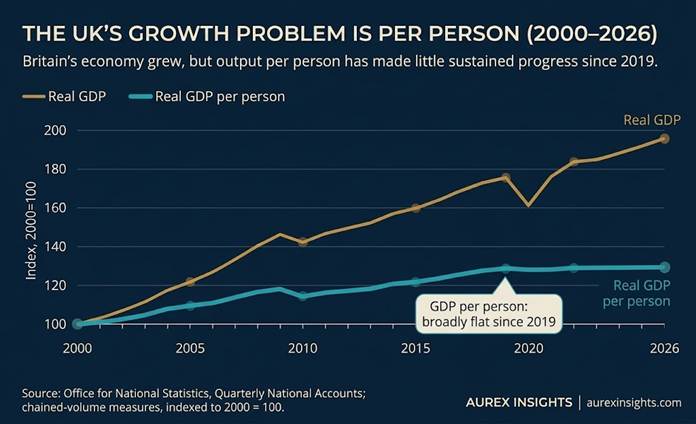
That is why official claims of economic growth can be met with a public response closer to disbelief than celebration. A country can become richer in aggregate while households feel little richer individually. If national output rises principally because the population is larger, rather than because workers and businesses are producing more value, the improvement in average living standards will necessarily be modest.
Productivity is the bridge between growth and prosperity. In plain English, it means producing more valuable output from the hours people work, the skills they possess, the technology they use and the infrastructure around them. It is not an instruction to work longer or harder. It is what enables an hour of work to support higher wages, stronger businesses and more reliable public revenues.
Without sustained productivity growth, the promises made by every modern government begin to compete with one another. Better healthcare, credible defence, decent pensions, lower taxes, stronger local services and rising living standards all draw upon an economy that is not expanding quickly enough to support them comfortably.
That is the arithmetic confronting John Healey on 28 October. Changing the occupant of Downing Street may alter the political mood. It does not, on its own, change the productive capacity of the country.
History offers two warnings
The first warning is against fatalism.
Britain emerged from the Second World War with public debt close to 250% of national income, according to the OBR’s historical series. The post-war state nevertheless expanded substantially, while the debt ratio subsequently declined over several decades. Those historical figures are not directly interchangeable with today’s headline net-debt measure, but they demonstrate why a debt ratio alone cannot determine a country’s future. https://obr.uk/docs/dlm_uploads/300-Years-of-public-finances-Accessible-PDF.pdf
The relevant question is not simply how much a government owes. It is how the debt evolves relative to the economy’s capacity to support it.
The second warning is against wishful thinking.
In September 2022, the sharp repricing following the Truss government’s mini-Budget interacted with leveraged pension-fund strategies, producing forced gilt sales and severe market dysfunction. The Bank of England intervened to prevent the disturbance from threatening financial stability.
That episode should not become an argument against every ambitious policy. It should remain an argument against confusing ambition with a credible plan.
Post-war history shows that a large debt burden need not condemn a country to decline. The 2022 crisis shows that declaring a growth strategy does not make its financing credible.
Healey must avoid both errors: the belief that Britain can only retrench, and the belief that borrowing becomes affordable because its purpose is described as transformative.
What the interest bill means
The fiscal debate becomes clearer once three different numbers are separated.
The deficit is the gap between government spending and income during a period. Debt is the accumulated stock of borrowing, after the relevant financial adjustments. Interest is the cost of servicing those obligations. The ONS publishes them separately because they answer different questions.
At the end of September, public-sector net debt was provisionally £3,005 billion, equivalent to 94% of annual economic output. That proportion was 0.7 percentage points lower than a year earlier, even though the cash amount had increased.
There is no contradiction. A debt can rise in pounds while falling relative to the income supporting it.
Interest presents a more immediate constraint. Central-government interest payable reached £60.8 billion in the first six months of this financial year, including £10.9 billion in September alone.
For an annual comparison, the Treasury’s published spending accounts put its wider public-sector interest category at £130.3 billion in 2025–26. That was slightly more than total education spending, approximately twice defence spending, and just over half health spending on the same functional spending framework. This broader interest measure includes Bank of England and public-sector pension-related components; it is not simply the coupon payments on government bonds.
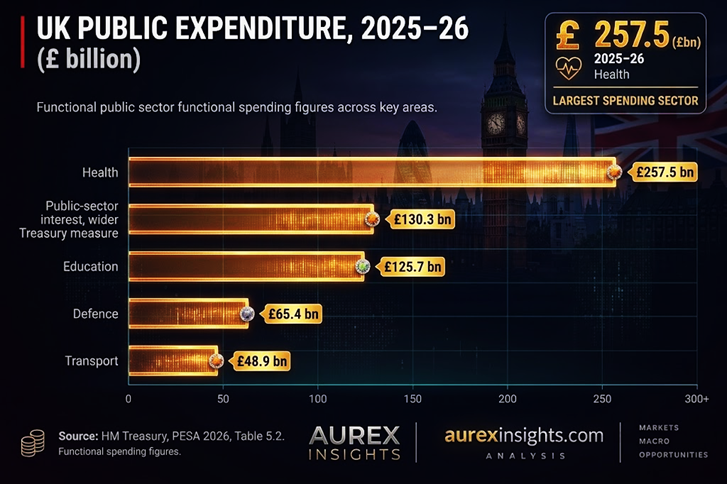
The comparison illustrates scale, not a pot of money that could simply be reassigned. Interest obligations cannot be cancelled to fund a hospital programme. Nor would eliminating a particular spending programme necessarily reduce interest costs by an equivalent amount.
The real cost is reduced freedom of action: more government resources committed before ministers decide what to build, improve or repair.
Why borrowing costs matter
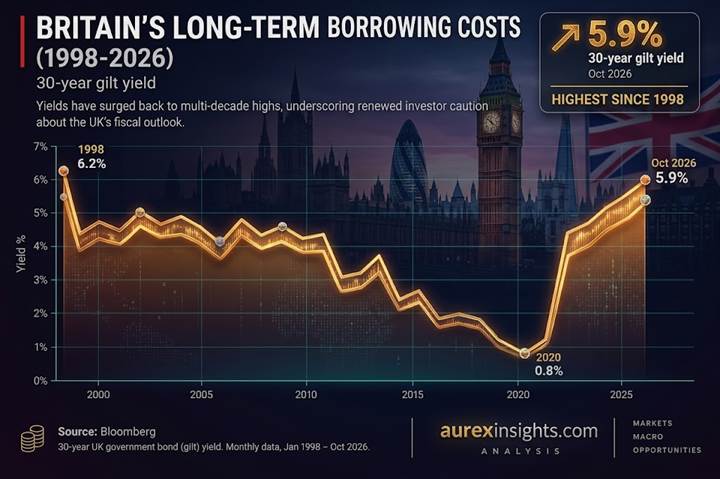
A gilt is a government bond: a promise to make specified payments to its holder. Its market yield measures the return investors require at the price they are willing to pay.
Higher yields make new borrowing more expensive. But they do not instantly reset the interest rate on every pound of existing debt. Much conventional debt carries fixed payments; higher market rates feed through as borrowing is added or refinanced.
The following chart shows why the bond market is now such an important constraint on the Chancellor’s room for manoeuvre.
Britain also has other exposures. Inflation increases the amount owed on index-linked gilts, while the Bank of England’s balance sheet creates sensitivity to its policy rate. In September, £4 billion of central-government interest payable reflected the inflation-related uplift on index-linked debt – n accrued liability, not all an immediate cash payment.
The distinction is technical; the consequence is not. Britain’s finances are sensitive to both interest rates and inflation.
The OBR estimated in March that a sustained one-percentage-point increase in Bank Rate and gilt yields would raise annual borrowing by approximately £15 billion in 2030–31. That is a sensitivity calculation, not a prediction, but it shows how changes in financing conditions can overwhelm relatively small Budget measures.
Investors do not respond only to British politics. Global interest rates, inflation expectations and the supply of government bonds also matter. The Chancellor cannot control those conditions.
He can influence whether Britain enters them with a convincing account of how its commitments will be financed.
Better growth, limited comfort
The latest IMF forecast offers some encouragement – but less than the government might wish.
The Fund now expects UK growth of 1.3% in 2026, followed by 1.2% in 2027. The upgrade applies to this year, not next year; higher energy costs and long-term interest rates weigh on the subsequent outlook.
The IMF has also recognised Britain’s deficit-reduction plans while warning against slippage as interest costs and demands for defence and energy support increase.
That combination captures Healey’s predicament. The economy is not standing still, but it is not growing fast enough to make the difficult choices disappear.
Nor is “fiscal headroom” an escape route.
Headroom is the forecast margin by which plans meet a fiscal target. It is not a reserve account containing money waiting to be spent. Its apparent precision can disguise uncertainty about growth, tax receipts, interest rates and the credibility of future spending restraint.
The IFS argues that spending pressures, rather than the headline margin against a fiscal rule, are the central Budget challenge. It also warns that existing public-service plans already depend on increasingly ambitious productivity assumptions.ifs+1
An efficiency saving is valuable when it means delivering the same service with fewer resources. It is an accounting convenience when the saving is announced first and the means of achieving it are left for somebody else to discover.
A credible Budget must distinguish the two.
The limits of another squeeze
There is no painless instrument waiting at the back of the Treasury cupboard.
Threshold freezes raise revenue without changing the published income-tax rates. But they still increase taxation as wages rise and more income crosses fixed thresholds. The March OBR forecast incorporated personal-tax threshold freezes until April 2031.
For a household receiving a pay rise that merely compensates for higher prices, the result can be a larger tax bill without a meaningful improvement in purchasing power.
Spending cuts also require distinctions.
The Treasury recorded approximately £332 billion of social-security benefits in 2025–26. That total includes pensions and other entitlements; it is not a single bill for unemployment or working-age disability. Treating it as such obscures the decisions that would actually be required to change it.
Health-related benefits deserve scrutiny, but reducing a payment and restoring someone’s capacity to work are different outcomes. The strongest reform would improve both the individual’s prospects and the public finances. A policy that merely moves costs between benefits, healthcare and local services may do neither.
The same discipline should govern household energy support. Temporary, targeted assistance can protect those most exposed without making an open-ended promise to insulate everyone from market prices. That is also the approach the IMF has advocated in the present debate.
Bank taxation offers another politically attractive option. It may contribute revenue, but no decision has yet been announced in the Budget itself; reports of an expected increase remain reports, not settled policy.
The test should be design, not symbolism: what is being taxed, how durable are the receipts, who ultimately bears the burden, and does the measure weaken competition or investment?
Britain does not have to choose between believing every industry warning and ignoring every behavioural response.
Growth needs a delivery system
The temptation is to treat growth as the answer that avoids specifying the choices.
It is better understood as the result of making them.
Healey’s September speech identified transport, energy, housing, investment and innovation as connected parts of the government’s strategy. He also promised a Budget roadmap for fiscal devolution, including greater business-rates retention and replacing some central grants with a share of local income tax for mayoral strategic authorities from 2028.
That could become a meaningful change in how Britain develops its regions. But transferring responsibility is not enough. Local leaders need predictable resources, delivery capability and accountability for results.
The wider growth programme needs the same practical focus.
A promising company requires more than an industrial-strategy designation. It needs premises, power, skilled people, customers and finance. A successful economic cluster requires housing and transport. Scientific excellence cannot indefinitely compensate for foundations that are expensive, congested or slow to provide.
Better data should support that effort. Government should be able to track emerging industries more precisely and distinguish innovative businesses from the broad categories in which they sit. But better classification must not be confused with discovering output that was wholly missing from GDP.
And Britain’s technology ambitions should not become an excuse to neglect the rest of the economy. The fiscal prize lies not only in producing exceptional firms, but in spreading better technologies and working practices through ordinary businesses and public services.
The OBR’s scenarios illustrate the stakes. It reported that persistently weaker productivity growth could leave borrowing £40 billion higher in 2030–31, while a stronger productivity scenario could leave it £50 billion lower. These are alternative paths, not guaranteed gains – and certainly not money available to spend next Wednesday.
A government cannot book the proceeds of a growth strategy before it has built the means of delivering it.
The European dimension
Brexit should neither explain every British weakness nor be excluded from the discussion of how to remedy them.
The productivity slowdown began before the referendum. That does not make additional barriers to trade, investment or business mobility irrelevant to the recovery.
For a government seeking stronger growth, the practical question is whether avoidable costs can be reduced – not whether every negotiation can be presented as a victory in an argument about sovereignty.
A closer European relationship is not a substitute for domestic reform. Easier trade will not, by itself, build homes, connect new electricity capacity or improve public-service productivity. Equally, domestic reform cannot make unnecessary external barriers economically beneficial.
For Ireland, the implications run through several channels: demand for exports, sterling movements, investment decisions, supply chains and the conditions facing businesses operating across these islands.
The distribution matters as much as the aggregate. A relocation that benefits one Irish business centre can coexist with weaker demand for firms selling into Britain.
Northern Ireland adds a further reason to favour predictable institutions and practical cooperation over recurring political confrontation.
The sensible Irish and European objective is not a permanently weakened competitor. It is a more prosperous, dependable neighbour whose recovery makes cross-border business easier rather than harder.
What 28 October must establish
A cautious Budget would not necessarily be a failed Budget.
With the spending review still ahead and financing conditions difficult, restraint may be sensible. What would be inadequate is caution without direction: another postponement of the choices that determine whether future Budgets are any easier.
Healey should therefore be judged on three things.
First, whether the financing is believable. Permanent promises need durable revenues or deliverable spending changes – not optimistic assumptions placed conveniently in the final year of a forecast.
Second, whether the government protects economic capacity. Investment needs rigorous selection and scrutiny, but it should not become the automatic casualty whenever day-to-day pressures increase.
Third, whether the growth programme has owners, timetables and measurable results. Devolution, planning reform, infrastructure, employment support and European cooperation must become a connected programme rather than a collection of announcements.
Burnham can change Britain’s direction. He cannot repeal the consequences of weak productivity or make yesterday’s borrowing costless.
The historical lesson is not that Britain must choose permanently between fiscal discipline and national renewal. It is that neither will endure without the other.
The Budget on 28 October will not repair Britain in an afternoon. It should show whether this government intends to spend the coming years repairing it – or merely financing its disappointments.
Dr Brian O’Donnell is Founder and Principal of Aurex Insights, an independent economic-policy and strategic-advisory practice working between Ireland and Canada. He advises businesses and organisations on Canada–Europe economic relations, market strategy and the policy developments shaping investment and commercial decisions.