The Budget 2027 test for Ireland’s export economy
Ireland has built one of Europe’s most successful export-led economies. The question is whether Budget 2027 will turn that success into deeper domestic capability, greater fiscal resilience and more Irish firms able to compete at global scale.
By Dr Brian O’Donnell | Aurex Insights

Every Budget creates a familiar political moment.
There are calls for tax reductions, higher welfare payments, more public-sector spending, new supports for business, more investment in housing, greater resources for health, education and infrastructure, and relief for households facing rising costs.
Most of these claims are understandable. Many are justified.
But Ireland approaches Budget 2027 with a larger strategic question than how to divide the proceeds of a good year.
The question is whether the State will use a period of exceptional export and fiscal strength to build the capabilities that allow Ireland to remain prosperous when global conditions become less favourable.
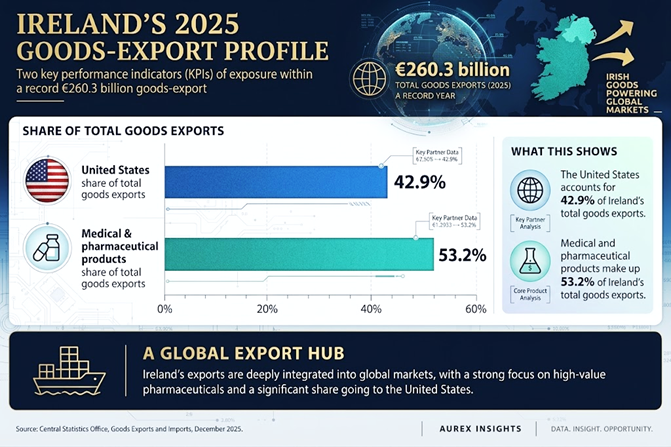
Ireland exported a record €260.3 billion of goods in 2025. That is an extraordinary figure for a country of just over five million people. It reflects decades of sound choices: membership of the European Union, investment in education, openness to trade, success in attracting foreign direct investment, the development of globally competitive clusters and the ambition of Irish firms operating in international markets.
But the composition of that success matters.
The United States accounted for €111.7 billion, or 42.9%, of Irish goods exports last year. Medical and pharmaceutical products accounted for €138.6 billion – 53.2% of the total. The figures were also affected by exceptional trade conditions, including tariff-related front-loading in parts of the pharmaceutical sector.
None of this is an argument against international trade, multinational investment or Ireland’s relationship with the United States.
Quite the opposite.
Ireland is wealthier because it is an open economy. It has succeeded because it has connected itself to markets far larger than its own, specialised in activities of global value and attracted world-class investment.
The issue is not openness.
The issue is whether Ireland is developing enough domestic capability, economic breadth and fiscal resilience around the openness that has made it prosperous.
Openness is not the same as resilience
Ireland should resist the false choice between celebrating globalisation and fearing it.
For a small country, turning inward would not create security. It would reduce opportunity. Ireland cannot sustain its living standards by trying to produce everything at home, insulating itself from international competition or treating foreign investment as a threat.
Small economies succeed by trading, specialising, importing ideas and technology, attracting capital and selling into larger markets.
But an economy can be highly open and still become vulnerable if too much of its prosperity depends on the same markets, the same sectors, the same ownership structures or the same policy assumptions.
That is Ireland’s central challenge.
The concern is not simply that the United States is Ireland’s largest export market, or that pharmaceuticals and medical products are its largest goods-export category. The deeper issue is that a number of risks can move together.
A change in US trade policy, corporate-tax arrangements, pharmaceutical demand, the location of intellectual property or the investment strategy of a small number of large firms can affect exports, measured GDP and Exchequer receipts simultaneously.
Economists describe this as a covariance problem.
In practical terms, it means that risks which appear separate may be driven by common forces. Technology and pharmaceuticals are different industries, but the diversification they provide is weaker if both depend heavily on internationally mobile activity, multinational investment and the policy choices of large economies.
Ireland’s economic model is successful.
But success must be managed.
The fiscal dividend is real – but it is concentrated
Corporation-tax receipts have strengthened Ireland’s public finances. They help fund public services, capital investment and national savings. They are a real dividend of Ireland’s ability to host profitable, globally competitive activity.
But they are also concentrated.
Revenue reports that corporation tax transferred to the Exchequer reached €34.7 billion in 2025. Excluding once-off receipts associated with the Court of Justice of the European Union ruling, net corporation-tax receipts were €32.9 billion. Foreign-owned multinational groups accounted for €28.8 billion of that amount – 87% of net receipts. Revenue’s analysis also shows that the ten largest corporate groups accounted for almost 60% of corporation-tax receipts in 2024.
This does not diminish the contribution of multinational firms. They provide employment, generate income taxes and PRSI, purchase services, support industrial clusters and bring skills, technologies and international commercial networks into Ireland.
But it should influence how the State treats unusually strong revenues.
A Government can use uncertain or volatile revenues in two very different ways.
It can use them to build long-lived assets, reduce debt, invest in productive infrastructure and create buffers for future shocks.
Or it can use them to finance permanent commitments that continue long after the revenue source has weakened.
The first approach strengthens resilience.
The second creates a mismatch between a volatile income stream and permanent obligations.
That is where short-term political gain can become long-term economic self-sabotage.
A tax measure, pay agreement or new spending commitment may be justified in isolation. But it becomes less responsible if it is designed mainly to deliver an immediate political return while relying on revenue whose permanence has not been established – or if it displaces the investment and reform needed to improve the country’s capacity over the next decade.
Ireland has already taken sensible steps to protect against this risk. The Future Ireland Fund and the Infrastructure, Climate and Nature Fund are intended to convert part of today’s fiscal strength into longer-term national resilience.
That is prudent.
But financial buffers alone are not enough. A fund can help the State absorb a future shock. It cannot itself deliver homes, connect power, improve water infrastructure, train workers, reduce regulatory friction or build the next generation of Irish-owned international firms.
National advantage is built at home
Michael Porter, the Harvard Business School economist and strategist best known for his work on national competitiveness, argued that countries do not sustain prosperity merely through favourable tax rates, location or access to markets. They do so by continually upgrading the domestic environment in which firms compete.
Porter identified four interrelated conditions: advanced skills and infrastructure; demanding customers; strong suppliers and related industries; and an environment in which firms are compelled to innovate, improve and scale.
Ireland has built many of these advantages.
It has an educated workforce, internationally connected universities, globally significant clusters in life sciences, technology and financial services, a strong record in attracting investment and access to the European Single Market.
But the domestic conditions that support competitiveness have not always kept pace with the international success of the economy.
Housing shortages restrict labour mobility and make it harder to recruit and retain talent. Electricity-grid constraints affect investment decisions. Delays in planning, water connections and infrastructure delivery increase costs. Complexity in tax, regulation and public administration absorbs management time that should be devoted to innovation, investment and growth.
These are not separate domestic-policy failures.
They are the conditions that determine whether Ireland can continue to compete internationally in high-value activity.
For a small economy, the European Single Market also acts as an extended home market. It gives Irish firms access to sophisticated customers, common rules, demanding competitors and the scale that domestic demand alone cannot provide.
The strategic objective should be to ensure that more Irish-owned firms can use that platform to grow internationally, while more multinational activity becomes embedded in Ireland through supplier relationships, skills, research, management capability and locally retained value.
Ireland needs a stronger second pillar
Ireland should not seek to replace foreign direct investment.
Its success in attracting global firms is one of the country’s greatest national assets. It must be protected, strengthened and adapted to a more competitive international environment.
But the next phase of economic policy should build a stronger second pillar alongside it: more Irish-headquartered firms capable of competing internationally at scale.
Ireland has become good at supporting entrepreneurship, early-stage businesses and first steps into exporting. The more difficult task is helping more companies make the transition from promising firms to substantial international enterprises.
That means companies able to export across multiple markets, retain intellectual property and strategic decision-making in Ireland, establish a serious presence overseas, acquire strategically, employ highly skilled people and generate durable tax revenues over decades.
This is not an argument for choosing Irish-owned firms over multinational investment.
It is an argument for building a more balanced economic base.
A larger cohort of Irish companies operating at international scale would diversify the tax base, create more local ownership of productive assets, strengthen regional employment, deepen domestic supply chains and reduce Ireland’s exposure to decisions made in a relatively small number of overseas corporate headquarters.
The aim should not simply be more exporters.
It should be more Irish firms with the capacity to remain, grow and compete globally from Ireland for the long term.
The Government’s Action Plan on Market Diversification, published in 2025, already provides a useful starting point. It contains more than 100 actions intended to strengthen Ireland’s economic resilience, reduce overdependence on individual markets and create opportunities in new markets.
Budget 2027 should test whether that strategy is being delivered at sufficient commercial scale.
- Can Irish firms access the market intelligence, export finance, risk insurance, regulatory advice, overseas networks and scale-up capital needed to compete for major international contracts?
- Can Enterprise Ireland and other agencies develop a deeper permanent footprint in priority markets?
- Can more Irish firms use the European Single Market not merely as an export destination, but as a platform for sustained international growth?
Those are practical competitiveness questions, not abstract policy ambitions.
The public-service test
A serious Budget 2027 must also ask what the State expects from the resources it already commits.
Since 2020, Ireland’s public-service pay bill has risen by €12 billion to an estimated €34 billion in 2026 – an increase of 55%. Public-service employment has exceeded 420,000, more than 70,000 above its 2020 level.
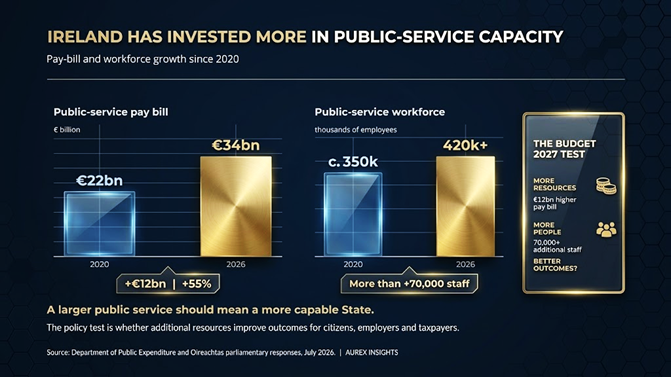
These figures should not be used as a crude argument against public servants or public services.
Ireland’s population has grown. Its population is ageing. Demand for health, education, social care, infrastructure delivery, regulation and public administration has increased. A capable State requires skilled people, fair pay and the ability to recruit and retain professionals in a competitive labour market.
Nor does international comparison support a simplistic claim that Ireland has an unusually large public sector workforce. On the OECD’s comparable measure, public employment accounted for 20.5% of total employment in Ireland in 2023, above the OECD average of 18.6%, but materially below Nordic countries such as Norway, Sweden and Denmark, where general-government employment represents roughly 27% to 30% of total employment. Different national models of delivering health, education and social services make population-based comparisons especially unreliable.
But the scale of recent Irish expansion does create a legitimate policy obligation.
A €34 billion annual pay bill is not simply an input into public services. It is a claim on future taxpayers and on the fiscal capacity required to fund housing, infrastructure, climate investment, enterprise supports and national resilience.
The relevant question is therefore not whether the public service should be larger or smaller in the abstract.
- It is whether additional staffing and expenditure are producing measurably better outcomes: shorter waiting times, faster planning and regulatory decisions, stronger project management, improved digital services, better workforce deployment and more reliable delivery for citizens and businesses.
This is particularly important as Government seeks a new public-service pay agreement, with Budget 2027 expected to make provision for any eventual deal. Pay certainty, fair treatment and collective bargaining matter. But a sustainable agreement should sit within a wider public-service compact: competitive remuneration, serious workforce planning, investment in digital tools and reform, and a clear commitment that higher expenditure will translate into better capacity and outcomes.
A stronger public service is not measured only by the number of people it employs or the money it spends, but by its ability to convert those resources into faster decisions, better services and greater national capacity.
That is not an austerity argument.
It is an argument for a better-resourced, more productive State – one that can reward public servants fairly while ensuring that the resources devoted to public services deliver the greatest possible value for citizens, employers and taxpayers.
What Budget 2027 should do
The Government has outlined an €8.5 billion package for Budget 2027, including €1.5 billion in tax measures and €7 billion in additional public spending. The pressure to use that package widely will be substantial.
But Budget 2027 should not be judged by whether it offers a small measure for every group.
It should be judged by whether it makes Ireland more capable of succeeding in a harder world.
That requires five commitments.
- Protect fiscal resilience. Treat exceptional and concentrated revenues cautiously. Build buffers, reduce avoidable exposure and direct windfalls towards assets that strengthen Ireland’s long-term productive capacity.
- Turn capital plans into delivery. Housing, power, water, transport and planning are not separate silos. They form the operating environment in which firms decide whether to invest, employ and scale from Ireland.
- Build a stronger indigenous enterprise base. Support firms with the potential to grow internationally through scale-up capital, export finance, commercial networks, management capability and access to sophisticated overseas markets.
- Deepen market diversification. The United States, the EU and the UK will remain central to Irish prosperity. Diversification does not mean withdrawing from them. It means building commercially meaningful opportunities in additional European and high-growth global markets.
- Demand outcomes from public expenditure. Protect public-service quality and fair pay but link higher spending and employment to measurable improvements in delivery, productivity, digital capacity and public value.
Ireland is not short of strengths.
It has access to the world’s largest integrated market. It has an educated workforce, strong public finances, internationally competitive industries, a successful FDI model and a record of adapting to economic change.
But the next phase of success requires more than distributing the proceeds of a strong year.
It requires investment in the things that make prosperity more durable: homes, energy, infrastructure, skills, innovation, competitive firms, capable public institutions and a broader base of domestic ownership and tax revenue.
Budget 2027 cannot shield Ireland from the world.
Nor should it try.
Its purpose should be to ensure that Ireland is better prepared to prosper in it.
Ireland does not need less globalisation. It needs the domestic capability to capture more of globalisation’s benefits – and retain them for longer.
Dr Brian O’Donnell is Founder and Principal of Aurex Insights, an independent economic-policy and strategic-advisory practice working between Ireland and Canada. He advises organisations on enterprise policy, industrial strategy, fiscal analysis, legislative engagement and Canada–Europe economic relations.