Too Important to Ignore, Too Unreliable to Depend On
Germany is rearming, borrowing and rebuilding. Yet it is also resisting a larger common European budget and rejecting new joint debt. Europe’s strategic challenge is no longer simply to persuade Berlin to lead, but to ensure that German power strengthens Europe rather than merely Germany.
By Dr Brian O’Donnell | Aurex Insights
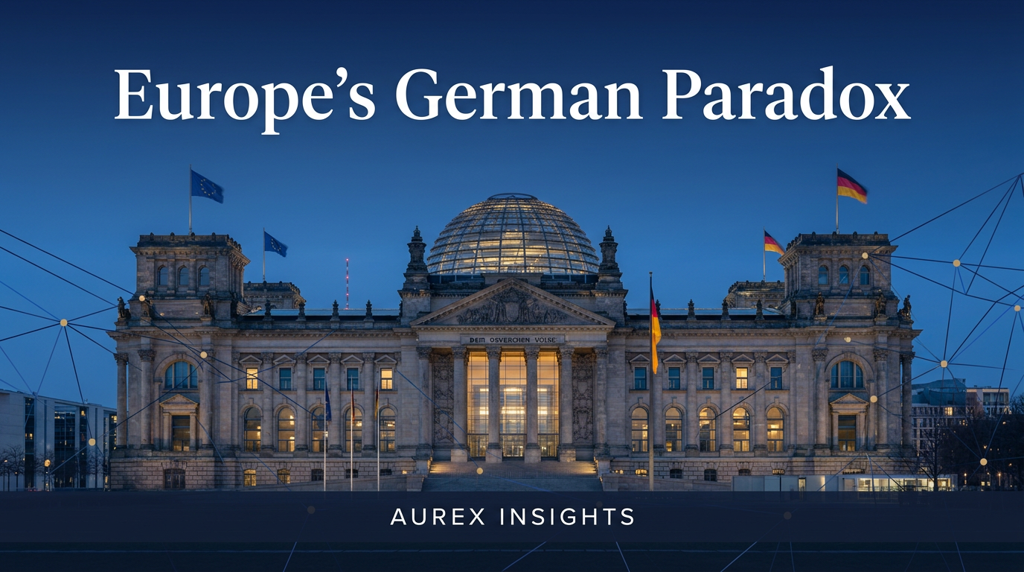
A delayed German train is no longer merely a national irritation. It is a metaphor.
For decades, Germany’s reputation rested on a particular promise: that competence, industrial depth and fiscal discipline would translate reliably into delivery. Europe could disagree with Berlin, resent its caution or complain about its surpluses. But it could generally assume that German capacity, once mobilised, would be serious, stable and consequential.
That assumption is now under strain.
Germany faces a historic set of demands. It must rebuild ageing infrastructure, restore military capacity, manage a more expensive energy system, preserve industrial competitiveness against China, adapt to demographic decline and reduce its strategic dependence on an increasingly transactional United States. At the same time, Europe expects Berlin to help finance, organise and politically sustain a more geopolitical European Union.
Germany has recognised much of the challenge. Its fiscal and defence turn is real. Yet recognition is not the same as execution, and national mobilisation is not the same as European leadership.
This is Europe’s new German paradox. A Germany that does too little leaves the European Union strategically exposed. A Germany that acts principally alone risks making the Union more unequal, more divided and more wary of German power.
The problem is not simply whether Chancellor Friedrich Merz survives the latest political pressures. Nor is it whether the Alternative für Deutschland’s (AfD) rise will soon translate into national government. The deeper issue is structural: Europe is asking Germany to become more capable at precisely the moment when German politics is becoming less able to sustain difficult choices – and when Berlin appears increasingly inclined to solve European problems through national rather than common instruments.
The European question is therefore not whether Germany should lead. It must. The question is whether it can lead in a way that makes Europe stronger as a system, rather than merely Germany stronger within it.
The End of the Old Model
Germany’s economic model was built on an unusually favourable geopolitical settlement.
It combined relatively cheap Russian pipeline gas, extensive access to Chinese demand, advanced manufacturing exports, an export-oriented euro area and the security umbrella of the United States. Fiscal restraint seemed prudent because the wider environment appeared stable. Industrial strength seemed durable because globalisation rewarded German engineering, capital goods and automotive production. Defence underinvestment appeared manageable because American power remained the ultimate guarantee.
That settlement has ended.
Russia’s invasion of Ukraine exposed the strategic vulnerability embedded in dependence on Russian energy. China is no longer merely a customer for German machinery, vehicles and chemicals; it is an increasingly formidable competitor in electric vehicles, batteries, renewable technologies and advanced manufacturing. The United States is now more openly willing to use tariffs, subsidies, export controls and security commitments in pursuit of national advantage.
Germany’s domestic constraints have sharpened at the same time. Its population is ageing. Skilled-labour shortages are intensifying. Infrastructure has deteriorated after years of underinvestment. Digitalisation has lagged. Planning, permitting and procurement processes remain too slow for an economy that now needs to build energy networks, housing, transport systems, data infrastructure and defence capacity at speed.
None of this means Germany is poor, weak or incapable. It remains Europe’s largest economy, retains formidable industrial capabilities and enjoys borrowing conditions that most European governments would envy.
The problem is more subtle: Germany has the means to adapt, but it has not yet demonstrated a political economy capable of converting those means into sustained, visible and Europeanised delivery.
Germany has found fiscal room. Its more difficult task is to convert fiscal capacity into state capacity.
National Strength, European Weakness
The Merz government’s position on the next EU budget captures the central contradiction of Europe’s present moment.
Germany is right about the diagnosis. The European Union cannot meet a harsher geopolitical environment with a budget designed for a more benign era. Its traditional architecture was not built to finance the demands now confronting the continent: defence readiness, industrial resilience, energy security, advanced technologies, critical supply chains and strategic competition with both the United States and China.
The status quo is not sufficient.
Yet Germany, joined by Denmark, the Netherlands, Austria, Finland and Sweden, has called for the European Commission’s proposed €2 trillion Multiannual Financial Framework for 2028–34 to be reduced by “several hundred billion euros.” The group argues that spending must be restrained across the board, priorities reshaped and further common borrowing avoided.
Their intervention has given the budget debate a more immediate political edge. The six governments have written to the Irish Presidency as Dublin prepares an updated “negotiating box” – the document intended to identify the core political trade-offs and narrow the range of acceptable outcomes before October’s European Council discussions.
The immediate question is therefore not whether the EU budget should be reformed. It should. The real question is whether Europe can credibly finance defence, competitiveness and resilience while reducing the instruments through which common European capacity is built.
Merz has framed the German position in language that is politically coherent at home. Europe, he argues, requires realism and reform; national governments themselves face pressure to control expenditure; and a budget roughly 60% larger than the previous seven-year framework is unaffordable. A “20th-century budget,” in this view, cannot meet 21st-century demands. Resources must move towards competitiveness and defence.
There is force in that argument. The Union cannot simply layer new priorities on top of old commitments and call the result strategy. It needs faster planning and permitting, deeper capital markets, stronger industrial capacity, more integrated energy infrastructure and a more credible defence base. Nor should Europe confuse the size of a budget with the quality of its outcomes.
But Berlin’s position contains a deeper contradiction.
Germany accepts that Europe faces a once-in-a-generation investment, security and competitiveness challenge. It is less willing to accept that meeting it requires a once-in-a-generation European capacity to finance and deliver common goods.
That distinction matters because many of Europe’s most urgent needs cannot be efficiently addressed through 27 separate national responses.
Defence procurement is more effective when it creates interoperable equipment, predictable cross-border demand and genuinely European supply chains. Energy security improves when member states invest in interconnectors, grids, storage and diversified sources of supply across borders rather than merely subsidising national resilience. Technological competitiveness depends on continental markets, deep pools of patient capital, shared research infrastructures and firms able to scale across the Union. Economic resilience requires supply chains that connect member states instead of reproducing national bottlenecks.
The choice is not between a larger EU budget and a better EU budget. Europe requires both a more strategic allocation of resources and the capacity to finance common goods that national budgets will otherwise underprovide.
The coming dispute over the 2028–34 MFF will determine whether Germany’s national strategic turn can be matched by European capacity. The question is not whether traditional programmes should be immune from reform. The Common Agricultural Policy and cohesion policy were designed for a different economic and political era, and both require serious scrutiny.
But Europe cannot fund a geopolitical turn by treating farmers, regions and cohesion as the residual claimants on a strategic agenda whose benefits may be concentrated in wealthier states, larger industrial economies and already well-capitalised firms.
The answer will be tested in the MFF negotiations now being led by Ireland. A German-led group of net contributors wants substantial reductions to the Commission’s proposed framework. The European Parliament and a broad group of member states insist that agricultural and cohesion funding cannot simply be sacrificed to a new agenda of defence and competitiveness.
This is not an argument for preserving every legacy expenditure. It is an argument about political economy.
Europe will not build a stronger common capacity if the costs of geopolitical adjustment are borne by rural communities, poorer regions and fiscally constrained member states, while the industrial and security gains accrue disproportionately elsewhere. A Union that becomes more strategically ambitious but less economically cohesive will not become more resilient. It will become harder to govern.
The Defence Test
Defence makes the issue impossible to avoid.
Germany’s decision to rearm is necessary. Europe cannot credibly take greater responsibility for its own security while its largest economy remains militarily underpowered. German investment in armed forces, equipment, infrastructure and defence production is therefore welcome – not only for Germany, but for Ukraine, NATO and the wider European security order.
But the value of German rearmament depends on how it is organised.
If Germany expands defence spending predominantly through national procurement, protects domestic industrial interests, resists shared financing and remains cautious about a genuine European defence market, the result could be a stronger Germany but a more asymmetric Europe.
Countries with less fiscal flexibility will struggle to match German investment. Their industries may be excluded from the most valuable supply chains. Europe’s aggregate defence capability may rise, but its internal cohesion may weaken. The result would be an uncomfortable return of an old problem in a modern form: not fear of German territorial ambition, but anxiety about unequal economic and military power inside the Union.
Germany’s defence expansion will strengthen Europe only if it is Europeanised.
That means procurement designed around interoperability rather than national preference; cross-border supply chains rather than narrow industrial protection; shared capability targets rather than fragmented duplication; and financing arrangements that do not convert national fiscal strength into permanent strategic hierarchy.
The same logic applies to energy, artificial intelligence, critical minerals and advanced manufacturing. In each field, Germany can create scale. But scale becomes European strength only when it is embedded in common institutions, markets and investment frameworks.
Political Fragmentation and Strategic Drift
Germany’s domestic political volatility raises the stakes.
Merz’s position is weaker than the normal turbulence of coalition politics would suggest. In Mecklenburg-Western Pomerania, the CDU secured only 4.9% of the vote in September, failing to clear the threshold for representation in a state parliament for the first time. The AfD won 38.2%. Earlier in the month, the AfD also came first in Saxony-Anhalt with 43.8%, while the CDU suffered a historic reversal.
Yet this does not necessarily make Merz’s departure imminent. The alternatives are unattractive. A fresh federal election would take place in a much more fragmented landscape and could strengthen the AfD. A CDU/CSU minority government would be structurally dependent on parliamentary support it has ruled out seeking from the AfD. And replacing a chancellor does not resolve the more fundamental problem: the governing coalition must still carry difficult reforms through a narrow parliamentary majority.
The consequence is a familiar but consequential form of political stasis. A weakened government may remain in office not because it has regained authority, but because no viable successor arrangement commands greater confidence. Its task is then to survive long enough to deliver: on pensions, long-term care, the 2027 budget, investment, industrial adjustment and defence. Every contentious vote becomes both a policy decision and a test of coalition endurance.
Merz still has time and opportunities to change the political narrative. The coalition has recently agreed the outline of long-term care reforms – a politically difficult response to mounting demographic and fiscal pressures – and the economy has shown tentative signs of stabilisation. Internationally, Germany’s role in Ukraine, European defence, the EU budget and economic relations with China gives the Chancellor repeated opportunities to demonstrate relevance. But external visibility is not a substitute for domestic delivery. A government that cannot translate strategy into credible improvements in incomes, services, infrastructure and economic security will not regain public trust simply by appearing more active abroad.
It would be an error to assume that far-right poll strength automatically translates into national power. Germany’s proportional electoral system, coalition arithmetic, constitutional safeguards and the continued refusal of mainstream parties to govern with the AfD remain meaningful constraints. Across Europe, electoral breakthroughs by radical parties have often been moderated by the realities of coalition-building, EU law, fiscal markets and governing responsibility.
The more immediate risk is not rupture. It is drift.
Political fragmentation can make decisions slower, more conditional and more nationally defensive long before it produces a formal change of government. It can weaken the appetite for sustained support for Ukraine. It can increase resistance to EU-level investment and common borrowing. It can make China policy more hesitant, particularly where industrial adjustment brings concentrated costs. It can encourage politicians to protect visible national interests while postponing European solutions whose benefits are diffuse and long-term.
Europe should worry less about a sudden German rupture than a prolonged German drift: a country too central to ignore, too politically divided to lead consistently, and too exposed to domestic pressure to pool the sovereignty that Europe increasingly requires.
That is why the debate must move beyond personalities. Whether Merz succeeds or fails, Germany’s central political-economy challenge will remain how to convince voters that strategic adaptation can produce security, prosperity and agency rather than only disruption, cost and loss of control.
A European strategy that cannot improve the lived economy will ultimately lose the political legitimacy required to sustain it.
Europe Needs Co-Leadership
The answer is not to replace Germany. No other European country can replicate its industrial weight, fiscal capacity or centrality to the continent’s security architecture.
Nor should Europe seek a return to a model in which Berlin carries the system alone. That would be politically unsustainable for Germany and strategically fragile for everyone else.
Europe needs co-leadership and institutional redundancy.
Germany should act in concert with France, Poland, Italy, Spain, the Nordic countries and other capable member states. The point is not to dilute German responsibility. It is to build a European system capable of acting even when one major capital is constrained by electoral uncertainty, fiscal politics or domestic priorities.
Three areas matter most.
First, defence and security. Europe needs joint procurement, common standards, cross-border industrial supply chains and a credible roadmap for assuming greater responsibility from the United States. Defence cannot become merely a competition among national subsidy schemes.
Second, competitiveness and technology. Europe requires integrated energy systems, serious AI and digital infrastructure, capital-markets union, greater scale-up finance and a collective response to unfair or heavily subsidised competition. The objective should not be autarky. It should be the capacity to innovate, produce and trade from a position of resilience.
Third, EU finances and governance. The next Multiannual Financial Framework should modernise spending and simplify delivery. But it must also maintain the cohesion and regional-development compact that makes European integration politically durable. A Union that funds defence and competitiveness by hollowing out the social and regional basis of support for common action would weaken itself in the name of strategy.
Europe needs fiscal discipline. It also needs a fiscal architecture equal to its strategic ambitions.
Ireland’s Broker Role
Ireland’s role in the budget negotiations is more important than it may first appear.
As holder of the rotating Council presidency, Dublin will be expected to help bridge the divide between net contributors demanding significant reductions and member states seeking stronger support for cohesion, agriculture, defence and industrial investment. The MFF requires unanimity among all 27 governments; a durable agreement cannot be imposed by either a northern “frugal” bloc or a southern and eastern coalition focused on traditional spending and common financing.
Ireland is well placed to make a constructive case.
As a small, open and highly globalised economy, it understands why competitiveness, trade, research, innovation and security matter. As a beneficiary of the European project, it also understands that cohesion is not charity. It is part of the political and economic foundation on which the single market – and therefore Europe’s collective strength – rests.
The essential Irish argument should be that Europe must not fund its geopolitical transition by eroding the social and regional compact that makes that transition politically sustainable.
A Wider Strategic Ecosystem
Canada’s evolving relationship with the European Union reinforces the same point.
The Canada–EU Strategic Partnership of the Future and the Security and Defence Partnership point toward deeper cooperation in trade, technology, energy, critical minerals, artificial intelligence and security. Canada joined the EU’s SAFE defence initiative in February 2026, becoming the first non-European participant and opening new avenues for industrial and procurement cooperation.
The significance is not that Canada can compensate for Germany, nor that outside partners can relieve Europe of the responsibility to organise itself. They cannot.
The value lies in strategic depth. Europe needs a wider network of trusted democratic partners with complementary strengths – particularly in defence, energy, critical minerals, technology and secure supply chains. Canada’s trade with the EU totalled about $178 billion in goods and services in 2025, while direct investment stocks run into the hundreds of billions on both sides of the Atlantic.
A more resilient Europe will not be built by replacing dependence on Washington with dependence on Berlin. It will be built by creating networks of capability – among member states and with reliable partners – that make the Union less vulnerable to the domestic constraints of any single capital.
Germany Must Become More European
Europe’s German question has changed.
The old fear was that Germany might become too powerful for the continent. The new danger is more paradoxical: Germany may be too important for Europe to ignore, but too politically constrained for Europe to depend upon unquestioningly.
Germany must become more European in the way it spends, rearms, invests and competes. Its national renewal should be designed to deepen common European capacity, not merely to reinforce German advantage.
But Brussels must also become less dependent on Berlin. A strategically mature European Union cannot allow the domestic instability, electoral pressures or fiscal preferences of any one member state to become a veto on collective capability.
That is not a rejection of German leadership. It is the only durable way to make German leadership work. “Europe should worry less about a sudden German rupture than a prolonged German drift…”
Dr Brian O’Donnell is Founder and Principal of Aurex Insights, an independent economic-policy and strategic-advisory practice working between Ireland and Canada. He advises organisations on enterprise policy, industrial strategy, fiscal analysis, legislative engagement and Canada–Europe economic relations.