
Budget 2027 and the landmines beneath the surplus
By Dr Brian O’Donnell | Aurex Insights | Economic Commentary | 6 October 2026
Ireland has delivered a Budget that many European finance ministers could only envy: tax cuts, higher welfare payments, record capital spending, another large surplus and a further contribution to a sovereign wealth fund. The economy is expected to add 53,000 jobs in 2027, Modified Domestic Demand is forecast to expand by 3 per cent, and the Government projects a general government surplus of €9.5 billion.
Yet this is not primarily a story about abundance. It is a story about whether Ireland can convert a temporary fiscal advantage into permanent productive capacity before its revenue model becomes less forgiving.
That distinction matters because Budget 2027 looks conservative when viewed through the headline surplus – and expansionary when viewed through the domestic economy, the underlying fiscal balance and the State’s delivery capacity. The central paradox is stark: Ireland is saving billions for the future while allowing recurring expenditure to grow faster than the durable tax base that must ultimately sustain it.
The Budget contains intelligent measures. It adjusts income-tax thresholds, supports childcare, invests in housing and infrastructure, strengthens incentives for entrepreneurship, improves the R&D regime and adds €1 billion to the Future Ireland Fund on top of a planned transfer of about €4.8 billion. But its fiscal architecture still rests on an uncomfortable proposition: that a highly concentrated stream of multinational corporation tax can finance both a rapidly expanding State and the funds intended to insure that State against the loss of those receipts.
A rich State can still have a fragile operating model. Budget 2027 does not create that fragility, but it does not yet resolve it.
A formidable headline
The Government’s narrative is easy to understand. Budget 2027 combines a €1.3 billion personal income-tax package with expanded public services, €20.3 billion of capital expenditure and total voted expenditure of €125.6 billion. The standard-rate income-tax cut-off rises by €2,500 to €46,500, the main tax credits rise by €125 and the USC threshold is adjusted to protect gains from the minimum-wage increase.
The household measures are tangible. Weekly welfare rates increase by €10; Fuel Allowance rises by €5; the Rent Tax Credit increases to €1,150 for a single claimant and €2,300 for a couple; and maximum childcare fees fall from €735 to €550 per month, an advertised saving of up to €2,220 a year. These are not merely political giveaways: they address genuine pressure from rents, energy and the cost of accessing essential services.
The enterprise agenda is also more serious than the usual collection of narrow reliefs. The standard Capital Gains Tax rate falls from 33 to 31 per cent; the R&D tax credit is expanded and simplified; the Knowledge Development Box is extended; start-up reliefs continue; and ISIF launches a €1 billion, three-year scaling programme for Irish companies. A new Irish Investment Account – with a €50,000 tax-free threshold, annual contributions capped at €12,000 and a 1 per cent tax on value above the threshold – could also begin to redirect household savings towards productive assets, although its design deserves close scrutiny before its planned July 2027 launch.
On its face, this is a balanced package: relief now, investment later, savings for the long term. The problem appears when the numbers are stripped of the exceptional tax revenues that make all three possible at once.
The surplus illusion
Ireland expects corporation-tax receipts to rise from €34.1 billion in 2026 to just over €39.0 billion in 2027 – an increase of almost €5 billion in a single year. Income tax remains the largest individual revenue source, rising from €39.3 billion to €41.4 billion, but corporation tax is forecast to close most of that gap.
That strength is real, but so is the concentration beneath it. In its June assessment, the Irish Fiscal Advisory Council estimated that €21.3 billion of the 2027 corporation-tax take could be “excess” – receipts above a counterfactual path linked more closely to domestic economic growth – and projected an underlying deficit of €12.8 billion after excluding those receipts.
The final Budget forecasts are not directly comparable with that earlier assessment, so the €21.3 billion should not simply be deducted from the Government’s newly projected €9.5 billion surplus. But the warning remains: Ireland’s strong headline balance depends heavily on a large, concentrated and potentially volatile stream of multinational corporation tax.
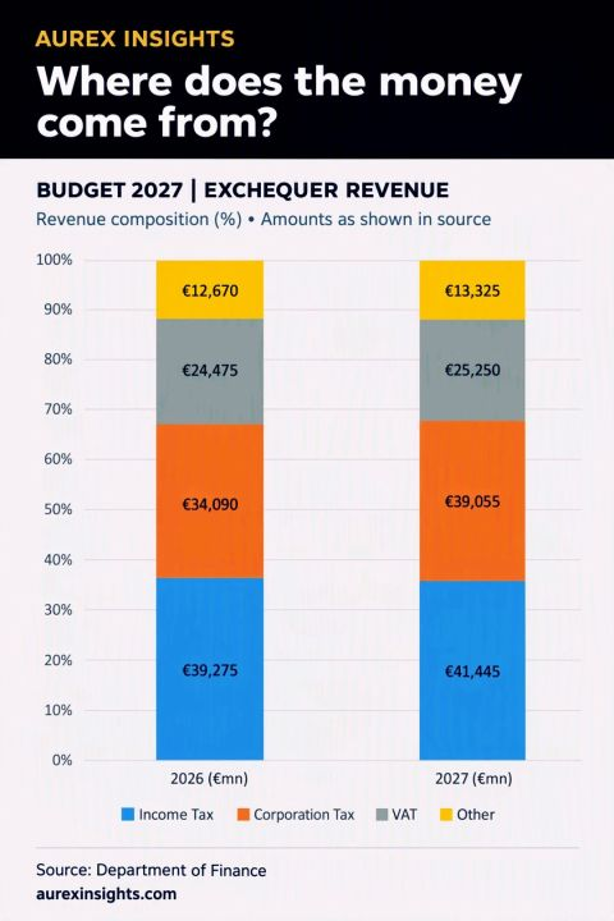
- Ireland’s revenue strength – and its concentration. Corporation tax is forecast to contribute just over €39 billion in 2027, almost one-third of projected Exchequer tax revenue. The issue is not whether these receipts are real, but how much can safely finance permanent commitments. Source: Department of Finance, Budget 2027.
That is the first landmine: the Budget surplus is being produced by a revenue stream that the Government itself does not regard as fully permanent.
The concentration risk is more severe than the aggregate figure suggests. Ten companies accounted for 56 per cent of net corporation-tax receipts in 2025, and the Fiscal Council’s analysis indicates that three companies may have accounted for nearly half. This is not a diversified tax base. It is closer to a sovereign exposure to a small portfolio of global firms, intellectual-property structures and product cycles over which Irish fiscal policy has limited control.
The issue is not that corporation-tax receipts are about to collapse. No serious analysis can predict that. The issue is asymmetry: if receipts remain elevated, Government can spend, invest and save; if they fall sharply, the recurring commitments remain but the revenue does not. Fiscal sustainability is not determined by the most likely year. It is determined by the State’s capacity to absorb the difficult one.
The trajectory is moving in the wrong direction. The Fiscal Council estimated that the share of corporation-tax receipts saved could fall from 34 per cent in 2025 to 13 per cent by 2030. Meanwhile, the Central Bank has warned that underlying expenditure growth is outpacing underlying revenue growth and that the deficit excluding excess corporation tax could reach €20 billion by 2030. Ireland is therefore becoming more dependent on the windfall even while formally building funds to protect itself from that dependence.
This is the Budget’s deepest contradiction: the State is saving the windfall with one hand and embedding it into permanent expenditure with the other.
The spending ratchet
Budget 2027 raises voted expenditure to €125.6 billion, approximately €58.3 billion above the 2019 level. The 2027 increase is 6 per cent, following years in which expenditure expanded much faster: the Government’s own framework records average growth of 9.4 per cent from 2019 to 2024 and targets about 6 per cent through 2030.assets.
A larger State is not inherently a problem. Ireland has a larger population, serious infrastructure deficits, an ageing society and legitimate unmet needs in health, disability, housing and education. The economic question is whether the growth in spending purchases additional capacity and measurable outcomes – or simply raises the price of maintaining the existing system.
The composition of the €7.1 billion spending increase is revealing. About €0.8 billion funds the 2027 cost of decisions already taken; €1.2 billion is reserved for the expired public-service pay agreement and any successor; €1.6 billion supports Ukraine and international-protection accommodation; €0.3 billion covers other temporary spending; and €4.8 billion covers both existing policies and new or expanded services. These are defensible requirements, but they show how little of the apparent package represents unconstrained money for genuinely new priorities.
Before Budget Day, the Parliamentary Budget Office estimated that maintaining existing service levels could absorb €2.66 billion – or 45 per cent – of the planned current-spending increase. A pay agreement could lift the share to 63 per cent, and welfare indexation could raise it to between 75 and 83 per cent, leaving perhaps €1.0 billion to €1.5 billion for new measures. Budget 2027 provides €1.2 billion for pay and recruits roughly 7,000 additional public servants, confirming the basic direction of that warning.assets.
This is the second landmine: the headline package exaggerates the amount of real policy choice. Much of the increase is required merely to carry forward previous decisions, meet rising prices, accommodate demographics and maintain an enlarged payroll.
That would be manageable if ceilings were consistently credible. They are not. The Government had already revised 2026 spending upward by €700 million before Budget Day, mainly because of Health, while the Fiscal Council warned that the overrun could reach €1 billion. Over the past decade, overruns have averaged more than €2 billion a year in today’s prices, and the last year in which spending finished at or below the original plan was 2013.
The Budget introduces a €446 million departmental efficiency levy, which is sensible in principle. But an efficiency target is not the same as a delivered saving. Without named reforms, baselines, implementation dates and measurable outputs, it risks becoming an accounting assumption that later reappears as a supplementary estimate.
Inflation by another route
Ireland enters 2027 with an economy close to full capacity. Employment exceeds 2.8 million; unemployment is expected to remain around 4.9 per cent; and the Government forecasts another 53,000 jobs next year. At the same time, Irish inflation has exceeded the euro-area average since September 2025, with rent, electricity and fuel prices doing much of the damage.
Fiscal policy matters more under these conditions because the ECB sets interest rates for the euro area, not for Ireland. When Irish inflation exceeds the euro-area rate, the inflation-adjusted interest rate faced by Irish borrowers is effectively lower, potentially reinforcing demand precisely when domestic capacity is tight. A Government that cannot tighten monetary policy for Ireland must exercise greater discipline over domestic demand.
Instead, Ireland is projected to record the second-fastest growth in general government spending in the EU in 2027 despite having lower unemployment than the euro-area average. The Fiscal Council judges 6 per cent net spending growth to be above the economy’s sustainable rate of roughly 5 per cent and warns that the economy does not need broad budgetary stimulus.
The third landmine is therefore macroeconomic rather than merely fiscal: in a capacity-constrained economy, more nominal spending does not guarantee more real public services. It may instead bid up construction prices, wages, rents and the cost of scarce professional labour.
This is particularly relevant to capital spending. Ireland needs water, energy, transport and housing infrastructure, and cutting investment would be a profound error. But capital allocations only expand productive capacity after projects are planned, consented, staffed, procured and built. The Central Bank noted before the Budget that capital investment was running 9 per cent behind target while current spending was moving faster. That creates a dangerous mix: recurring demand is injected immediately, while the supply response arrives late – or not at all.
The correct distinction is not austerity versus investment. It is consumption versus capacity. Expenditure that unlocks grid connections, water treatment, housing sites and transport bottlenecks can reduce inflationary pressure over time. Expenditure that expands demand without expanding supply can intensify it.
Infrastructure or allocation?
The Government’s €275.4 billion ten-year infrastructure plan is the right scale of ambition. Budget 2027 allocates €20.3 billion in capital expenditure, including major resources for housing, water and transport. Uisce Éireann receives €2.3 billion, while more than €1 billion is directed to the Starter Homes programme and €3 billion supports social-housing delivery.
Yet the institutional constraint is now more binding than the financial one. Planning delays, regulatory sequencing, judicial review, shortages of skilled labour, contractor capacity and weak project preparation can turn a larger allocation into higher unit costs rather than additional output. The State’s own Mid-Year Expenditure Report acknowledges that increased health spending and staffing have not always generated equivalent activity, and that capital delivery faces material bottlenecks.
Budget 2027 contains a €1.6 billion unallocated contingency reserve, which can be used for unexpected events, Ukraine and international protection, the Mother and Baby Institutions Payment Scheme, infrastructure acceleration and other in-year developments. A reserve is prudent, but this one is broad enough to conceal future policy choices and overruns inside the ceiling. It reduces the risk of a visible breach while increasing the need for rigorous disclosure when allocations are made.
The fourth landmine is thus delivery opacity. Announcing inputs is easier than measuring outputs. A world-class capital programme would publish, for each major project, the expected capacity created, stage-gate timetable, risk allocation, unit-cost benchmark and consequences for delay. Ireland’s fiscal problem is no longer simply “finding the money.” It is governing a capital programme at a scale the delivery system has not yet demonstrated it can absorb.
Housing measures collide
Housing exposes the Budget’s tendency to support both sides of an overheated market. The €3 billion social-housing programme, water investment, local-authority borrowing capacity and measures to address dereliction can expand supply. These are the right channels when they produce serviced land and completed homes.
By contrast, raising Help to Buy from €30,000 to €35,000 increases purchasing power in a market where supply remains constrained. The higher Rent Tax Credit provides welcome relief to tenants, but without sufficient rental supply, part of that relief can be captured through higher rents over time. The extension of Rent-a-Room relief and its higher €16,000 threshold may release some capacity, but it is not a substitute for building at scale.
This is the fifth landmine: demand subsidies can be politically immediate but economically self-defeating when supply is inelastic. The Budget’s housing package will be judged not by the number of supports claimed, but by the number of additional serviced, connected and occupied homes that would not otherwise have existed.
Carbon-policy credibility
Reducing the carbon-tax rate on kerosene and natural gas to €48.50 per tonne – rather than allowing it to rise to €78.50 – and freezing it for the lifetime of the Government responds to an acute energy shock. Extending temporary fuel-excise reductions through February 2027 also offers immediate relief, while the Government estimates that its interventions have lowered inflation by roughly 0.6 percentage points.
The distributional logic is understandable, particularly for the 700,000 households with no near-term alternative to oil heating. But permanently weakening the price signal creates a policy inconsistency. Ireland is spending heavily on retrofits and energy transition while lowering the recurring cost of fossil-fuel consumption, which reduces the private return to switching.
The sixth landmine is temporal inconsistency. Emergency relief may be justified, but converting emergency relief into a government-lifetime commitment damages the credibility of the announced carbon-price pathway. A more coherent approach would protect vulnerable households through targeted income or retrofit support while preserving a predictable long-run carbon signal.
The restoration of fuel excise in four phases by June 2027 also stores up a smaller but visible political and inflation risk. If energy prices remain elevated, the Government may delay again; if it proceeds, consumers will experience price increases after Budget Day. Either path illustrates the difficulty of making “temporary” tax reductions genuinely temporary.
Tax reform or new complexity?
The income-tax package largely offsets fiscal drag and rewards work, but it is not full indexation. A person earning €50,000 is expected to pay more than €700 less in income tax and USC, while a dual-income couple earning €100,000 gains about €1,500. The reform is economically defensible, but future Budgets will need a transparent rule for adjusting thresholds rather than annual political negotiation.
The CGT reduction from 33 to 31 per cent sends a welcome signal to entrepreneurs and owners considering reinvestment. Yet the growth effect will depend on the treatment of losses, relief design, investment pipelines and whether domestic firms can overcome non-tax constraints such as energy, housing and management talent. Tax rates cannot compensate indefinitely for infrastructure bottlenecks.
The Irish Investment Account is the most innovative measure and perhaps the most technically exposed. A 1 per cent annual tax on account value above €50,000 is simple to administer, but it taxes stock rather than realised return. In a weak market year, an investor could owe tax despite earning no return; in a strong year, the effective tax rate could be unusually low. Product eligibility, provider fees, consumer protection, transfers, valuation methodology and interaction with pensions will determine whether the account democratises investing or simply adds another privileged wrapper to an already complex savings system.
The Budget simultaneously lowers Investment Undertaking Tax and Life Assurance Exit Tax from 38 to 35 per cent while promising further work on deemed disposal. The direction is positive, but the coexistence of a new account, revised fund taxation and unreformed legacy rules risks creating more complexity before simplification arrives.
The debt paradox
Ireland’s debt ratio is expected to decline relative to GNI*, but nominal debt is projected to rise by €31.5 billion between 2026 and 2030. Debt-interest costs are expected to approximately double from €3 billion in 2025 to €6.1 billion in 2030 as cheap debt is refinanced and the stock of debt increases.
This matters because the Government is contributing more to sovereign funds while its forecast surpluses are expected to decline after 2027. The Fiscal Council has warned that borrowing may eventually be required to maintain planned contributions to the Future Ireland Fund and the Infrastructure, Climate and Nature Fund.
That produces the seventh landmine: borrowing to save. There can be a legitimate portfolio case for holding financial assets while maintaining gross debt, especially where long maturities and strong liquidity protect the sovereign. But the strategy becomes questionable if recurring spending absorbs windfall tax, deficits widen underneath the headline and the State issues higher-cost debt to preserve politically committed fund transfers.
A sovereign wealth fund is not a substitute for a sustainable operating balance. It is strongest when funded from genuine excess revenue – not when paired with a structural deficit and rising interest costs.
The Budget’s real scorecard
Budget 2027 should not be assessed by whether every constituency received something. It should be assessed against five harder tests.
| Test | Budget 2027 assessment | What would change the verdict |
| Fiscal resilience | Headline surplus is strong, but heavily dependent on concentrated windfall corporation tax. | Publish and target a declining windfall-adjusted deficit through 2030. |
| Demand management | A 6 per cent spending increase is difficult to reconcile with full employment and above-euro-area inflation. | Hold underlying spending growth closer to sustainable revenue growth and target relief narrowly. |
| Productive capacity | Record capital allocations are welcome, but delivery capacity and capital underspending remain binding constraints. | Tie capital envelopes to project milestones, capacity outputs and transparent unit costs. |
| Spending control | A €446 million efficiency levy and €1.6 billion reserve offer flexibility, but overruns have become routine. | Specify reforms, publish quarterly delivery data (outputs) and require explicit offsets for overruns. |
| Policy coherence | Enterprise and investment reforms are promising, but housing-demand subsidies and fossil-fuel tax reductions can work against supply and climate goals. | Prioritise supply-side housing measures and targeted energy relief while retaining long-run price signals. |
The strongest decision in the Budget may be the additional €1 billion transfer to the Future Ireland Fund. The most consequential weakness is that the State still lacks an operational rule linking permanent expenditure to permanent revenue.
Ireland needs a domestic fiscal anchor that is simple enough to explain and hard enough to matter. The core rule should cap growth in recurring net expenditure at the sustainable growth rate of non-windfall revenue, with an escape clause for genuine emergencies and separate protection for high-quality capital investment. The Fiscal Council and Central Bank have both argued for a path closer to 5 per cent annual growth under current conditions.
That rule should be accompanied by a windfall protocol: a predefined share of excess corporation tax saved, a share directed to productivity-enhancing capital that passes a rigorous appraisal, and none used to finance permanent current spending without an identified durable revenue source.
The opportunity – and warning
Budget 2027 is not reckless in the conventional European sense. Ireland is not confronting a large headline deficit, unemployment remains low, debt ratios are falling and the State retains strong access to capital. The Budget also contains credible pro-growth measures: a lower Capital Gains Tax rate, enhanced R&D incentives, extended supports for entrepreneurship and a €1 billion ISIF programme intended to help Irish businesses scale internationally.
These are important measures, and they deserve recognition. The additional €1 billion contribution to the Future Ireland Fund also demonstrates that the Government understands at least part of the risk presented by exceptional corporation-tax revenues.
But conventional metrics can be dangerously reassuring in Ireland. The central fiscal challenge is not an immediate shortage of money. It is the mismatch between the apparent permanence of the State’s commitments and the uncertain permanence of the revenues financing them.
Budget 2027 still asks exceptional corporation-tax receipts to perform four jobs at once: finance expanding public services, reduce taxation, build infrastructure and capitalise sovereign funds. That model can function while the windfall persists. It cannot be mistaken for a permanently sustainable fiscal architecture. Remove the estimated windfall component of corporation tax and the projected €9.5 billion surplus becomes a substantial underlying deficit.
There is also a broader strategic omission. Budget 2027 contains useful enterprise instruments, but it does not yet amount to a comprehensive response to Ireland’s competitiveness and resilience challenge. Housing, energy, water, infrastructure, skills and regulatory costs continue to determine whether businesses can invest and scale – and whether public capital produces additional capacity rather than simply higher prices.
Most importantly, the Budget does not fully confront the widening divide between Ireland’s multinational and indigenous economies. In 2025, labour productivity was estimated at €323.20 per hour in foreign-owned companies, compared with €59.50 in Irish-owned companies. In information and communications, the corresponding figures were €625.20 and €39.90; in manufacturing, €577.40 and €43.60.
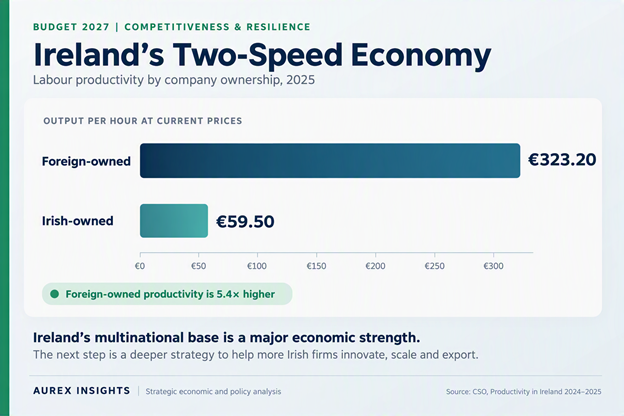
This should not be read as an argument against foreign investment. Ireland’s multinational sector remains one of the country’s greatest economic achievements. The danger lies in failing to convert more of that success into indigenous productive capacity: stronger domestic supply chains, deeper research collaboration, faster technology adoption, better management capability, patient scale-up capital and more internationally competitive Irish-owned exporters.
The €1 billion ISIF programme, CGT reduction and R&D reforms are welcome foundations. But they are instruments, not yet a strategy. A stronger Budget would have connected enterprise policy explicitly to fiscal resilience – recognising that Ireland cannot sustainably diversify its tax base without diversifying the productive economy from which that tax base is drawn.
That is the larger opportunity presented by today’s abundance. Ireland can use exceptional revenues not merely to support current living standards, but to reduce the structural dependencies beneath them: dependence on a handful of corporate taxpayers, dependence on imported energy, dependence on constrained infrastructure and dependence on foreign-owned firms for a disproportionate share of productivity, innovation and exports.
The test of Budget 2027 will therefore not be the €9.5 billion surplus recorded in next year’s accounts. It will be whether Ireland emerges from this period with more homes, greater grid and water capacity, better transport connectivity, stronger public-sector productivity – and a larger cohort of innovative, internationally scalable Irish-owned businesses.
If it does, the corporation-tax windfall will have been converted into national wealth, productive capacity and economic resilience.
If it does not, Ireland will have used temporary revenues to finance a permanently more expensive State while leaving the underlying concentration of its economic model largely intact.
A country should not measure resilience by how much it can spend while exceptional revenues continue. It should measure resilience by how well it can prosper when they do not.
Dr Brian O’Donnell is Founder and Principal of Aurex Insights, an independent economic-policy and strategic-advisory practice working between Ireland and Canada. He advises organisations on enterprise policy, industrial strategy, fiscal analysis, legislative engagement and Canada–Europe economic relations.