Industrial policy is back on the global stage – with trillion‑dollar announcements, new institutions and renewed state ambition. Ireland is conspicuously quiet. That silence is no longer affordable.
By Dr. Brian O’Donnell | Aurex Insights | May 27, 2026

OECD Ireland warning, 2026:
“A large population of low‑productivity SMEs poorly prepared for the twin digital and green transitions, and an enterprise landscape where foreign‑controlled firms account for a dominant share of value added but a minority of employment.” – OECD, Developing a Responsible Business Compass for Ireland (2026)
There is a paradox at the heart of the Irish economic success story. For two decades, Ireland has been held up as the gold standard of small-country economic strategy: low corporate taxes, a pro-business regulatory culture, deep integration into European and transatlantic value chains, and a talent pipeline that consistently punches above its weight. The results, on headline measures, have been extraordinary. GDP per capita figures that rival Switzerland. Corporation tax receipts that fund schools, hospitals, and infrastructure. A roster of multinational employers that reads like a directory of Silicon Valley and Big Pharma.
And yet, if you look carefully at what the latest OECD evidence actually shows – not the headline GDP figures, not the FDI league tables, but the detailed architecture of industrial and enterprise policy – a starkly different picture emerges. Ireland is not running a world-class enterprise policy system. It is running one of the leanest, most fragmented, and structurally under-resourced SME support systems in the entire OECD sample. The gap between Ireland’s reputation and its reality is not a rounding error. It is a structural vulnerability that a decade of complacency has allowed to deepen.
The OECD Numbers Don’t Lie
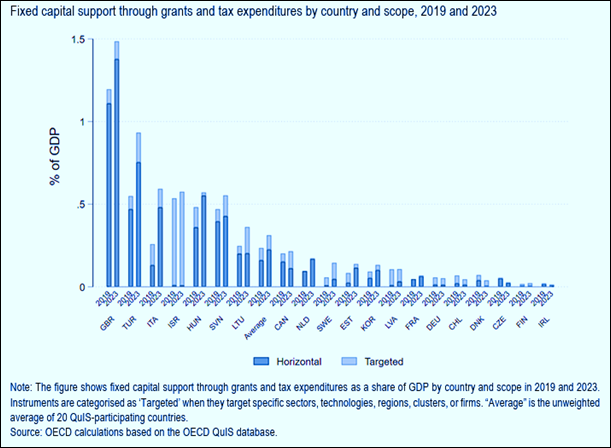
The OECD’s Quantifying Industrial Strategies (QuIS) project is the most rigorous cross-country benchmarking of industrial policy architecture ever published. It measures not intentions or announcements, but actual expenditures – grants, tax instruments, financial tools, guarantees – harmonised across 20 OECD countries and broken down by policy category, instrument type, and beneficiary.
In its latest iteration, the QuIS database has been expanded to cover 20 OECD economies, including Canada and Ireland, and now uses a richer classification that identifies both the types of firms targeted – for example SMEs, specific sectors or technology developers – and the kinds of expenses supported, from fixed capital and R&D to labour and energy costs. This allows for a genuinely comparative view of industrial policy architecture: not just how much governments spend, but how they prioritise sectors, instruments and firm types over time.
For Ireland, the findings are unambiguous. Industrial policy expenditures are significantly lower than the benchmark across every major category. In 2021, grants and tax expenditures amounted to just 0.58% of GDP in Ireland, compared with 1.47% in the benchmark group. Financial instruments – loans, guarantees, equity – stood at 0.21% of GDP against a benchmark of 1.70%. Even when using Ireland’s Modified GNI to correct for the well-known multinational distortions in Irish GDP, the gap narrows but does not close: grants and tax expenditures rise to 1.05% of GNI* against a benchmark of 1.50%.
The more revealing data, however, is not the headline aggregate. It is where the underinvestment is most concentrated. SME-focused industrial policies in Ireland amounted to just 0.02% of GDP in 2021, against a benchmark average of 0.25% – and the Netherlands, at 0.51% of GDP, operating at more than 25 times the Irish level. In monetary terms, Ireland spent just €97 million on SME‑focused industrial policy schemes in 2021 as captured in the OECD’s QuIS database, equivalent to 0.02% of GDP, compared with 0.25% in the benchmark. For a eurozone economy of Ireland’s scale, that is a strikingly small, dedicated SME support effort.
The financial instruments gap is equally revealing. Ireland has no export credit agency. SME-focused guarantees – one of the most cost-effective levers in any modern enterprise toolkit – represented just 0.004% of GDP in Ireland in 2021, compared with 0.26% in Canada and 0.88% in France. The only active SME guarantee scheme was an EU instrument; Ireland’s own Credit Guarantee Scheme had been converted into a COVID emergency tool and was, in practice, dormant as a structural support.
This is not a marginal shortfall. The cross‑country data also show that industrial policy is not a sudden proliferation of new schemes: the stock of instruments increases only slowly and existing programmes have an average “half‑life” of almost 18 years, meaning most of today’s industrial policies are long‑standing structures rather than short‑term political experiments. This is a systematic and decades-long underinvestment in the institutional infrastructure that turns ambitious domestic firms into export-capable, innovation-driven, employment-rich enterprises.
The Corporation Tax Trap and Industrial Policy
How did Ireland arrive here? The answer lies in a strategic choice that was, at the time, rational, and has since become a trap.
Ireland chose to anchor its enterprise strategy around a single, powerful instrument: a low headline corporate tax rate. That rate became the gravitational centre of Irish economic policy. Everything else – grant programmes, advisory services, export supports, finance instruments, management capability interventions – was, by comparison, secondary. The OECD analysis makes the mechanism explicit: Ireland has lower industrial policy tax expenditures than the benchmark partly because it already has a low corporate income tax rate, leaving less margin for targeted incentives on top. Ireland’s combined corporate income tax rate is roughly half the benchmark average. The policy space for supplementary instruments is correspondingly narrow.
The result is a state that became extraordinarily skilled at one thing – attracting and retaining globally mobile capital – and proportionally less skilled at everything else. As research by Alan Ahearne and others has documented, much of Ireland’s headline productivity performance is accounted for by a small cohort of foreign-owned multinationals, while a large share of the indigenous enterprise base remains ordinary in productivity terms and heavily exposed to any slowdown in FDI flows. That is not a technical footnote; it is a structural vulnerability. Living standards, tax revenues, and regional opportunity are all, to an uncomfortable degree, dependent on decisions made in boardrooms in California, Boston, and Basel.
Strong corporation tax receipts, which have reached well over €30 billion in recent years, have provided the political anesthetic that made reform feel unnecessary. Why redesign a system that is producing record revenues? The answer, which the OECD data now makes impossible to dismiss, is that the revenue performance of the FDI model has been masking the underperformance of indigenous enterprise policy for years.
A Fragmented System That Fails the Firms It Claims to Support
Ask any Irish SME founder or managing director what navigating the enterprise support landscape feels like, and the answers converge quickly: overlapping agencies, inconsistent criteria, short programme cycles, advisory services that do not connect to finance, finance that does not connect to export readiness, export supports that do not connect to management capability. The system is not malicious. It is simply not designed around the growth journey of an actual firm.
My own 2024 DBA research examined this architecture in detail and reached a conclusion that the OECD data now validates quantitatively: Ireland’s enterprise policy system is structurally fragmented, underpowered relative to peer countries, and lacks a sufficiently integrated, mandated, and resourced mechanism to support SMEs across the full capability spectrum – from early stage through growth, internationalisation, and scale.
The fragmentation is not merely administrative inconvenience. It is a policy failure with economic consequences. Firms that cannot navigate the system do not receive support. Supports that are not connected to each other do not compound. Capability gaps in leadership, management quality, and innovation adoption – the drivers of long-run productivity identified in the work of Bloom, Van Reenen, and others – go unaddressed because no institution owns that agenda comprehensively.
A separate OECD study on developing a Responsible Business Compass for Ireland, prepared to help firms navigate new EU sustainability and due‑diligence legislation, reaches a similar conclusion from another angle. It notes that Ireland combines one of the highest per‑capita emissions profiles in the OECD with a very low circular material use rate, a large population of low‑productivity SMEs poorly prepared for the twin digital and green transitions, and an enterprise landscape where foreign‑controlled firms account for a dominant share of value added but a minority of employment. Mapping the support system for responsible business reveals more than fifty measures across thirteen departments and agencies, with uneven coverage and a risk of duplication – evidence that Ireland’s problem is not a shortage of initiatives, but a lack of integrated architecture for domestic firms.
The IMF’s most recent Article IV consultation on Ireland similarly highlighted the concentration risks in the Irish growth model and the need for stronger domestic productive capacity. The OECD findings add the policy architecture dimension: it is not just that indigenous firms underperform, but that the state’s toolkit for supporting them is unusually thin.
Canada Is Moving. Ireland Is Still Standing Still.
The contrast with Canada is instructive – not because Canada has solved its industrial policy challenge, but because it illustrates what a more complete toolkit looks like and where the political centre of gravity is moving.
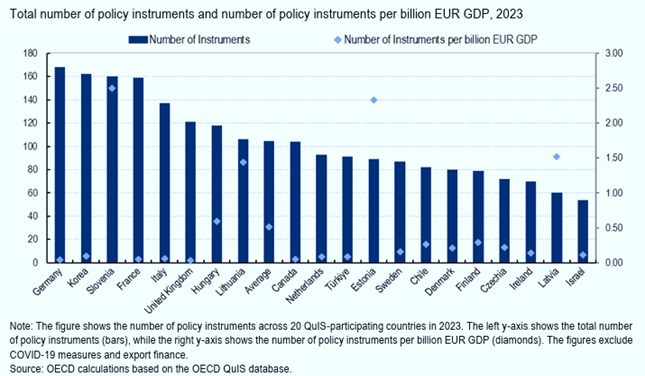
On the OECD’s cross-country comparison of policy instrument breadth, Canada sits close to the middle of the pack; Ireland is near the bottom. Canada provides SME guarantees at 0.26% of GDP – 65 times the Irish level. It has long-standing export finance infrastructure, public lending mechanisms, and a more diversified set of financial instruments for domestic firms. None of this has prevented Canada from having its own productivity and scale-up challenges. But the institutional base for a more active enterprise strategy exists.
The OECD’s recent analysis of Canada using the QuIS database, alongside complementary sources, frames this explicitly in terms of structural challenges: slow productivity growth, weak business investment, limited scale‑up of innovative firms and the transition to a low‑carbon economy. It notes that green industrial support and SME financing have expanded meaningfully, but argues that clearer strategic direction, stronger policy co‑ordination and more systematic evaluation will be needed if this new wave of intervention is to translate into durable productivity gains rather than short‑term subsidies.
More importantly, the political direction in Canada is explicit. Mark Carney has positioned economic security, productive investment, supply chain resilience, and industrial capability as central priorities. The conversation in Ottawa is about expanding and deploying the state’s enterprise toolkit. The conversation in Dublin, where it is happening at all, is too often about protecting what already exists.
This is not an argument for Ireland to adopt Canadian institutions wholesale. Ireland’s small size, EU membership, and specific institutional history all matter. But the directional contrast is striking: one country is interrogating and strengthening its enterprise architecture; the other is largely assuming its current model is adequate.
The Case for a Dedicated SME Agency
The most direct policy implication of this evidence – from the OECD QuIS data, from the IMF analysis, and from my own DBA research – is that Ireland needs a new institutional settlement for SME policy.
This is not an argument that nothing is happening today. Local Enterprise Offices, Enterprise Ireland, Údarás na Gaeltachta, the Western Development Commission and others are doing important work with entrepreneurs and firms in every county. They have built strong client relationships, supported real success stories, and helped many companies survive, innovate and export. The problem is not the quality of individual teams. It is that the overall system they operate in is structurally fragmented and hierarchically skewed toward a small number of “winners,” rather than designed around the broad base of SMEs that drive employment, regional vitality and long‑term productivity.
At the top of the system, Enterprise Ireland quite rationally concentrates scarce resources on firms with the clearest export and scaling potential. That focus has delivered impressive individual successes, but it leaves a wide “missing middle” of firms that are too big for start‑up programmes, too small or too early for the classic EI model, and often spread across regions where advisory and financial support is thin. At the local level, the LEO network is energetic but uneven, with 31 offices attempting to deliver a patchwork of national schemes while also acting as first responders for every new initiative. For many founders, the landscape feels like a mosaic of programmes, pilot schemes and press releases about star performers – not a coherent growth pathway.
Tinkering at the margins will not fix this. Rebranding existing structures, launching new challenge funds, or issuing more success stories does not change the underlying architecture. What is missing is an institutional anchor for indigenous enterprise with the scale, mandate and political visibility that IDA Ireland has long enjoyed on the FDI side. A dedicated SME agency with equivalent strategic weight would give domestic firms a clear home in the policymaking system – a place at the table when decisions on tax, finance, skills and infrastructure are made, rather than an afterthought once multinational needs have been accommodated.
Such an agency would do four things that the current system does not do coherently. First, it would provide a single, navigable front door for firms at every stage of development – removing the compliance and navigation burden that currently falls on founders and owner‑managers rather than the state. Second, it would unify access to financial instruments: credit guarantees at meaningful scale, growth loans and export‑readiness finance that bring Ireland’s toolkit closer to what Canada, France and the Netherlands already operate. Third, it would deliver non‑financial capability programmes – in management quality, digital adoption, decarbonisation planning and internationalisation – as an integrated offer rather than a menu of disconnected schemes. Fourth, it would carry an explicit regional mandate, ensuring that the pipeline of supported firms extends beyond Dublin and the main urban nodes into second‑tier cities and rural enterprise bases where regional cohesion is actually won or lost.
This is not a radical proposal. It is, in effect, what most of Ireland’s peer economies have already built: a central institution for domestic enterprise with the firepower to match its strategic importance. The OECD data show the cost of not having built it. The practical experience of SMEs – and the lived reality of agencies working heroically within a fragmented system – show that the time for minor adjustments has passed. A dedicated, IDA‑scale SME agency would not solve every problem overnight, but it would finally align institutional power with the scale of the challenge.
For those who want to go deeper, my DBA thesis – Delivering a Strategic Policy Framework to Protect Irish SMEs – sets out a concrete blueprint for such an agency and the wider enterprise policy reforms it would require: Delivering a Strategic Policy Framework to Protect Irish SMEs.
The Window Is Open. It Will Not Stay Open.
Industrial policy has a rare moment of political legitimacy. Globally, the state is being asked to do more: to shape supply chains, accelerate the green transition, support strategic sectors, and ensure that the gains from growth are more broadly shared. Ireland can participate in that moment on its own terms – or it can remain a spectator, watching peer economies deepen their enterprise architectures while Ireland continues to rely on a single, concentrated instrument that faces rising political risk in Washington, Brussels, and beyond.
The SMEs that have been raising these concerns for years deserve to be heard – not with another consultation process, but with a concrete, resourced, and durable institutional response. The OECD has now provided the cross-country evidence that confirms what those firms have been saying. The IMF has identified the structural risk. The DBA research has mapped the architecture gap and identified the solution.
The question is whether Irish policymakers will use this window – or whether the next wave of corporation tax revenues will once again make urgency feel optional.
A country serious about productivity, regional balance, and long-term economic resilience cannot sustain a world-class FDI platform on top of a minimalist SME strategy indefinitely. The data now says so. The moment to act is now.
Dr. Brian O’Donnell is the founder and principal of Aurex Insights, an independent public policy, economic and legislative strategy practice specialising in enterprise policy, industrial strategy and fiscal analysis, working between Ireland and Canada.
Sources
- Bloom, N. and Van Reenen, J. (2007) ‘Measuring and explaining management practices across firms and countries’, Quarterly Journal of Economics, 122(4), pp. 1351–1408.
- OECD (2026) Quantifying industrial strategies across 20 OECD countries: 2019–2023 trends and priorities. Paris: OECD. Available at: https://www.oecd.org/en/publications/quantifying-industrial-strategies-across-20-oecd-countries_0e3ab6dd-en.html
- OECD (2026) Developing a responsible business compass for Ireland. Paris: OECD. Available at: https://www.oecd.org/content/dam/oecd/en/publications/reports/2026/05/developing-a-responsible-business-compass-for-ireland_7fb45270/20fcc34e-en.pdf (Accessed: 27 May 2026).
- OECD (2023) Quantifying industrial strategy: Ireland. Paris: OECD. Available at: https://www.oecd.org/content/dam/oecd/en/topics/policy-sub-issues/quantifying-industrial-strategies/QuIS-Ireland.pdf
- OECD (2019) SME and entrepreneurship policy in Ireland. Paris: OECD. Available at: https://www.oecd.org/en/publications/sme-and-entrepreneurship-policy-in-ireland_e726f46d-en.html
- OECD (2025) Industrial policy: an institutional framework for industrial strategies. Paris: OECD. Available at: https://www.oecd.org/content/dam/oecd/en/publications/reports/2025/06/an-institutional-framework-for-industrial-policies_ab944c3.pdf
- International Monetary Fund (2025) Ireland: 2025 Article IV consultation—Press release; staff report; and statement by the Executive Director for Ireland. IMF Country Report No. 2025/128. Washington, DC: International Monetary Fund. Available at: https://www.imf.org/en/publications/cr/issues/2025/06/10/ireland-2025-article-iv-consultation-press-release-staff-report-and-staff-statement
- Ahearne, A. (2026) Entrepreneurial activity and living standards in Ireland. Galway: University of Galway. Available at: https://research.universityofgalway.ie/media/universityofgalway/research/Entrepreneurial-Activity-and-Living-Standards-in-Ireland.pdf
- O’Donnell, B. (2024) ‘Delivering a strategic policy framework to protect Irish SMEs’, Global Journal of Business and Integral Security (GBIS), 9(4), Available at: https://repository.learn-portal.org/index.php/rps/article/view/631
- Mazzucato, M. and Rodrik, D. (2026) ‘Industrial policy with conditionalities: a taxonomy and sample cases’, Industrial and Corporate Change, advance article. Available at: https://academic.oup.com/icc/advance-article/doi/10.1093/icc/dtaf063/8528994