How policy failure is loading the cost of ageing onto younger generations
Dr. Brian O’Donnell | Aurex Insights | June 2026
Every generation makes an implicit promise to the one that follows: we will build something worth inheriting. On current trends, Western governments are breaking that promise – not dramatically, not deliberately, but through a slow accumulation of policy failure, political cowardice, and convenient arithmetic that nobody wants to say out loud in an election year.
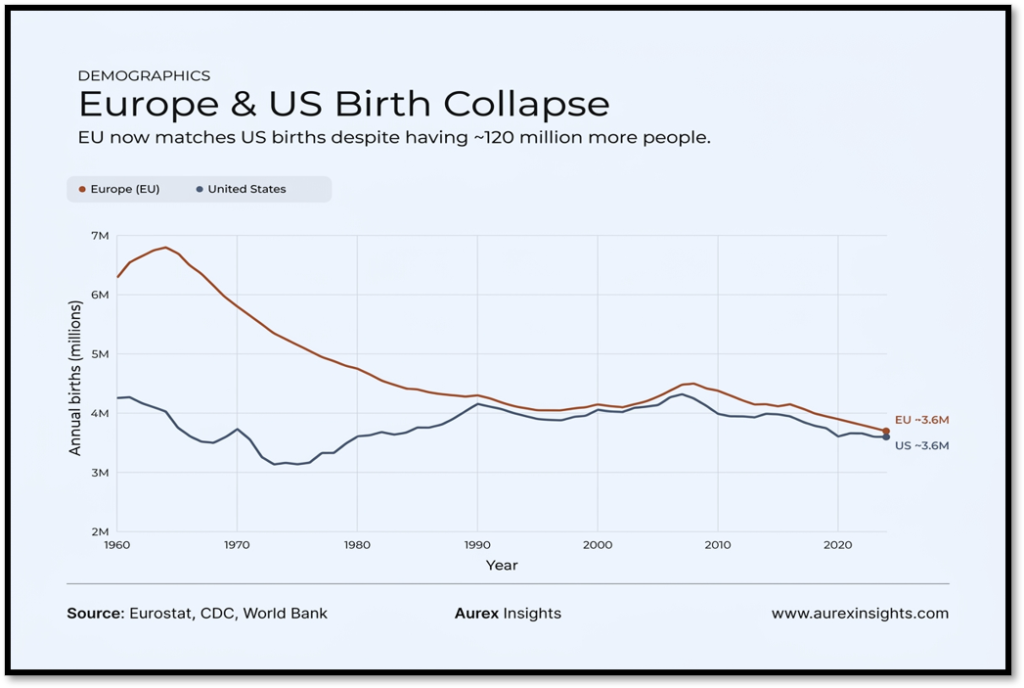
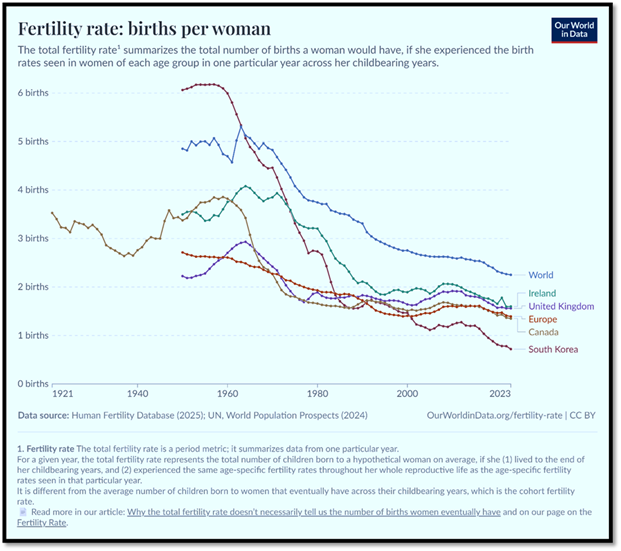
The numbers are now too stark to avoid. In 2024, the European Union recorded approximately 3.55 million births – roughly the same as the United States, despite having 120 million more people. EU fertility has fallen to a record low of 1.34 children per woman. The OECD average has dropped to 1.5, less than half what it was in 1960. These are not marginal adjustments. They are the early readings on a structural failure that will reshape pensions, public finances, labour markets and the lives of younger workers long before most politicians are willing to admit it. The tragedy is not that governments don’t know what to do. It is that the political cost of acting before an election has always been higher than the cost of leaving it to the next one.
The scale of the failure is already visible in the data. South Korea has spent over $200 billion on government programmes designed to raise its birth rate since 2006. Its total fertility rate in 2023 was 0.72 – the lowest ever recorded for a developed nation. The money did not move the needle. That is not an argument for doing nothing. It is an argument for being honest about which interventions work, which do not, and why housing, economic security and gender equality matter more than cash incentives paid to people who cannot yet afford a home.
The babies not born this year will not appear in the labour force in 2048. That is the simplest way to understand what is now at stake.
The democratic squeeze and the arithmetic politicians avoid
In pay-as-you-go pension systems, current workers fund current retirees. Those systems work best when the working-age population is broad, wages are rising, and each generation is large enough to replace the one before it. That world is dissolving. The OECD projects that the ratio of people aged 65 and over per 100 working-age people will roughly double – from around 30 today to approximately 59 by 2060. The fiscal implications are severe: a 2025 OECD analysis projects that without corrective action, age-related fiscal pressure will rise by an average of 6.25 percentage points of GDP across OECD economies between now and 2060, with demographic ageing accounting for over 40% of that pressure.
The IMF and major pension researchers have similarly warned that ageing populations are putting sustained pressure on pension adequacy and fiscal sustainability – and that reform is unavoidable even before accounting for the latest collapse in births. The problem is not that public pensions will suddenly disappear. It is more subtle, and therefore politically easier to evade. If low fertility persists, younger and middle-aged cohorts will retire into systems that are less generous, less predictable, and more conditional than those enjoyed by many current retirees. The adjustment will come through four channels: later retirement ages, higher social contributions, lower replacement rates, or higher debt repaid through future taxation. None of these options is painless. All of them redistribute costs to younger workers if reform is delayed.
An IMF working paper on Europe’s fertility slowdown finds that the decline in fertility can produce persistent long-run losses in income per capita, as a smaller labour force makes a reduced contribution to growth while ageing drags on macroeconomic performance. The EBRD estimates demographic decline will lower annual GDP per capita growth by 0.36 percentage points in EU economies between 2024 and 2050. A major review in the Annual Review of Economics similarly concludes that low fertility in high-income countries is associated with weaker labour-force growth, labour shortages, slower innovation, and greater strain on social insurance systems. The policy question, then, is not whether demographics matter. It is whether governments are willing to respond honestly enough, and early enough, to prevent a much harsher adjustment later.
Ireland is a warning, not an exception
Ireland illustrates the issue with unusual clarity. Births fell from 67,462 in 2014 to approximately 54,000 in 2024 – a drop of roughly one-fifth in a decade. Yet over the same period, Ireland’s total population grew strongly, reaching about 5.4 million in 2024. That combination matters. Headline population growth creates an illusion of demographic health even while the underlying birth trend deteriorates.
A country can grow through immigration or population momentum while its domestic fertility weakens sharply. Ireland’s fertility rate now stands at approximately 1.5 – below replacement level and far below the assumptions that once underpinned more optimistic thinking about long-term demographic resilience. Ireland is no longer demographically exceptional in the way it once was.
The drivers are not mysterious. National Economic and Social Council work cited in 2026 reporting argues explicitly that the housing crisis is suppressing fertility, with high housing costs and insecure accommodation delaying or displacing family formation. Research across advanced economies consistently shows that people end up having fewer children than they want when housing is unaffordable, childcare is costly or unavailable, employment is insecure, and the career penalties of parenthood remain steep – penalties that continue to fall disproportionately on women. That is why the current fertility decline should not be described merely as a matter of private preference. It is also a failure of economic infrastructure. When secure housing, affordable childcare and predictable work become harder to obtain, family formation becomes more fragile – and with it, the future contributor base on which pensions and public services rely.
The politics of postponement
If the economics are clear, why has policy been so hesitant? Because the political incentives strongly favour delay.
Ireland’s pension-age debate in 2020 is a textbook example. The planned increase in the state pension age became a major general election issue, with parties competing to reassure voters that the previously legislated rise would be deferred or reversed. The subsequent Programme for Government kept the state pension age at 66 and removed the planned increases from legislation pending review. That decision was politically understandable, but it exemplified a broader failure of democratic honesty: the government reduced immediate political pain while leaving the underlying arithmetic unresolved.
This is not uniquely Irish. Across many advanced democracies, politicians acknowledge ageing in the abstract while avoiding the concrete choices it implies. Pension reports warn of “pressure” and “sustainability challenges,” but public communication routinely stops short of stating the real implication: absent reform, today’s workers will either pay more, retire later, or receive less relative to earnings. The danger is that delayed reform does not eliminate pain – it compresses it. A pension age increase announced fifteen years in advance is a planning problem. A more abrupt increase announced in a fiscal crunch is an income shock. Political systems that repeatedly avoid gradual adjustment tend to produce harsher and less equitable corrections later.
What pronatalist policy can and cannot do
Here a necessary honesty is required – one that many demographic commentaries avoid. Pronatalist policy – government programmes designed to raise birth rates through financial incentives, childcare support and parental leave. – can help raise fertility at the margin, but the evidence that pronatalism reverses large-scale fertility declines is considerably more sobering than the ambition of most government programmes.
France, which spends over 1.3% of GDP on family support, maintains a total fertility rate of approximately 1.8 – among the highest in the EU, but still well below replacement. Hungary’s aggressive pronatalist programme, including tax exemptions and loans forgiven at the third child, has produced a modest uptick – but the debate continues over whether it reflects a genuine fertility shift or a timing effect from births being brought forward. Most strikingly, South Korea, as already noted, is the cautionary extreme – $200 billion spent, a TFR of 0.72 – but Japan, Hungary and even France tell a similarly sobering story of modest returns on large investments.
The honest conclusion is that coherent economic infrastructure – affordable housing, accessible childcare, equitable workplace conditions – can probably raise fertility from 1.3 toward 1.6 to 1.7 in favourable conditions. It will not restore replacement-level fertility in advanced economies. The demographic gap in pension systems will therefore need to be addressed on its own terms through structural pension reform, not just by hoping that births recover.
Can immigration fix this?
Immigration can help materially, and any serious analysis must say so clearly. Younger migrants can add to the labour force, support tax revenues, and ease short- to medium-term pension pressures, especially where labour-market integration is strong. In countries with very low fertility, migration often prevents outright population decline or slows it significantly.
But immigration is not a complete answer, for two reasons. First, the academic literature consistently finds that it can soften ageing pressures, not abolish them. Migrants age. The benefits depend critically on age of arrival, skills, employment rates and integration quality. If fertility remains very low for decades, even high immigration does not remove the need for pension reform, stronger productivity growth, and better family policy.
Second – and this point is underappreciated – the scale of immigration required to maintain current worker-to-retiree ratios through migration alone would require flows that are politically unsustainable in most current Western electoral environments. The gap between what the economics requires and what the politics permits is the real constraint. Immigration is a necessary ingredient of any credible response, but it cannot substitute for the harder domestic reforms.
Are environmentalists right? The degrowth challenge
A growing body of environmental and degrowth thinking argues that falling birth rates are not a crisis but a correction – that smaller populations consume fewer resources, produce lower emissions, and create the conditions for a transition to a sustainable steady-state economy. Pension problems, the argument runs, are solvable by redistributing existing wealth rather than producing more workers. This deserves a serious engagement rather than a dismissal.
There is a genuine truth embedded in the degrowth argument: population size does matter for environmental impact, and a world of nine rather than twelve billion people carries different ecological pressures. Climate anxiety is also now measurable in fertility surveys as a real factor shaping reproductive decisions, particularly among younger adults.
But the degrowth response to demographic ageing is ultimately too narrow, for three reasons.
First, the distribution problem is not solved by degrowth. Pay-as-you-go pensions are a ratio problem, not a wealth problem. Even in a wealthy economy, if four workers must support ten retirees rather than ten supporting four, the burden per worker rises dramatically regardless of aggregate national wealth. Redistribution of existing assets can partially compensate, but it requires either very large taxes on wealth – politically difficult in most democracies – or liquidating national savings, which reduces investment, future productivity and, ironically, the fiscal capacity to fund green transitions.
Second, the transition is asymmetric in time. Environmental benefits from population reduction accrue over decades and centuries. Pension and fiscal crises from rapid ageing arrive within ten to twenty years, in the careers and retirement plans of people alive today. A policy framework that accepts immediate fiscal pain in exchange for long-dated environmental gains does not represent a balanced intergenerational bargain – it shifts costs toward the workers of the 2030s and 2040s who did nothing to cause the fertility decline.
Third, population scale and innovation capacity are connected. The economics of ideas literature – Romer, Jones, Bloom and others – documents that larger populations with strong human capital systems generate more researchers, inventors and entrepreneurs. Demographic decline, if sharp and sustained, could slow the pace of green technology development precisely when the world needs it most. The environmental argument inadvertently weakens its own case.
The right framing is not that population growth is good or that population decline is good. It is that managed, gradual demographic transitions, supported by good policy, allow societies to adapt. Abrupt fertility collapse followed by political paralysis does not.
Why the squeezed middle should care now
This is not a distant problem for future retirees. It is already embedded in the lived economics of the squeezed middle.
Younger workers across North America, Europe and in Ireland are managing some combination of high rents, delayed homeownership, expensive childcare, more fragmented work patterns, and weaker affordability than earlier generations experienced at the same age. If those same cohorts are then expected to support a growing retired population through higher contributions while also saving more privately for their own less certain retirement, the intergenerational bargain starts to break down – not dramatically and suddenly, but through a slow accumulation of constraint and disappointment.
The fertility debate is becoming more urgent precisely because low birth rates are not only a fiscal issue. They are also a signal that people increasingly feel constrained from forming the families they want, because of housing, economic insecurity, persistent gender inequality in the workplace and home, and genuine anxiety about the future. Those constraints align closely with the evidence. A society in which wanted children become harder to afford is not just becoming older. It is becoming less confident in its own future.
A serious response before the 2030s close
A credible policy response rests on four pillars.
Pension reform must be gradual, predictable and rules-based. Linking retirement ages or benefit formulas more transparently to longevity and dependency trends is politically difficult but far fairer than serial postponement followed by abrupt change. The earlier the adjustment begins, the more equitably the burden is distributed.
Housing and childcare must be treated as growth and fiscal policy, not merely social policy. If unaffordable housing and poor childcare provision suppress family formation, then they are not only hurting households today – they are weakening the future contributor base of the state. The fiscal case for investment in both is as strong as the social one.
Productivity growth must be a sustained policy priority. In ageing societies, output per worker matters more because there will be fewer workers supporting more dependants. Sustained attention to innovation, skills, infrastructure, technology adoption, and labour-force participation – especially among older workers and under-represented groups – is the only way to maintain living standards as the workforce shrinks. Automation and AI may partially offset demographic drag, but only if tax and regulatory systems are designed to capture the productivity dividend rather than allow it to accrue entirely to capital.
Immigration policy needs to be economically serious rather than merely symbolic. That means focusing on employability, integration quality and long-term contribution – and being honest with electorates about how much demographic and fiscal need immigration can realistically address.
The bigger failure
The deeper issue is not that birth rates are falling. Societies have navigated demographic transitions before. The failure is that politics has not integrated demography, housing, pensions and labour supply into a coherent, honest response. Governments have allowed the costs of family formation to rise, delayed pension adjustment, offered pronatalist gestures without the structural investment they require, and then acted surprised when younger adults hesitate to have children and doubt whether the retirement system will serve them.
The babies not born in 2024 are the missing contributors of 2050. That fact will not be spun away, deferred to the next electoral cycle, or resolved by any single lever. The question is no longer whether this reckoning is coming – the numbers settled that a decade ago. The question is whether democratic politics can act before the adjustment becomes a crisis, or whether, once again, the costs of delay will be quietly loaded onto the generation least responsible for creating them. On current form, the answer is not encouraging. But the window has not yet closed – and that, for now, is the only reason for cautious optimism.
Dr. Brian O’Donnell is the founder and principal of Aurex Insights, an independent economic and public policy consultancy. He holds a Doctorate in Business Administration specialising in enterprise policy. Aurex Insights advises SMEs, NGOs, industry groups and public bodies across Ireland, Canada and the EU. www.aurexinsights.com
If you found this analysis useful, Aurex Insights produces regular briefings on fiscal policy, demographic risk, enterprise strategy and the Ireland-Canada economic relationship. To commission a bespoke analysis or discuss how demographic trends affect your organisation’s planning horizon, contact brian@aurexinsights.com.