Canada is presenting global investors with 167 opportunities while seeking a deeper economic relationship with Europe. The real test is whether it can turn confidence, capital and market access into productive capacity.
Today, Canada will present some of the world’s largest investors with 167 reasons to invest – and, in doing so, test whether it can help rewire the economic cabling of the Western alliance.
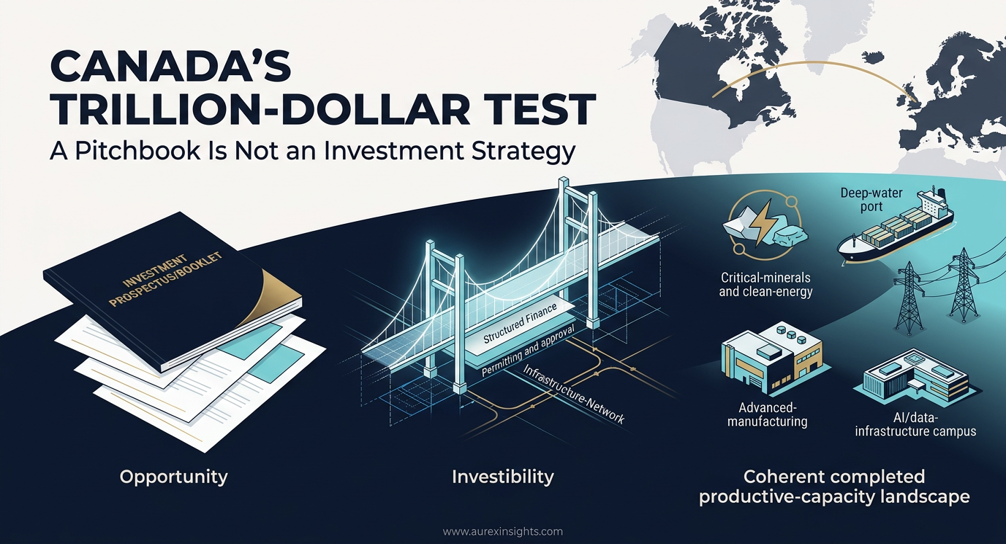
The prospectus prepared for the Canada Investment Summit spans mining and metals, ports, conventional and clean energy, power, advanced manufacturing, transportation, AI infrastructure and data centres. It is an impressive expression of national ambition, and a reminder of the strategic assets Canada can bring to a more fractured global economy.
But a pitchbook is not an investment strategy.
Nor is a catalogue of opportunities the same thing as a credible, investible pipeline.
A project can appear compelling on paper while still lacking a regulatory pathway, transmission connection, serviced site, commercial structure, revenue model, workforce, Indigenous partnership, financing certainty or realistic timetable for delivery.
That is the real economic question behind the Canada Investment Summit, which opens in Toronto today.
It is also the significance of reports this weekend that Prime Minister Mark Carney is exploring a form of “associate” relationship with the European Union – short of membership, but potentially deeper than a conventional trade agreement. The reported discussions extend to strategic supply chains, energy, AI, defence, critical minerals, worker mobility, undersea cables, cloud infrastructure and satellite networks.
Whether such an arrangement proves politically or legally achievable remains uncertain. The European Union does not have an established associate-membership model for a country such as Canada.
But the direction of travel is clear.
Canada is not simply looking for alternative export markets. It is testing whether a deeper economic and strategic relationship with Europe can reduce excessive dependence on the United States and create a stronger platform for investment, infrastructure, innovation and trade.
There is a historical echo.
When the United States adopted the Smoot–Hawley tariff in 1930, Canada retaliated and accelerated its reorientation toward Britain and the Commonwealth through Imperial Preference. Canada did not stop trading with the United States. It sought to reduce exposure to a suddenly less reliable market.
The current circumstances are different, but the underlying strategic logic is familiar.
Canada’s relationship with the United States remains indispensable. Geography, shared infrastructure, integrated industrial supply chains and the scale of the North American market ensure that no European strategy can replace it.
But concentration creates vulnerability when market access, tariff treatment and the wider political relationship become less predictable.
Diversification is not departure. It is insurance.
In 2025, Canadian exports to the United States fell by 3.7%, while exports to non-U.S. markets rose by 11.1%. Non-U.S. markets accounted for 32.8% of Canadian exports – their highest share in more than four decades.
The strategic objective is not replacement, but additionality: more markets, more capital partners, more resilient supply chains and more Canadian firms capable of competing internationally.
That final point deserves greater attention.
A country can redirect trade flows without fundamentally diversifying its exporting economy. If growth beyond the United States remains concentrated among established exporters, particular sectors and a limited number of cities, the underlying vulnerability remains.
Canada may be diversifying trade flows without yet fully diversifying its exporting economy.
The wider geopolitical risk is that fragmentation among democratic market economies creates strategic openings for competitors. When Canada, the United States and Europe spend more time managing tariff disputes, regulatory uncertainty and supply-chain disruption, they weaken the capacity of the wider Western alliance to invest, innovate and build resilient industrial systems together.
The answer is not rhetorical solidarity. It is practical economic alignment: investment, infrastructure, market access, secure supply chains and commercial relationships capable of withstanding political shocks.
Europe must become commercial
Europe matters to Canada as a market, but it is more than a market.
It is a potential long-term capital partner, industrial collaborator, technology ally and source of strategic supply-chain resilience. It is also part of the infrastructure, energy, defence and technology systems that will shape the next economy.
The reported associate-membership discussions should not be read as a romantic Canadian turn to Europe, nor as a substitute for North America. They should be understood as an attempt to build a relationship capable of operating at the scale required by a world of contested supply chains, AI infrastructure, clean-energy systems, critical minerals and defence investment.
CETA has already demonstrated the value of reducing barriers. Since its provisional application began in 2017, two-way Canada–EU goods trade has grown by more than 75%, while bilateral services trade has risen by 97%.
CETA is not a failed framework. It is a successful one.
But its success makes the next challenge clearer.
Trade agreements reduce formal barriers. They do not identify customers, create export capability, establish distribution, resolve regulatory complexity, secure local partnerships or ensure that a small or medium-sized enterprise is ready to enter and grow in a demanding market.
Market access is not market entry.
Market access to market conversion
This matters particularly in services, technology and specialist sectors.
Canada’s services exports have become increasingly important, while sales by Canadian foreign affiliates abroad reached approximately $1 trillion in 2024. International growth increasingly depends on commercial presence, local capability and relationships built inside overseas markets – not simply on goods crossing a border.
For a Canadian company, Ireland may be a first customer market, a European operating base, a location for research or investment, a partnership platform, or a route into specialist procurement and wider EU networks.
Those are different strategic choices.
Ireland should not be reduced to a generic English-speaking “gateway to Europe.” Nor should Canadian firms assume that CETA, valuable though it is, provides a complete market-entry strategy.
The more consequential question is this:
Where can a Canadian company build the customer relationships, regulatory understanding, local capability and commercial platform required to succeed in Europe?
That is the move from market access to market conversion.
CETA’s unfinished business
CETA has demonstrated the value of reducing barriers. Since provisional application began in 2017, two-way Canada–EU goods trade has grown by more than 75%, while bilateral services trade has increased by 97%.
Yet the agreement remains institutionally incomplete.
Only 17 of the EU’s 27 member states have completed national ratification. Most provisions continue to operate, but elements of the investment-protection and dispute-resolution framework remain outside full application. Ireland and Belgium are among the ten member states that have not yet completed their national processes.
At a time when Canada and Europe are considering a closer and more strategic relationship, completing CETA’s institutional architecture would reinforce that ambition.
The lesson extends beyond CETA:
Strategic ambition is often strongest at the moment of declaration and weakest at the point of institutional completion.
Canada and Europe should not allow that to become the defining feature of their relationship.
From trust to investibility
A recent report by the CPP Investments Insights Institute – the research arm of CPP Investments, one of the world’s largest institutional investors – captures the challenge in a single sentence:
“Global capital is abundant. Deployable opportunity is not.”
That is the question confronting Canada this week.
Canada remains a trusted market: supported by strong institutions, significant resources, sophisticated expertise, a highly educated workforce and globally significant pension investors.
It also continues to attract international capital. Inward foreign direct investment reached $93 billion in 2025, its highest level in two decades. For the first time since 2013, inward FDI exceeded Canadian direct investment abroad.
But trust is an asset. It is not an outcome.
Global capital does not allocate to countries in the abstract. It allocates to opportunities that can be understood, priced, financed, permitted, insured, staffed, constructed and operated with confidence.
Investors do not experience energy, infrastructure, housing, permitting, skills, regulation and community partnership as separate government files. They experience them as one investment environment.
Working across the Canada–Ireland relationship, I see versions of the same challenge on both sides of the Atlantic. Governments do not lack strategies, funding commitments or economic assets. Too often, however, the systems needed to convert those advantages into outcomes remain fragmented.
A critical-minerals strategy is not investible simply because Canada has critical minerals.
A clean-energy strategy is not investible simply because Canada has renewable potential.
An AI strategy is not investible simply because Canada has talent, research institutions and promising firms.
Each requires the physical and institutional conditions that allow capital to deploy: dependable energy, transmission capacity, water, serviced land, skilled labour, housing, permitting certainty, appropriate financing structures and durable partnerships with communities and Indigenous peoples.
A country can be trusted without being ready.
Canada must be both.
Five tests after Toronto and Strasbourg
The Investment Summit and Canada’s renewed European strategy should be judged against five practical tests.
1. Readiness
Are major Canadian projects permitted, structured, financed and capable of delivery within a credible timeframe?
2. Additionality
Will new investment create productive capacity, innovation, export potential and economic resilience – or mainly transfer ownership of existing assets?
3. Capability
Will diversification enable more Canadian firms, particularly SMEs, to become successful international businesses – or remain concentrated among established exporters and major sectors?
4. Infrastructure
Can Canada provide the power, grid capacity, transport, housing, skills, regulatory certainty and community partnerships required to support the growth it seeks?
5. Conversion
Are CETA and deeper Canada–EU relations producing customers, investment, procurement opportunities, supply-chain partnerships, commercial presence and sustained two-way growth?
Together, these are the operating conditions of national competitiveness.
The more consequential test
The Investment Summit will test whether Canada can mobilise capital.
Carney’s Strasbourg address will test whether Canada can deepen strategic alignment with Europe.
The more consequential test begins when the speeches end and the pitchbooks are put away.
Can Canada turn a prospectus into an investible pipeline?
Can it convert market access into commercial presence?
Can it help more Canadian firms establish durable international businesses?
Can it align investment, energy, infrastructure, housing, skills and regulation around the practical requirements of long-term growth?
Canada has the ingredients for success: trusted institutions, strategic assets, capable firms, world-class investors and a growing network of international partners.
But the global competition is no longer simply for capital. Capital is available.
The competition is for investible opportunities – and for countries capable of delivering them.
Canada’s next advantage must be not merely that it is trusted, but that it is ready.
Dr Brian O’Donnell is Founder and Principal of Aurex Insights, an independent economic-policy and strategic-advisory practice working between Ireland and Canada. He advises organisations on enterprise policy, industrial strategy, fiscal analysis, legislative engagement and Canada–Europe economic relations.