By Dr Brian O’Donnell | Founder, Aurex Insights | 24 July 2026 | 9-minute read
Ireland is not merely preparing another Budget. It is quietly deciding what kind of State it will become when the windfall fades.
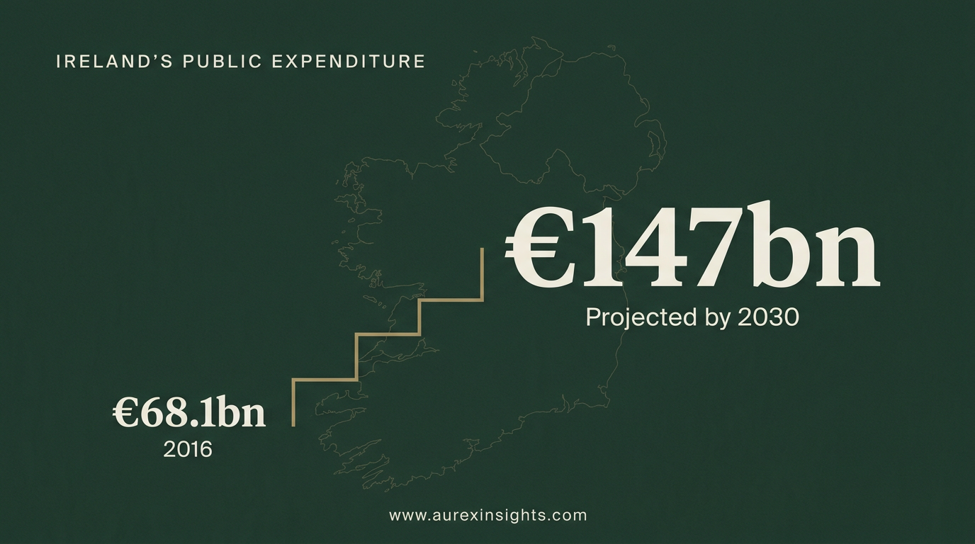
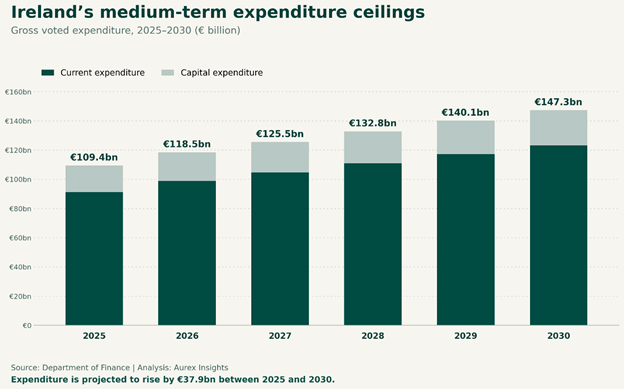
This week’s Summer Economic Statement does more than set the parameters for Budget 2027. It confirms that Ireland is building a fundamentally larger State. The package provides €8.5 billion for next year – €7 billion in additional public spending and €1.5 billion in tax measures – lifting the expenditure ceiling to €125.5 billion. The trajectory is striking: gross voted expenditure is set to rise from €109.4 billion in 2025 to €147.3 billion by 2030. In five years, the State will be spending almost €38 billion more each year. The question is no longer whether Ireland can afford a larger State, but whether it can ensure that one delivers more.
This is not, in itself, an argument against a larger State. Ireland has a larger population, an ageing society, inadequate housing and infrastructure, a constrained electricity system, and public services struggling to meet demand.
But there is a distinction Ireland’s fiscal debate too often misses:
A larger State is not necessarily a more capable State.
The real test is whether the additional billions produce more homes, faster planning, shorter hospital waits, dependable water and power connections, affordable childcare, and a stronger domestic economy. If they do not, Ireland will have built a more expensive system – not a better one.
The budget is growing faster
The Fiscal Council’s warning is unusually clear. Ireland’s planned net-spending growth is the fastest in the European Union and exceeds the economy’s estimated sustainable growth rate. The Government’s plans imply net spending growth of about 6% annually over 2026 – 2030, compared with a nominal sustainable rate estimated by the Council at roughly 4.5% to 5%.
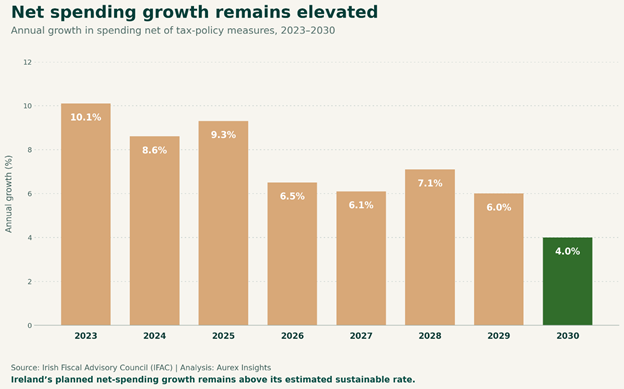
This is not austerity versus investment. It is a question of timing, discipline and value.
The Irish economy is already operating from a position of exceptional strength: employment is at record levels, unemployment is low, and demand remains robust. Adding fiscal stimulus at this point risks reinforcing construction bottlenecks, inflating costs, and making it harder for public investment to buy real capacity.
The problem is not that Ireland is spending. The problem is that it is too often paying more for the same output.
Since Budget 2024, spending overruns have accounted for €6.8 billion – almost 30% of the cumulative rise in spending over that period. That is not a minor administrative issue. It is evidence that the State’s budgeting system routinely mistakes aspiration for delivery capacity.
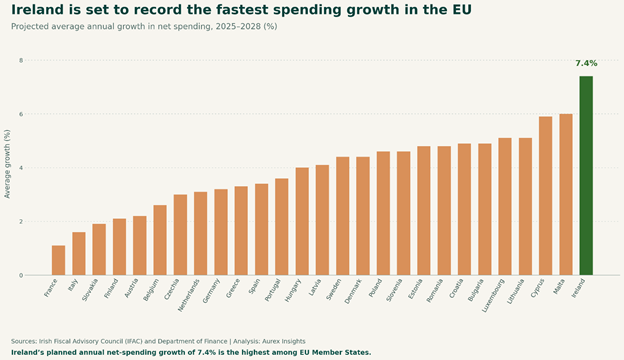
Ireland is planning to spend at a pace no other EU country is matching. At 7.4% average annual net-spending growth between 2025 and 2028, Ireland is projected to have the fastest pace in the European Union.
A ratchet, not a strategy
The Summer Economic Statement allocates €5.9 billion of the planned 2027 increase to current expenditure and roughly €1.2 billion to capital spending. In plain terms, five out of every six additional euro is directed to the recurring cost of running the State, rather than to assets that expand its future productive capacity.
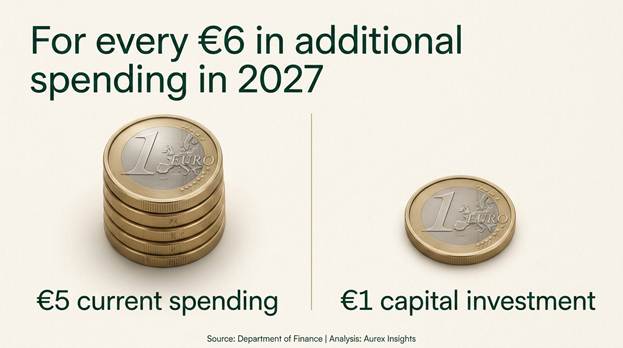
Current spending matters. Hospitals need staff. Schools need teachers. Older citizens need pensions and care. But permanent spending has a ratchet effect: once added to the baseline, it is politically and operationally difficult to reverse.
The Fiscal Council estimates that standstill costs – population growth, ageing, inflation, pay and maintaining existing service levels – could absorb €5.5 billion in 2027 before new policy begins. That means a larger budget may create little genuine room for reform. It can simply become the price of keeping an unreformed system moving.
That is why every major spending commitment should face three tests:
- Outcomes: What specific improvement will this funding buy?
- Productivity: How will the public body deliver more or better service per euro?
- Durability: Is the commitment financed by recurring revenue, rather than a windfall?
Ireland should publish these tests department by department, programme by programme, before Budget day -not after it.
The revenue is concentrated
Ireland’s apparent fiscal strength is real. But it is also unusually dependent on a small number of companies whose investment decisions are made far beyond Irish political control.
Three multinational companies accounted for roughly €13 billion, or 46%, of corporation-tax receipts in 2024. The State’s exposure is therefore not simply to “foreign direct investment” in the abstract; it is exposed to the profitability, tax structures, capital expenditure and global strategies of a handful of firms.
That risk is becoming more important, not less. The large technology companies that underpin a material share of Ireland’s corporate-tax base are investing heavily in artificial intelligence infrastructure. Wall Street analysts expect Big Tech AI capital expenditure to exceed $1 trillion in 2027. Alphabet’s negative free cash flow in the second quarter of 2026 illustrates the scale of the capital-intensity now being accepted in pursuit of AI leadership.
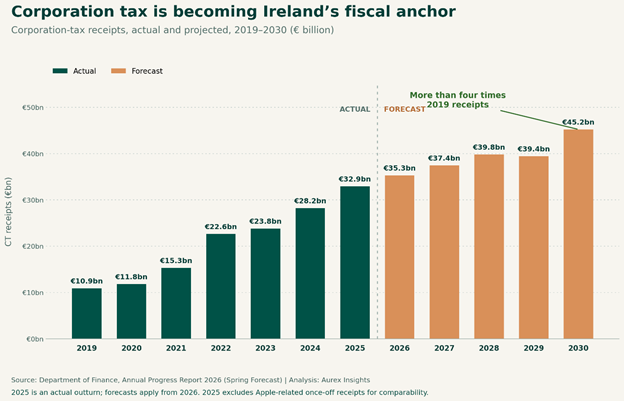
The point is not that the AI investment cycle will fail; it may generate enormous value. It is that a growing share of Ireland’s fiscal capacity is exposed to corporate profits, investment decisions and tax structures determined in global boardrooms rather than in Dublin. That is not an argument against FDI. It is an argument against treating its associated revenues as permanently secure.
The Fiscal Council estimates that, excluding excess corporation tax, the underlying fiscal position moves from a deficit of €11.3 billion in 2026 toward almost €21 billion by 2030. A headline surplus can coexist with a structurally fragile fiscal model.
That should change the question from “How much room do we have to spend?” to “How much permanent spending can Ireland safely carry if exceptional corporate-tax receipts disappoint?”
Alberta’s useful warning
Ireland is not Alberta. Alberta relied heavily on oil and gas royalties; Ireland relies heavily on multinational corporate profits. The assets, industries and institutions are different.
Alberta’s experience shows how easily a volatile windfall can become embedded in the normal business of government. Research covering 1970 to 2017 found that successive governments increased programme spending by roughly 63 cents for each additional dollar of non-renewable-resource revenue, while the adjustment in weaker years was far less symmetrical. Ireland’s exposure is different – corporate profits rather than oil and gas royalties – but the fiscal psychology is familiar: exceptional revenue begins to look like ordinary income.
The lesson for Ireland is not that collapse is inevitable. It is that windfalls weaken incentives to choose. They can delay reform, normalise higher baselines, and make saving look politically unnecessary precisely when it is most valuable.
Ireland is already approaching that boundary. Under the Government’s plan, only €1 of every €6 in corporation-tax receipts is set aside, while the remaining €5 supports ongoing commitments. Meanwhile, the Fiscal Council projects that the State will need to borrow to finance part of its planned contributions to its savings funds.
Borrowing for high-return infrastructure can be sensible. But borrowing while a windfall is being absorbed into recurring expenditure should invite harder scrutiny.
Build the indigenous economy
The answer is not to retreat from FDI. Ireland’s FDI strategy has delivered jobs, exports, capabilities and revenue on a scale few small economies could match.
But FDI must now be paired with a more serious strategy for indigenous scale.
Irish domestic firms are not a footnote to the economy. They are the broad employment base, the local investment base, the source of regional resilience, and the companies whose decisions are more likely to remain anchored in Ireland through a global downturn. Yet Revenue data show domestic non-multinational companies contributed 8% of net corporation-tax receipts in 2024, highlighting the narrowness of the current corporate-tax base.
The policy objective should not be to extract more tax from small firms. It should be to help more of them become medium-sized exporters, technology adopters and long-term employers. The strategic objective is broader than a larger SME sector: it is a tax base with more Irish-owned exporters, more high-productivity firms and fewer fiscal eggs in a small number of multinational baskets.
A credible indigenous-growth agenda would include:
- Scale-up capital: Expand patient equity, later-stage growth finance and management buyout funding for Irish firms with export potential.
- Procurement as capability policy: Make public procurement a more accessible route for Irish SMEs to build reference customers, without weakening value-for-money rules.
- Energy certainty: Accelerate grid connections, renewable generation, storage and industrial power solutions. Data centres consumed 22% of Irish electricity in 2024, while grid and generation constraints limit future investment.
- Innovation diffusion: Shift attention from subsidising research at the frontier alone to helping ordinary firms adopt AI, automation, digital systems and energy-efficient production.
- Export depth: Help firms move from local services to international revenues through trade finance, market intelligence and targeted commercial diplomacy.
- Housing and infrastructure: Treat these not as social-policy silos, but as competitiveness policy. Firms cannot scale where workers cannot live.
The goal is straightforward: turn Ireland from a location that hosts global capital into an economy that generates more capital, technology and export capacity of its own.
Spend for resilience
Ireland has an exceptional opportunity. It can use this period of abundance to build homes, grid capacity, transport links, water systems, skills, innovation and fiscal buffers.
Or it can allow the windfall to disappear into the recurring cost of a State that remains difficult to navigate, slow to build and weak at converting money into outcomes.
By 2030, Ireland will have a much larger State. The question is whether it will also have a stronger country.
A windfall should not make government spending easier.
It should make Ireland more resilient when the windfall is gone.
About the author
Dr Brian O’Donnell is Founder and Principal of Aurex Insights, an independent economic-policy and strategic-advisory practice working between Ireland and Canada. He specialises in enterprise policy, industrial strategy, fiscal analysis and legislative engagement.