Why Washington’s 50% tariffs on Canada turn treaty‑protected trade into political risk
By Dr Brian O’Donnell | Founder, Aurex Insights | 29 July 2026
Executive summary
- The United States has invoked Section 338 of the Tariff Act of 1930 to impose additional 50% tariffs on almost US$20 billion of Canadian goods, covering roughly 5–6% of Canada’s goods exports to the U.S.
- These measures apply even to CUSMA‑compliant products, signalling that legal compliance alone may no longer guarantee predictable market access in North America.
- The result is a new North American risk premium: a higher hurdle rate for investment, supply‑chain integration and expansion decisions that depend on stable cross‑border rules rather than discretionary political action.
1. Tariffs you can see, risk you can’t
A tariff is visible. It appears on an invoice, alters a price and reduces a margin.
Uncertainty is harder to see. But it can be more economically damaging.
That is the deeper significance of Washington’s decision to invoke Section 338 of the U.S. Tariff Act of 1930 to impose additional 50% duties on selected Canadian imports. The immediate measures are substantial, affecting close to US$20 billion in Canadian goods according to the U.S. administration, but their wider effect may be greater still: they tell businesses that compliance with a modern trade agreement may no longer be sufficient to ensure predictable access to the North American market.
CUSMA has not collapsed. It remains in force.
But for covered goods, CUSMA origin compliance does not provide an exemption from the new Section 338 duties. That is not merely a trade‑policy detail. It changes the calculation facing companies deciding where to invest, how to structure supply chains and whether a cross‑border business model remains worth expanding.
The tariff is the headline.
The more consequential story is the new risk premium now being attached to North American investment.
2. A new rulebook for an old relationship
For decades, Canada and the United States built one of the most deeply integrated economic relationships in the world. Factories, farms, energy systems, transport networks and supply chains developed around an assumption that was rarely stated because it was so widely shared: cross‑border commerce would be governed by stable rules.
That assumption did not mean there would be no disputes. Trade disputes are a normal feature of any large economic relationship. It meant firms could make long‑term decisions with reasonable confidence that compliance with agreed rules of origin would protect their market access.
That confidence has now been weakened.
Section 338 is a provision of the Tariff Act of 1930, enacted in the era associated with Smoot‑Hawley and the Great Depression. It permits the President to impose additional duties of up to 50% where another country is judged to discriminate against U.S. commerce, and its modern‑day use against Canada is striking not simply because of its age, but because it introduces a discretionary political instrument into a relationship normally governed by a modern regional trade agreement.
The point is not that CUSMA no longer matters. It plainly does.
The point is that businesses must now consider a more uncomfortable possibility: treaty‑compliant access can still be vulnerable to unilateral political action.
3. A targeted shock, not a national collapse
The new measures do not apply to all Canadian trade. Energy, potash, critical minerals and goods already subject to Section 232 measures are excluded, so the direct national macroeconomic impact is likely to be smaller than the headline 50% tariff rate suggests.
But the impact is highly concentrated. The White House estimates that the affected goods account for almost US$20 billion in imports, while Canadian calculations based on tariff classifications put the figure closer to CAD$31 billion in 2025 – roughly 6% of Canadian goods exports to the United States and 5% of total Canadian goods exports.
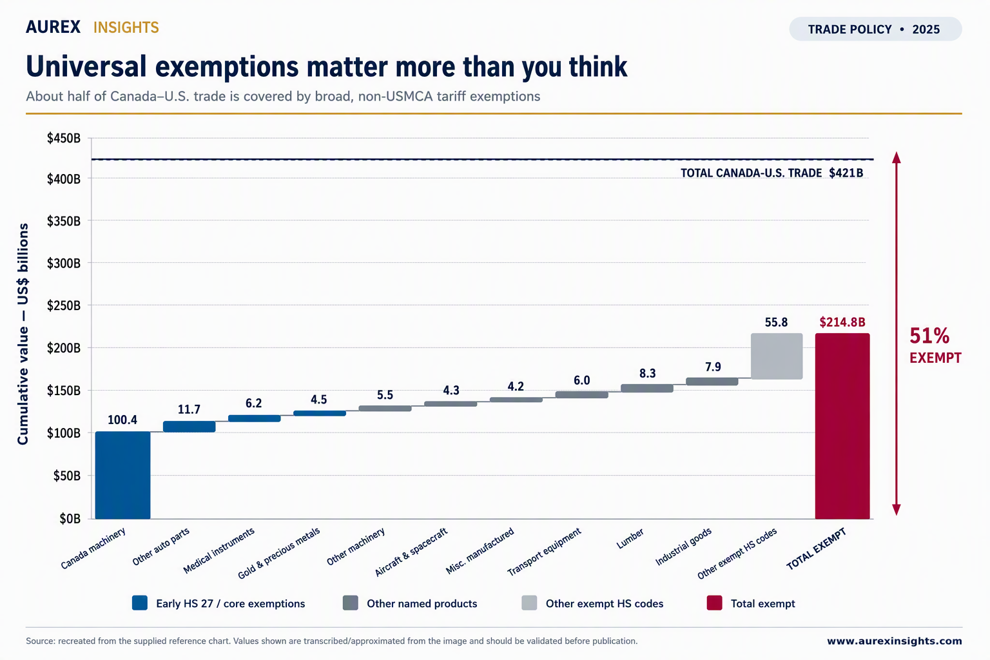
The chart above shows how product exemptions now shape real market access, starting from the headline 50% tariff exposure and deducting exempt categories such as energy, potash, critical minerals and Section 232‑covered goods.
The tariff schedules reveal why a headline rate is an inadequate guide to the commercial effect. Exclusions and product‑specific coverage lists can preserve access for some goods while making others uncompetitive overnight. For executives, the meaningful unit of analysis is not the country‑level tariff rate but the individual product line, its classification, its applicable exemptions and the availability of commercial alternatives.
The goods affected are wide‑ranging: alcoholic beverages, dairy products, cement, furniture, electronics, textiles, sporting goods, equipment and other manufactured products. The “motor vehicles” proclamation, despite its name, extends well beyond vehicles themselves.
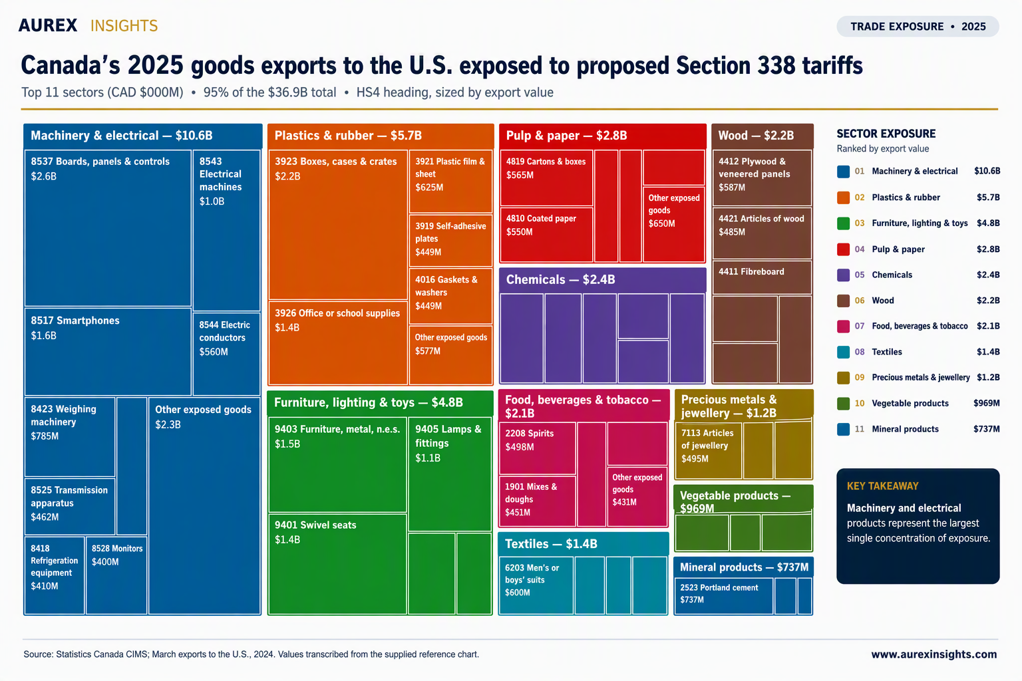
As the chart above illustrates, Section 338 exposure is broad but concentrated in specific tariff lines, with the largest exposure in machinery and electrical products, plastics and rubber, furniture and lighting, pulp and paper, chemicals, wood and food‑related goods.
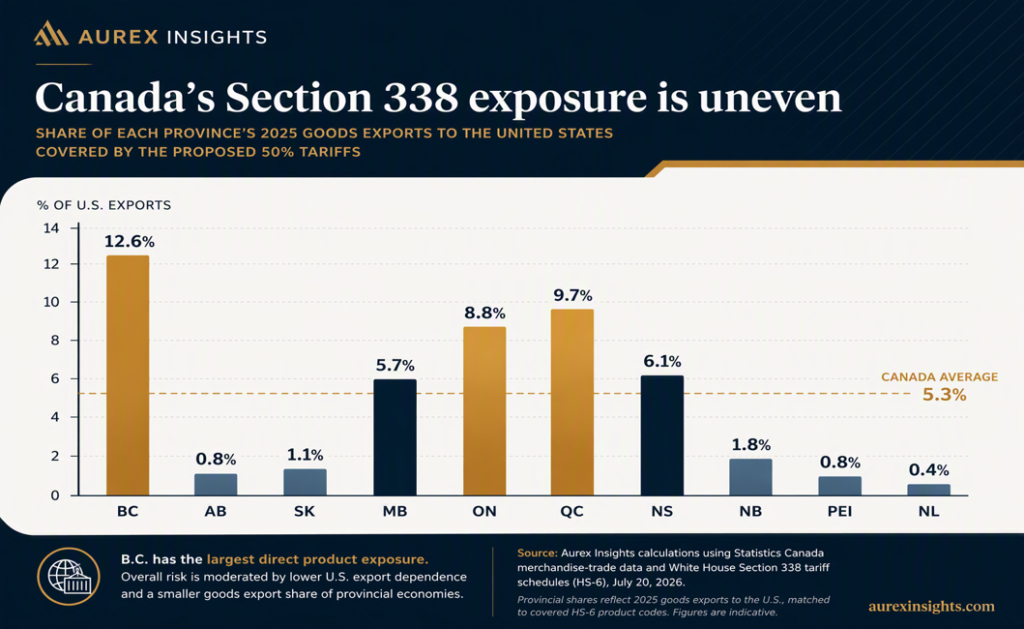
The regional exposure is therefore uneven. British Columbia, Ontario and Quebec face the greatest direct impact, while energy‑heavy Alberta is comparatively less exposed because its dominant export categories are largely outside the new measures. For Ottawa and provincial capitals, the relevant risk metric is the share of regional exports tied to vulnerable tariff lines, not the national average.
For affected businesses, the critical change is not simply the tariff rate. It is the removal of the practical CUSMA protection that had insulated qualifying goods from many broader U.S. tariff actions. A product can meet the agreement’s rules of origin and still face the full 50% duty.
That is why the significance exceeds the value of the goods immediately covered.
4. From tariffs to a North American risk premium
The direct economic effects of a tariff are familiar. Canadian exporters face lower volumes, weaker margins or pressure to absorb part of the cost; U.S. importers face higher landed prices; manufacturers using Canadian inputs must either accept tighter margins, increase prices or seek alternative suppliers; and consumers ultimately bear part of the burden.
But the greater economic cost sits beyond the tariff line. When firms cannot reliably forecast future market access, they change their behaviour. They defer capital expenditure because waiting has value, carry more inventory because supply interruptions are harder to price, duplicate suppliers because efficiency becomes less valuable than resilience and renegotiate contracts to cope with shifting political risk.
This is already visible in sentiment and investment data. The Bank of Canada’s Business Outlook Survey reports that trade tensions and softer demand have weighed on sales, with many firms prioritising maintenance over expansion despite a modest improvement in investment intentions. Export Development Canada’s Trade Confidence Index shows that exporters’ confidence rose to 69.7 by the end of 2025, four points higher than mid‑year, but still below its historical average, while many exporters look beyond the U.S. to Europe and the Asia‑Pacific for near‑term growth.
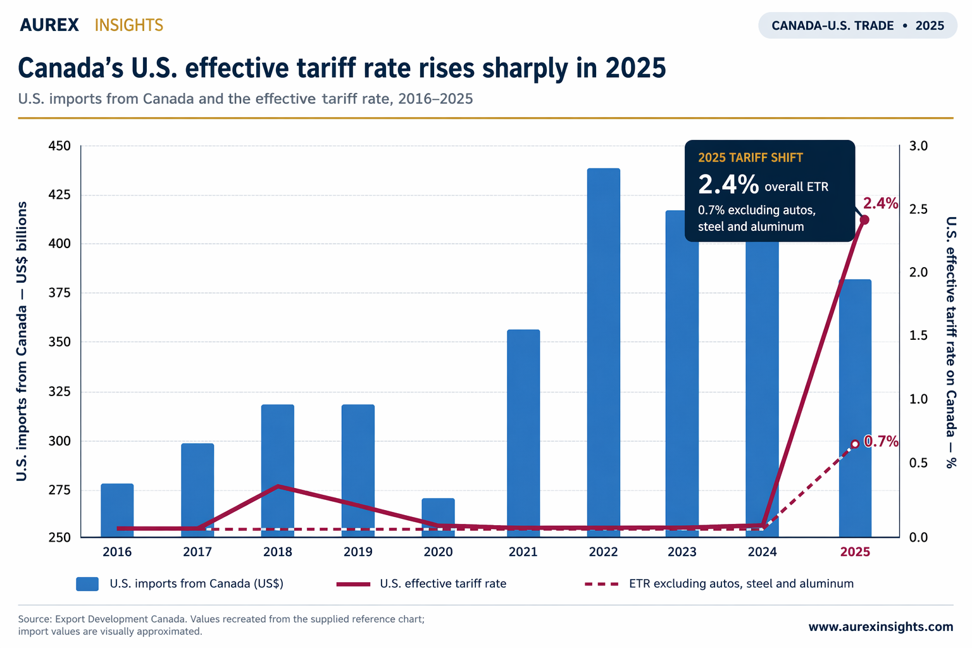
The line and bar chart above shows Canada’s U.S. effective tariff rate over time (2016–2025), plotting U.S. imports from Canada alongside the effective tariff rate, including and excluding autos, steel and aluminum.
Even before Section 338, the U.S. effective tariff rate on Canadian goods climbed from near zero to 2.4% in 2025 – 0.7% when autos, steel and aluminum are excluded – illustrating how a narrow set of lines can materially change the price of access to the U.S. market. Section 338 adds a new layer of discretionary political risk on top of this rising baseline.
In corporate‑finance terms, North American projects reliant on cross‑border trade now face a higher hurdle rate. The expected return must compensate not just for commercial risk, but for the possibility that treaty‑compliant market access can be altered with relatively short political notice. That is the new North American risk premium: a continent‑wide increase in the required return on investment connected to an integrated but politically exposed market.
5. The hidden deadweight loss
Economists use the term “deadweight loss” to describe economic activity that disappears because policy distorts otherwise productive choices. Tariffs can create deadweight losses by raising prices, reducing consumption and shifting production toward less efficient suppliers.
But the more important loss in this case may be the activity that never begins. A company deciding whether to expand production in Ontario for U.S. customers may now demand a higher expected return before committing capital, while a U.S. manufacturer reliant on Canadian inputs may decide to re‑source at higher cost rather than risk future tariff exposure. A Canadian exporter may postpone hiring, product development or expansion while it waits to see whether market access remains stable.
None of those decisions makes either country more productive. They represent resources redirected from innovation, investment and trade toward compliance, duplication, contingency planning and risk management. This is not a theoretical concern. North American prosperity has been built partly on the ability of firms to organise production across borders with relatively low friction, and when that predictability weakens, the economic cost compounds through thousands of smaller decisions.
The visible tariff is only part of the bill. The larger cost may be the investment forgone because the rules can no longer be valued with the same confidence.
6. Self‑defeating economics for both sides
The immediate commercial damage will fall most heavily on Canadian firms and workers exposed to the covered product lines. But the policy is not costless for the United States. Canadian goods do not arrive in American markets as abstract foreign imports; they are inputs into U.S. construction, manufacturing, retail, food systems and consumer spending. Higher costs imposed on Canadian suppliers can travel through U.S. supply chains and eventually reach American businesses and households.
Previous U.S. tariff episodes show a similar pattern: a relatively small group of Canadian products accounted for more than half of estimated duties paid by U.S. importers in 2025, led by passenger vehicles, unwrought aluminum, motor vehicle parts and certain steel and aluminum products.
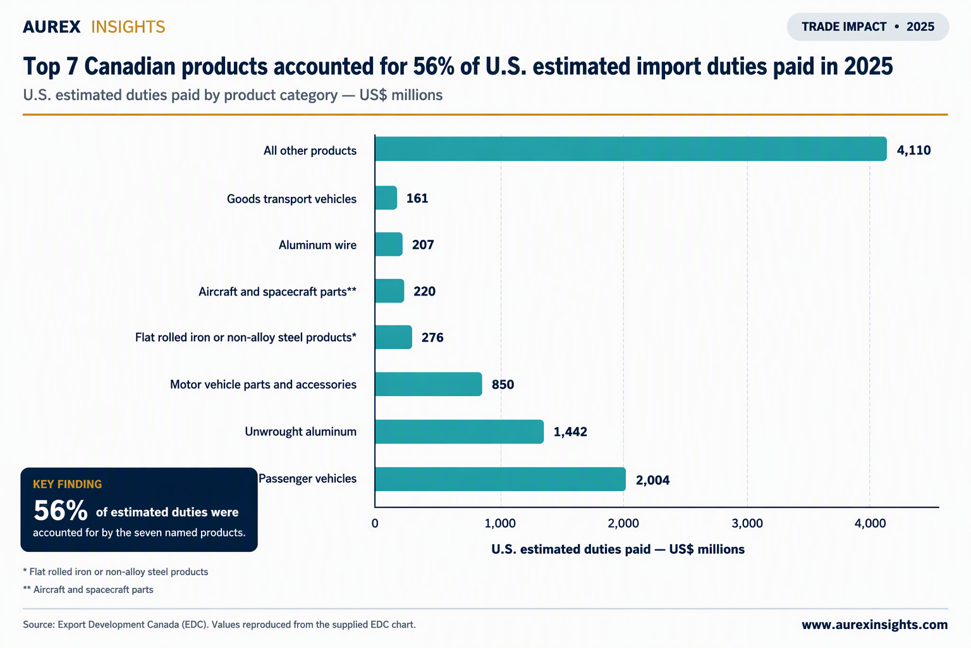
The figure above illustrates the top Canadian products that accounted for 56% of U.S. estimated import duties paid in 2025. This concentration matters because Canada and the United States are tightly connected through integrated supply chains. In industries such as automotive manufacturing, parts and components can cross the border multiple times before a finished vehicle is assembled, meaning tariffs can be applied at several stages of production. When duties are layered on top of complex supply chains, their impact is amplified across multiple firms, plants and communities.
A measure can therefore have a modest aggregate impact while inflicting serious damage on specific firms, industries, regions and supply chains. More importantly, its strategic effect extends beyond the trade value immediately covered: it signals that an integrated partner’s market access may be governed not only by negotiated treaty rules, but by shifting political discretion.
That makes North America less efficient, less investable and, ultimately, less competitive against other major economic blocs.
7. Canada’s strategic response: options, not isolation
Canada cannot – and should not – attempt to decouple from the United States. The relationship remains economically indispensable, and geography, infrastructure, energy systems and decades of business integration ensure that it will remain so.
But dependence on one market is not the same as resilience. This moment reinforces the case for Canada to invest in the practical foundations of greater economic choice: trade corridors, ports, rail, energy capacity, critical‑minerals processing, housing‑enabling infrastructure, skilled labour and commercial links with Europe, the Indo‑Pacific and other markets. Export data already show that growth in goods and services exports to non‑U.S. markets is helping to offset weakness in U.S.‑focused trade, with services such as travel, transportation and commercial services providing a partial cushion.
This is not an argument for isolation.
It is an argument for options. A country with diversified markets, reliable infrastructure and stronger domestic productive capacity is not immune to external pressure, but it has more room to respond when external rules become less reliable. That is the real test facing Ottawa.
Canada must become more strategically ambitious. It must also become more disciplined. Urgency does not make every project productive, and a trade shock does not turn every public expenditure into an investment. The country needs to build capacity – but with clear tests of additionality, return, delivery and long‑term value.
The Government’s proposed Canada Strong Fund, initially capitalised with $25 billion, could be part of that response. But its success will rest not on its title, but on whether it identifies genuine bottlenecks, mobilises private capital, maintains independence from political allocation and produces assets that outlast the public cheque.
8. The executive test: pricing the new premium
For Canadian business leaders, the immediate task is practical. The key question is no longer simply: What tariff applies to our product?
It is: What is the cost of relying on a market where legal compliance may no longer be sufficient to secure predictable access?
That requires firms to reassess:
- U.S. revenue concentration by product line and customer
- Exposure to tariff classifications and future unilateral trade actions
- Contractual ability to pass through costs
- Supplier concentration and realistic alternatives
- Inventory, logistics and working‑capital requirements
- Investment plans dependent on stable U.S. access
- The commercial viability of diversification beyond North America
The measures may still be withdrawn, amended or negotiated away before they take effect. But businesses do not wait for final legal certainty before changing behaviour. The announcement alone can delay investment, raise supply‑chain costs and encourage firms to place their next marginal dollar of capital in the United States rather than Canada.
That is the new North American risk premium: not merely a tariff on goods crossing the border, but a higher hurdle rate for the investment that might otherwise have crossed it.
Dr Brian O’Donnell is Founder and Principal of Aurex Insights, an independent economic-policy and strategic-advisory practice working between Ireland and Canada. He specialises in enterprise policy, industrial strategy, fiscal analysis and legislative engagement.