Published by Dr. Brian O’Donnell | Aurex Insights | 22 April 2026
Aaron Wildavsky, the leading scholar of public budgeting, put it simply: “If you cannot budget, you cannot govern.”
He was not making a point about spreadsheets. He meant that a budget is where a government’s real choices become visible – where competing priorities collide with limited money, and where someone has to decide what happens. Not what is promised. What happens.
That same logic applies to every organisation trying to influence the budget. If you cannot frame your ask in terms that work inside the system – fiscal, evidenced, politically grounded – you are not really competing. You are filing.
Inside the Department of Finance, every pre-Budget submission quietly ends up in one of three piles.
One pile shapes the options ministers bring to Cabinet.
One pile is noted and filed.
One pile is never really read at all.
Ahead of Budget 2025, more than 700 submissions arrived. Only 105 were even published. Most went into pile three.
Budget 2027 will be even more competitive. The question for any organisation that cares about the decisions made in Merrion Street is simple:
Which pile are you writing for?
1. The Fiscal Backdrop to Budget 2027: What Yesterday’s Numbers Actually Mean
Yesterday, Tuesday 21 April 2026, the Department of Finance published its Annual Progress Report – its most up-to-date set of economic and spending projections for Ireland out to 2030. This is not a routine release. It is the official scorecard for how public finances are tracking and what the Government is planning across the medium term. Here is what it says in plain language – and what it means for anyone making a Budget 2027 ask.
The Headline Looks Fine. The Detail Is More Complicated.
On the surface, Ireland still looks like one of Europe’s better-managed economies. The government is running a surplus – bringing in more money than it spends. Employment is growing and is forecast to approach 3 million by 2030. The economy continues to expand despite higher energy prices.
But yesterday’s report contains three signals that matter directly for anyone planning a Budget 2027 submission.
Signal 1: The Spending Plan Is Already Running Hot
Ireland now operates under new EU fiscal rules that came into effect last year. The core rule is straightforward: there is a limit on how fast the government can grow its spending. The idea is to prevent countries building up structural problems during good times that become crises when times get harder.
By that measure, Ireland is already pushing against the limit.
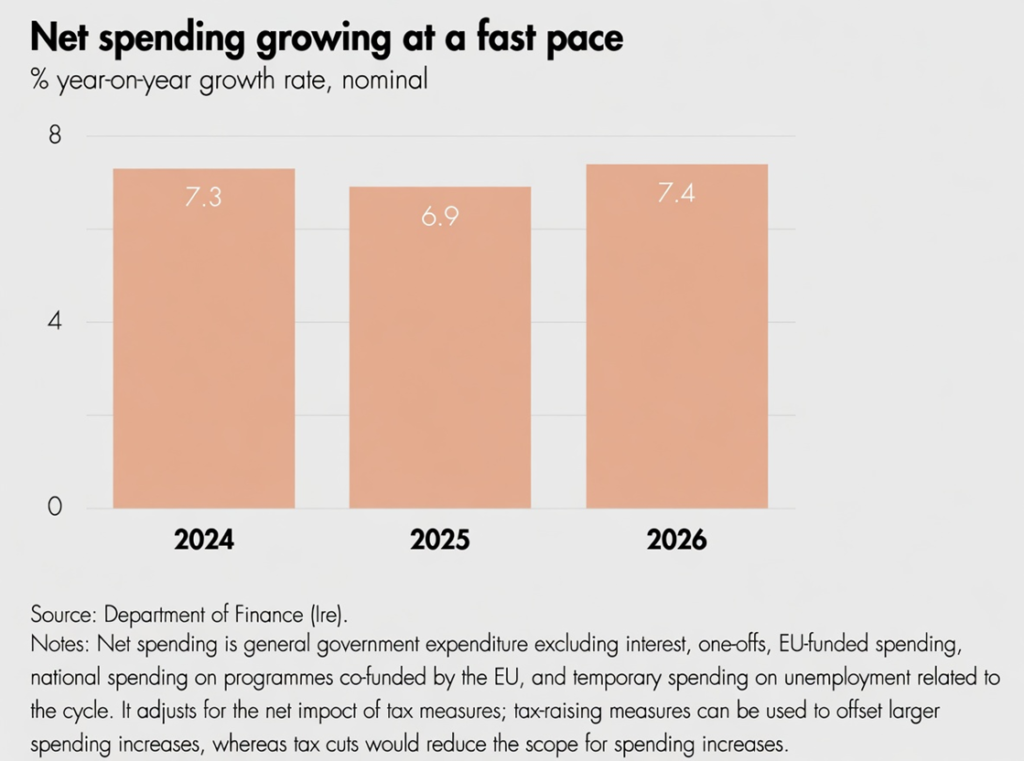
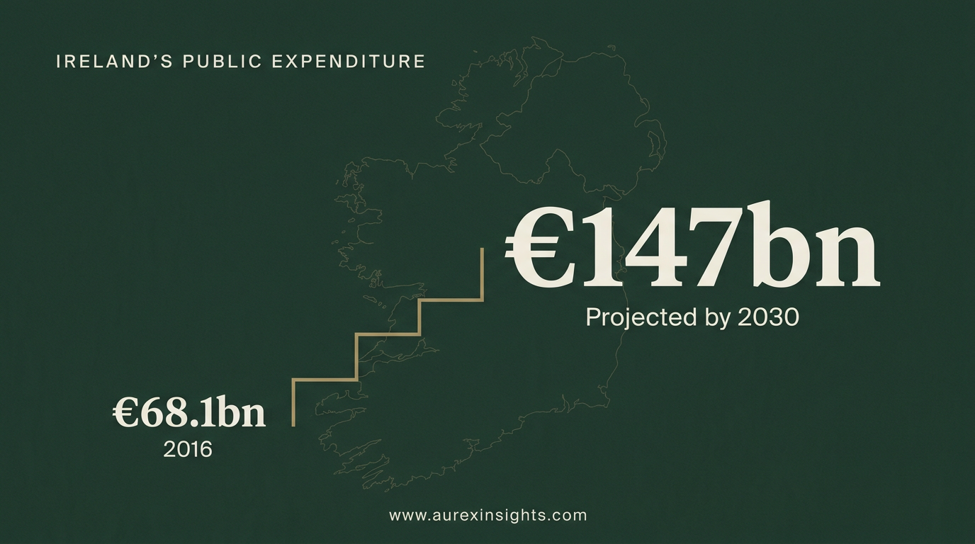
Net spending – roughly, what the government spends after stripping out interest payments, one-off items and EU co-funded programmes – grew by 7.3 per cent in 2024 and 6.9 per cent in 2025. The Government now plans to grow it by 7.4 per cent in 2026. That figure is higher than the 6.6 per cent projected as recently as January – meaning the plan has already loosened in the space of three months.
This year’s spending ceiling has already been revised up by €700 million, linked to likely overruns in the education sector and new supports introduced for transport, farming and fishing. While looking further ahead, the Government’s spending plans exceed the rate the economy can sustainably support across the full period to 2030.
For organisations making a Budget ask, this is the most important signal in the report. Every new commitment is being added to a spending plan that officials already know is running above the sustainable rate. The scrutiny on new asks – and the pressure to demonstrate value for money – will be intense.
Signal 2: Surpluses Are Getting Smaller, Deliberately
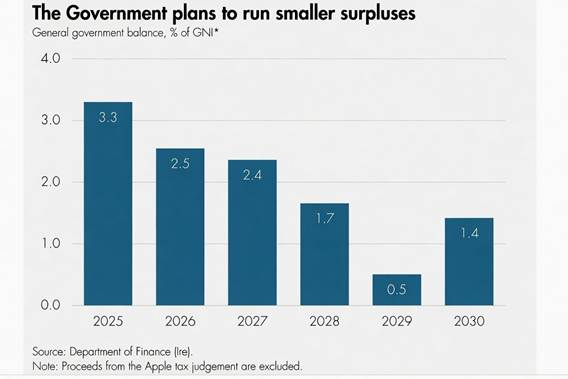
Despite record levels of corporation tax coming in, the Government is planning to run smaller and smaller surpluses each year. The chart above tells the story clearly: the headline surplus – the gap between what comes in and what goes out – is projected to fall from 3.3 per cent of national income in 2025 to just 0.5 per cent in 2029.
Think of it like a household that earns well but is gradually reducing how much it saves each month, even as their income grows. That feels manageable when times are good. It means there is very little buffer when something unexpected happens – an energy price spike, a global trade shock, a public health emergency. This year alone, the Government had to find an unplanned €750 million to respond to energy price pressures and social unrest. That kind of in-year demand does not disappear; it becomes more dangerous when reserves are thin.
Signal 3: The Corporation Tax Dependence Nobody Wants to Name
Ireland’s public finances rest heavily on a single, volatile income source: corporation tax paid largely by a small number of large multinationals. Yesterday’s report makes clear how dependent the Government’s plans remain on that income continuing at current levels.
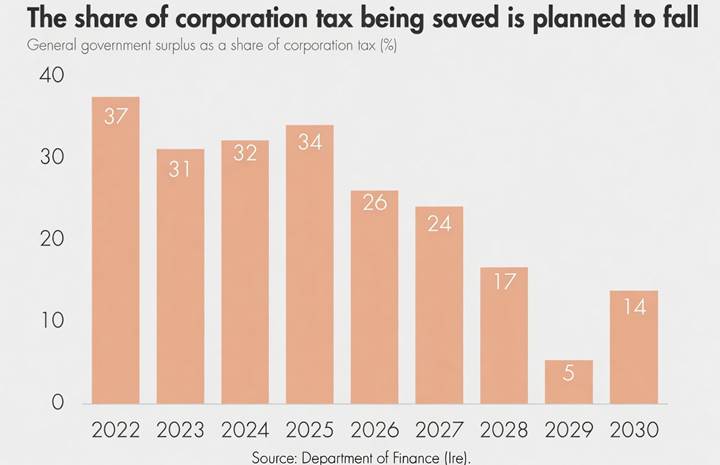
The Government plans to save just over €1 in every €6 it collects in corporation tax between now and 2030. The other €5 in every €6 goes straight into spending. As Joseph Schumpeter – Austrian economist, Harvard professor, and briefly Austria’s own Finance Minister – once observed: “the budget is the skeleton of the state stripped of all misleading ideologies.”
The headline surplus is the ideology. The corporation tax dependency is the skeleton.
The numbers make this concrete. The Department’s own Budgetary Projections 2025–2030 (see table below) forecast corporation tax revenues rising from €32.9 billion this year to €45.2 billion by 2030 – a 37 per cent increase over five years. For years, most commentators – the Irish Fiscal Advisory Council, the NTMA, and independent economists – have correctly identified CT concentration and volatility as the central structural risk in Ireland’s public finances. Three multinational companies now account for almost half of all CT receipts. Foreign-owned multinationals paid 88 per cent of net CT in 2024 while representing just 11 per cent of all companies filing. The volatility warnings are well-founded and well-evidenced.
| Year | CT Revenue (€m) | Year-on-Year Change |
| 2025 | 32,945 | — |
| 2026 | 35,290 | +€2,345 (+7.1%) |
| 2027 | 37,380 | +€2,090 (+5.9%) |
| 2028 | 39,830 | +€2,450 (+6.6%) |
| 2029 | 39,405 | −€425 (−1.1%) |
| 2030 | 45,200 | +€5,795 (+14.7%) |
Yet the Department’s own medium-term projections now embed continued strong CT growth as a planning assumption – year on year, through to 2030, with only a marginal and transient dip in 2029. The Government is not hedging against the risk it publicly acknowledges. It is budgeting around it. Every organisation preparing a Budget 2027 submission should understand what this means in practice: the spending plans are built on revenues that are real today and fragile tomorrow. An organisation that can situate its ask within that tension – acknowledging the dependency, quantifying the fiscal space it is competing within, and making the case for why its proposal is a durable investment rather than a cyclical spend – is speaking the language of officials who are themselves managing that same contradiction every day.
This matters because corporation tax receipts can fall sharply and quickly – if a major company restructures, if international tax rules shift again, or if global growth slows. A government that has locked in spending growth above the sustainable rate, while saving only a fraction of its windfall income, has limited room to respond.
There is also a structural paradox in yesterday’s figures worth flagging. The Government is investing in two long-term savings vehicles – the Future Ireland Fund and the Infrastructure, Climate and Nature Fund – designed to set money aside for future needs. But the surpluses it is running are not large enough to fund those contributions. So the Government is planning to borrow to invest in them. Government debt is set to increase by €30 billion between 2025 and 2030.
What this means for your Budget 2027 submission: the room for manoeuvre is real but narrowing. Officials and ministers are operating in an environment where the big picture is tightening even as the headlines look comfortable. Submissions that acknowledge this – that situate their ask within a realistic sense of what else is competing for the same envelope – will be taken far more seriously than those that treat Budget 2027 as open season.
2. The Three Piles on a Budget Desk
Understanding the fiscal backdrop matters because it shapes how officials and ministers are thinking when your submission arrives on their desk. With that context, here is the reality of how submissions get sorted.
- Pile One – Must Engage
These submissions shape the options that go to ministers. They do not always get everything they ask for, but they change the internal conversation. They are read, interrogated and referenced in briefings. - Pile Two – Worth Noting
These are read and sometimes referenced in internal notes or public commentary. They may add a data point to a minister’s speech. They rarely drive decisions. - Pile Three – File and Forget
These are technically received and logged. They may be acknowledged with a form letter. Practically, they go nowhere.
Most organisations – including well-resourced, credible ones – live in piles two and three. The work is earnest. The impact is marginal. And the reason is almost never the quality of the underlying ask. It is how the ask is made.
3. What Landing Submissions Do Differently
Submissions that consistently reach pile one do four things well. They require preparation, discipline and a willingness to think from the reader’s point of view.
a) They speak fiscal language, not just advocacy language
Officials and ministers are not indifferent to need. But the system is built to respond to cost-benefit analysis, fiscal impact and programme alignment – not simply to compelling stories of unmet need. Both matter; only one closes the deal.
A landing submission:
- States exactly what is being asked for in euro terms, over what period
- Identifies where it sits in the Estimates – the annual government spending plan – specifying whether it is current spending (ongoing running costs) or capital (one-off investment)
- Articulates trade-offs: what will not be done if this is funded, and why that is an acceptable exchange
- Shows how the ask aligns with existing government commitments – Housing for All, the Climate Action Plan, Sláintecare, national strategies – so officials do not have to do that work themselves
Advocacy language will get you empathy. Fiscal language is what gets you options.
b) They move early
The Budget 2027 pre-Budget window is nominally April to September. In practice, the shaping work happens well before the September deadline most organisations treat as the starting gun.
A well-framed 4–6 page submission sent in May or early June:
- Can still influence internal scoping work before departmental positions harden
- Has time to be discussed with officials informally
- Can be reinforced with targeted political engagement – with relevant TDs, Senators, committee members and advisers – over the summer recess
A 40-page document that arrives in late August or September often lands after the real choices have already been made. It may be acknowledged. It is unlikely to change anything.
c) They are evidenced and costed
Finance and line Departments are allergic to assertions. A submission that states “significant investment is needed” without defining what significant means or where the number comes from is easily set aside.
Landing submissions:
- Draw on published research, programme evaluations and international comparators
- Present simple, transparent costings with clearly stated assumptions – not black-box models, but reasoning that can survive a first reading by someone who scrutinises spending lines every day
- Where possible, quantify downstream impacts: avoided costs, improved outcomes, productivity gains. If your programme reduces hospital admissions, say by how many and what that saves
d) They are politically aligned and objection-proof
A submission that ignores the political context – or assumes that raising awareness is a sufficient objective – is not yet a submission. It is a position paper.
Landing submissions:
- Situate the ask inside the Government’s stated priorities, not alongside them
- Anticipate the objections – fiscal, operational, precedent – that officials and advisers will raise in the room where your document is discussed
- Provide a credible, proportionate answer to those objections before they are even asked
If you cannot write down, in a single sentence, the objection you most fear from the Department of Finance – and your answer to it – you are not ready to submit.
4. What Most Organisations Get Wrong
The same traps appear year after year:
- Treating the process as an annual obligation rather than a strategic opportunity
- Submitting late, on the assumption that the deadline is the decision point
- Sending a wish-list with no clear prioritisation, costings or sequencing
- Writing in pure advocacy language – rich in need, empty of fiscal framing
- Ignoring the political context, or assuming a compelling case will speak for itself
The difference shows up most clearly in how the same underlying ask is framed:
Without fiscal framing:
“We are calling on the Government to increase funding for [service] to address the critical unmet need across communities.”
With fiscal framing:
“An additional €X million in current funding for [service] in Budget 2027 would reduce unplanned acute presentations by an estimated Y per cent, generating net Exchequer savings of roughly €Z million over three years versus a ‘do nothing’ scenario – and would advance the Government’s commitments under [specific strategy] on A, B and C.”
Same underlying ask. Completely different impact when it lands on a desk in Merrion Street. The first version belongs in pile three. The second has a real chance of reaching pile one.
5. A Quick Self-Diagnostic
Before anyone opens a Word document, three questions are worth asking honestly:
Can you summarise your entire ask in two sentences and one number?
If not, you have a clarity problem – and that problem will be far more damaging inside a departmental briefing than it ever is in your own boardroom.
Do you know which line in your draft Finance will challenge first – and how you will answer?
If not, you haven’t yet done the internal argument. The official reading your submission will do it in minutes; it is worth doing it yourself first.
Can you explain, in concrete terms, what you would not prioritise if your proposal is funded?
If not, you are not yet thinking in the programme terms that officials use. Every euro asked for is implicitly a euro not available for something else. Acknowledging that – and having an answer – signals serious, credible engagement.
If the answer to any of these is “no,” that is where the work needs to start. Everything else – the analysis, the drafting, the engagement plan – flows from getting these three things right.
6. How Aurex Insights Can Help
The gap between a submission that sits in pile two and one that reaches pile one is almost never about the quality of the underlying ask. It is about fiscal framing, timing and how well the internal argument has been made before the document ever leaves your organisation.
That is the specific gap Aurex Insights is designed to close.
Aurex Insights works at the intersection of economic rigour and political reality. Led by Dr Brian O’Donnell – whose Doctorate in Business Administration focused on economic policy and whose advisory work spans civil society, business, and the public sector – Aurex Insights helps organisations across Ireland translate complex priorities into submissions that Finance, line Departments and the Oireachtas can act on.
Between now and September, Aurex Insights is collaborating with clients at three levels:
- Strategy Clinics
Focused 60–90-minute sessions to clarify your core ask, stress-test it against how Finance and key Departments are likely to view it and identify a targeted engagement plan. Ideal if you have internal capacity but want an external, politically literate eye before you invest scarce time and resource. - Economic Upgrades of Existing Drafts
For organisations with a draft that feels too advocacy-heavy or light on numbers. Aurex Insights works directly with your existing text to sharpen the economic analysis, build credible costings and scenarios, integrate relevant evidence, and strengthen objection-handling. The submission remains entirely yours in tone and branding – it simply does more of the work you need it to do. - Full Pre-Budget Submission Builds
For organisations that need deeper, end-to-end support: mapping strategic priorities, identifying the strongest and best-timed ask, designing, and executing economic and policy analysis, drafting a concise Finance-ready submission, and developing an engagement map across TDs, Senators, committees, and relevant advisers.
7. Next Steps
If you are responsible for your organisation’s Budget 2027 submission – whether you work in civil society, the voluntary sector, a trade or sector body, a large employer, or a public interest organisation – the real window is now, not September.
Aurex Insights is offering a limited number of free 30-minute discovery calls between now and the end of June to:
- Understand your context and constraints
- Identify where economic and political support could add the most value
- Determine whether a strategy clinic, an economic upgrade or a full build is the right fit
To arrange a call:
📧 Email brian@aurexinsights.com with “Budget 2027” in the subject line
📅 Or book directly at www.aurexinsights.com/book-a-consulting-call
Budget submissions do not have to be a ritual that disappears into the system. With the right economic rigour and political framing, they can become one of the most powerful advocacy tools your organisation has – not just for Budget 2027, but for the relationships and credibility that carry into every budget cycle that follows.
Wildavsky was right. If you cannot budget, you cannot govern. And if you cannot make your case in the language of the budget, you cannot influence it.
That is the work Aurex Insights does. Now is the time to put it to use.