
Published by Dr. Brian O’Donnell | Aurex Insights | April 2026
Ireland’s fuel protests are easy to caricature as sectional politics. The harder – and more important – task is to listen to what they are saying about Irish public spending, Ireland’s inflation problem, and Irish government economic policy. The blockades themselves were disruptive and wrong; essential supply chains cannot be held hostage. At the same time, many of the people who turned out – hauliers, farmers and contractors – were airing genuine grievances about costs that have become impossible to absorb. What matters for policy is the signal these protests send about how people are experiencing the state of the economy.
The blockades are not just about diesel. They are a symptom of a deeper imbalance: a country that spends like a wealthy state, has endured a once‑in‑a‑generation inflation shock, and yet still delivers housing, infrastructure and basic services that feel stubbornly second‑tier. Whether one agrees with the protesters or not is secondary – their grievances should be addressed through democratic channels, not blockades. The real issue is the economics the Government has chosen not to confront or has drifted into ignoring.
Ireland does not lack ambition. What it increasingly appears to lack is ownership: clear responsibility for delivery, for value for money, and for the real‑world consequences of Irish fiscal policy on households and firms.
Ireland’s inflation problem, measured by the CSO
This is not an impressionistic story. The Central Statistics Office (CSO) has put hard numbers on Ireland’s inflation since the pandemic. By 2025, the average cost of the typical basket of goods and services was about 24% higher than in 2019, meaning that a euro now buys barely three‑quarters of what it did before Covid. For many households the basic cost of living is now structurally higher, not just temporarily elevated.
That erosion of purchasing power matters twice over. First, it means that even where nominal wages have risen, pay packets often feel as if they are running just to stand still. Second, it means that every euro of government spending – on welfare, pensions, public pay or capital projects – delivers less real value than it did five years ago, unless budgets are explicitly adjusted for that 24% price shock.
Small businesses and farmers do not experience inflation as a neat index; they experience it as cash‑flow pressure. For hauliers, farmers and local service providers, the last five years have been an experiment in absorbing as much of that cost as possible – on fuel, inputs, insurance and credit – in order not to fully pass it on to customers who are also under strain.
The Central Bank expects headline inflation to trend back towards more normal rates, but it also stresses that renewed spikes in international energy prices would push Irish inflation higher again. Once the price level has ratcheted up by roughly a quarter, “normal” inflation does not restore lost ground – it simply slows the pace at which the squeeze worsens. In that environment, even relatively modest new fuel price shocks land on households, farms and small firms that have already used up much of their buffer.
Why Ireland’s fuel protests matter for public spending.
Ireland’s public spending surge: from restraint to expansion
If this were only a story of rising prices, anger might be easier to contain. But over the same period that the CSO shows prices rising by about 24% since 2019, total Exchequer spending has surged from roughly €77 billion in 2019 to over €133 billion in 2026 – an increase of more than 70% in cash terms. Ireland is not a low‑spend state drifting along; it is a high‑spend state whose citizens increasingly struggle to see where the extra money has gone.
If that spending were translating into visibly better services, public patience with higher costs might be stronger. Instead, Ireland has become a country where almost every major department and flagship project seems to arrive with a health warning about overruns. The Fiscal Council has documented repeated breaches of the National Spending Rule, with core net spending rising well above its 5% benchmark and plans now assuming further breaches out to 2026. In health, for example, overruns have become structural rather than exceptional, with hundreds of millions in excess spending becoming the norm year after year.
On the capital side the pattern is similar. The National Children’s Hospital, once billed as a symbol of modern, world‑class healthcare, has become a byword for spiralling costs – with the core budget now exceeding €2.2 billion and additional claims of more than €800 million still in dispute. Transport and housing projects routinely come back to Cabinet with revised costings that bear little resemblance to the original numbers. International assessments of Ireland’s public spending efficiency reach a similar conclusion: the overall level of spending has risen sharply, but there is significant room to improve how that money translates into infrastructure, health and education outcomes. For citizens stuck in traffic, waiting on lists or priced out of the housing market, these headlines don’t read like evidence of progress; they read like proof that money is being burned without changing daily life: International analysis of Ireland’s spending efficiency reaches a similar conclusion: high outlays with significant scope to improve how they translate into infrastructure, health and education outcomes (see, for example, the IMF’s benchmarking of Irish public‑spending efficiency https://www.imf.org/-/media/files/publications/selected-issues-papers/2025/english/sipea2025090.pdf).
The result is a political paradox. The State is spending far more, yet large parts of the electorate feel poorer and less well‑served. When another shock hits – like a spike in fuel prices – it lands on households whose real incomes have already been eroded and on firms whose margins have already been squeezed, while they watch a State that appears to “throw money at” problems without ever fixing the pipes. In that context, it is hardly surprising that support for the Government is fragile despite the biggest expansion in public spending in the State’s history.
A useful analogy is to think of the Irish State as a house with leaking plumbing. Every time a new leak appears, the response is to turn up the water pressure and buy more buckets, rather than replace the pipes. For a while, this looks like action: there is lots of activity, money is clearly being spent, and every room has a bucket in it. But the water level on the floor keeps rising. That is how many households, farmers and small businesses now experience Irish fiscal policy – not as a lack of money, but as a lack of design.
Spending surge at a glance, 2016–2026
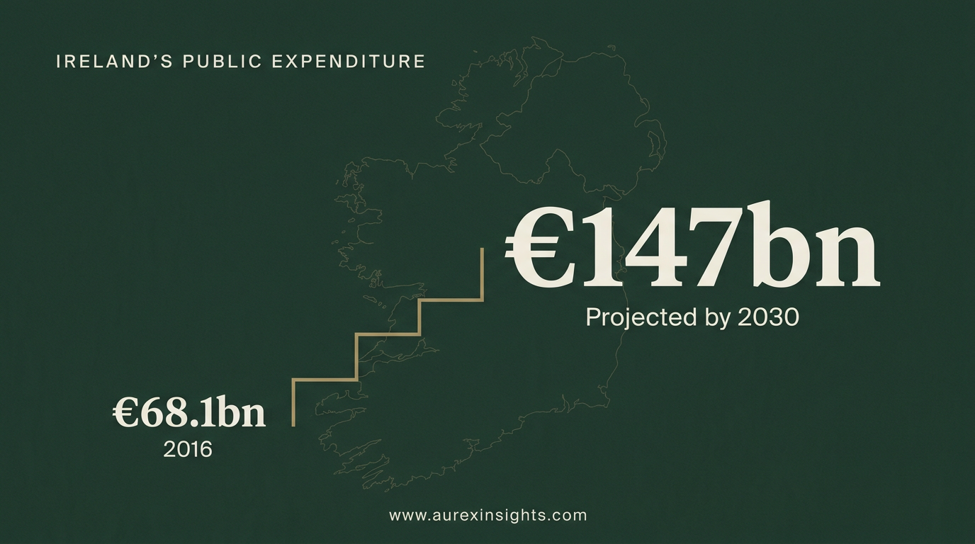
The simple story is that Ireland has added roughly €75 billion to its annual spending in a decade.
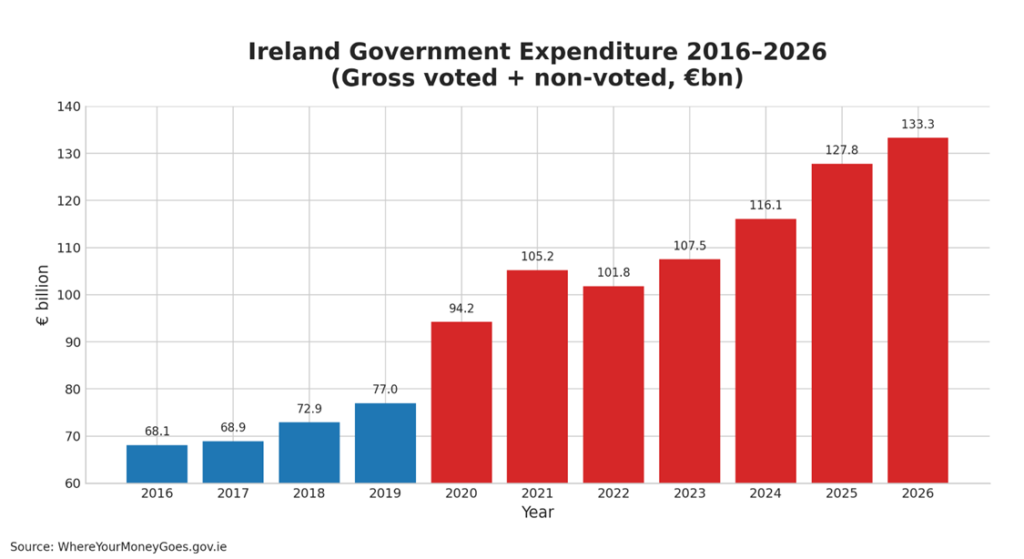
The key distinctions:
- Gross voted expenditure is the part of spending the Dáil explicitly approves each year through the Exchequer and departmental Votes. The 2026 Budget sets this at just over €132 billion.
- Non‑voted expenditure consists of items that never pass through those Votes – for example, some social‑insurance funds, interest payments and technical EU‑related flows.
- When you add gross voted and non‑voted spending together, you get the general‑government total – the number that matters for the economy and for investors. On current projections, that puts total State spending in the mid‑€140 billions in 2026, almost double the 2016 level.
In that sense, the simple story is that Ireland has added roughly €75 billion to its annual spending in a decade.
Budget 2026 alone contains €9.4 billion in new measures – €8.1 billion in additional spending and €1.3 billion in tax cuts – on top of existing baselines. Spending overruns of about €3.7 billion in 2025 have been rolled into the starting point for this year, so the system is running “hot” even before any new decisions are taken.
Why fiscal rules in Ireland were introduced
The fiscal rules in Ireland were introduced after the last crash precisely to stop this pattern of pro‑cyclical, election‑driven expansion.
The logic was straightforward: In good times, governments are tempted to treat windfall revenues as permanent and to create programmes that cannot be sustained when conditions turn. That behaviour amplified the pre‑2008 boom and left Ireland brutally exposed when the property and credit bubble burst. A medium‑term expenditure rule, linked to the sustainable growth rate of the domestic economy and overseen by an independent fiscal council, was meant to act as a governor on that temptation.
Yet barely a decade later, Irish government economic policy is drifting beyond those rules again. IFAC – the budgetary watchdog – worries that underlying general‑government expenditure is rising much faster than nominal growth and that plans for 2026 involve additional increases that are “not appropriate” given current conditions. Even with record corporation‑tax receipts, the underlying fiscal position – once those windfalls are stripped out – points to a sizeable deficit.
A dangerously concentrated tax base
Beneath the headline numbers sits a tax base that is far more fragile than it appears.
Analysis, drawing on Revenue data, shows that the top ten corporate companies (multinationals) now pay close to 60% of all corporation tax, up from about one‑third in 2008. The top three alone are estimated to have paid around 46% of receipts in 2024 – roughly €13 billion – with two US technology firms accounting for almost €11 billion, or about 40% of the total, on their own. Corporation‑tax revenues have almost doubled since 2021 largely because of increased payments from this handful of firms.
That is not a broad tax base; it is a highly leveraged bet on the profits, strategies and tax‑planning of a tiny group of multinationals. A global re‑pricing of tech stocks, a product mis‑step, a change in US tax law, or a decision to re‑book profits elsewhere could knock billions off Ireland’s receipts, even if the domestic economy is otherwise healthy.
The new 15% minimum effective tax rate for large companies may add several billion euro to receipts over the next few years, but it does not remove this underlying concentration risk. In effect, Ireland is loading more weight onto an already narrow beam.
The delivery gap in Irish public spending
All of this would be less troubling if it were visibly transforming the country. But on the metrics that matter most to people, progress feels grudging. Housing completions have improved (CSO 2025) https://www.cso.ie/en/releasesandpublications/ep/p-ndc/newdwellingcompletionsq42025/, yet rents and prices remain out of reach for many younger and middle‑income households; public transport and major infrastructure projects remain mired in long timelines and serial cost escalations; and hospital waiting lists, school capacity and local services have improved only marginally relative to the rise in population and demand. In short, Irish public spending has almost doubled since 2016, but Ireland’s lived experience of housing, transport, health and local services does not feel like a country that has doubled its spend. The issue is not simply “efficiency” in a narrow technocratic sense. It is ownership.
Projects overrun, budgets slip, strategies multiply – but it is rare to see a senior official or minister lose their job, their bonus or even their brief for persistent non‑delivery. In the private sector, performance has a price. In too many corners of the State, performance has a press release. Irish hospitals operate at close to 95% bed‑occupancy – among the highest rates in the developed world – with fewer than three hospital beds per 1,000 people, well below many EU peers. Hundreds of thousands of people remain on hospital and outpatient waiting lists, despite repeated action plans. More than three‑quarters of GP practices have, at some point, closed their lists to new patients as workload and demand outstrip capacity.
Educational attainment is rightly a strength, yet around 35,000 Irish citizens emigrated in the year to April 2025, many of them younger graduates who simply cannot build a sustainable life at home. And all of this is happening in a country whose population has grown rapidly over the past decade, so capacity has to rise just to stand still. The bar chart in this article measures what the State spends and builds; these pressures are a reminder that outcomes often succeed in spite of the system, not because of it.
Energy, carbon and the real economy
These choices are most visible in energy and carbon policy, where clean principles often collide with physics and cash‑flow. Hauliers, farmers and small manufacturers operate in a world where international fuel prices are volatile, carbon charges and compliance costs are rising, and domestic policy offers only sporadic, reactive relief. Carbon pricing can be an efficient tool, but only if it is embedded in a credible and sequenced transition plan. Other jurisdictions have recognised this. Canada’s federal system, for example, uses targeted exemptions and refunds for certain on‑farm fuels, acknowledging that you cannot decarbonise food production simply by taxing it and expecting emissions to fall on their own. The objective is to move emissions, not just money.
In Ireland, energy and carbon policy has been slower to reflect this nuance. That may appeal to those who prefer a purist climate narrative, but it creates serious stress in the productive base of the economy. Combined with the post‑Covid price shock, it is hardly surprising that farmers and hauliers feel squeezed from all sides.
Public opinion: anger without alignment
Recent polling underlines how far public sentiment has drifted from the Government’s reading of events. Ireland Thinks and other surveys suggest that a clear majority of voters expressed sympathy with the fuel protests, despite the disruption they caused – with support especially strong among opposition and independent voters. That does not mean people endorse every tactic or every spokesperson; it does mean they recognise a legitimate underlying grievance about costs, drift and a sense of not being heard.
It is important to say that most policymakers are not villains; many are conscientious, hard‑working people trying to do the right thing in an increasingly complex system. But the way we staff that system does not always help them. Individual ministers now employ sizeable teams of special advisers and communications staff, paid by the taxpayer, with the annual salary bill for political advisers estimated at around €5–6 million. Their primary job is most often to manage headlines and social‑media cycles. That may make sense from a party‑political perspective, yet it means scarce resources are used to sharpen soundbites rather than to deepen the technical capacity of departments – hiring specialist policy, project‑management and evaluation expertise in the areas ministers are actually responsible for. The result is a State that can explain itself more fluently than ever, but still struggles to design and deliver the outcomes people experience in health, housing, infrastructure and energy.
Ownership, not just competence
It has become fashionable to say Ireland suffers from a lack of competence. That underestimates the problem. The State has many capable people and has avoided the outright fiscal recklessness of the pre‑2008 period. The deeper weakness is a lack of ownership in Irish government economic policy: ownership of delivery – who is accountable when a project overruns by years or billions?; ownership of trade‑offs – who stands before voters and says, plainly, “We chose X over Y, and here is why”?; ownership of risk – who takes responsibility when a budget is built on revenues that can disappear as quickly as they appeared? Without ownership, competence dissipates into process. Targets are set, reports written, strategies launched. But when everything is everyone’s job, nothing is anyone’s fault.
It is not too late – but the window is not infinite
Ireland still has real strengths: a young, skilled population; strong, if concentrated, tax revenues; and deep institutional know‑how in law, finance, technology and trade. Those strengths can still be converted into a more resilient, less brittle model. Doing so means three shifts in Irish fiscal policy.
First, anchor spending again in reality.
Permanent spending should grow at a rate consistent with sustainable domestic growth, not at the pace of the latest windfall. Corporation‑tax windfalls must be treated as temporary and uncertain; using them to fund permanent current programmes is a bet that future governments may lose.
Ireland has begun to move in the right direction with new wealth‑fund structures, but the scale and discipline are still extremely modest by international standards. Norway is the clearest north star: it channelled temporary oil revenues into a sovereign wealth fund that is now worth over 21 trillion kroner (around 2 trillion dollars), equivalent to roughly 350 thousand dollars per citizen and financing close to one‑fifth of the national budget from its annual investment returns alone. In other words, a once‑off windfall has been turned into a permanent income stream and a very large financial asset for younger and future generations, without being eaten up by day‑to‑day politics.
Ireland needs the same mindset shift: build assets that will still be there in 20 – 30 years, instead of using every good year to ratchet up current spending. That requires thinking beyond the electoral cycle – and voters have a role here too. If the political system mostly rewards parties for promising new permanent giveaways from temporary revenue, prudence will always lose. Yet almost no party, on either side, is making the long‑term case in plain, factual terms: what is sustainable, what is not, and what we owe to the cohort who will live with today’s decisions long after this electoral cycle has passed.
Second, treat energy and carbon as industrial policy.
Climate targets are non‑negotiable in the long run, but the path to them is not. Strategic uses of energy in freight, agriculture and key manufacturing need tailored transition plans and supports, built into a coherent framework for Ireland’s energy policy. That framework should be explicit about costs, trade‑offs and timelines: which activities we want to keep in Ireland, which can realistically shrink or relocate, and what infrastructure and pricing signals are needed so that decarbonisation does not simply mean de‑industrialisation. At the moment, firms often experience climate policy as a series of ad‑hoc charges and compliance demands; they need a stable, bankable roadmap instead of a rolling sequence of surprises.
Third, hard‑wire ownership (accountability) into the system.
Accountability in Ireland formally exists but functionally leaks – and the public can now see the leaks. Major projects regularly blow through their original budgets and timelines without any clear sense that careers are on the line or that lessons are systematically learned. That must change.
Major projects should come with named accountable leaders, clear milestones, independent cost reviews and real consequences for failure – including at the top of departments and agencies, not just for contractors. Departments and agencies should report not only on money spent but on measurable outcomes achieved, with those reports benchmarked against peers and scrutinised publicly. Parliamentary oversight and audit institutions need the resources and political backing to challenge weak business cases before money is committed, not just produce angry reports afterwards. Public debate, in turn, must shift from fixating on new announcements to tracking delivery over time: what was promised, what was delivered, at what cost, and who is responsible for the gap.
Ireland’s fuel protests as early warning, not end point.
Viewed through this lens, the fuel protests are a warning light on the dashboard, not the engine failure itself. They highlight how inflation, spending drift and a lack of ownership are slowly eroding the contract between citizens, firms and the State.
Ireland remains, by any international benchmark, a rich and successful country. The risk is not an imminent crash; it is a slow squander – of fiscal space, of public trust, and of the opportunity to use this decade’s revenues to build a more resilient, lower‑carbon, better‑run economy.
Avoiding that outcome will require more than clever rhetoric and last‑minute concessions. It will require the one thing Ireland’s political and administrative system has too often treated as optional: clear, enforceable ownership of economic decisions and their consequences – by ministers, by departments, and ultimately by voters themselves.
About Aurex Insights
Aurex Insights is an independent economic and public‑policy consultancy practice founded by Dr Brian O’Donnell, DBA. We work with SMEs, NGOs, sectoral bodies and public institutions across Ireland, the EU and Canada.
If your organisation needs to understand what the 2026 global oil shock means for your budget, business model or policy choices, I offer a complimentary initial consultation to scope the options. You can book a consultation here:
https://aurexinsights.com/contact/#Booking-form
2 thoughts on “Why Ireland’s Fuel Protests Expose a Deeper Crisis in Public Spending”
Hi Brian, I must say I’m really enjoying you thought provoking articles. The Govt expenditure is off the scale at present. €36billion on healthcare, how did we get there?
We could have a massive wealth fund earning substantial dividends. Our government default is rather than deal with an issue it is to throw money at it and deal with it as remotely as possible. Regarding energy our biggest fail was dismantling the ESB in favour of energy invoicing companies. We would be energy independent if we had left them to it. Morgan
Thanks Morgan – really appreciate the thoughtful comment. You put your finger on the central issue: spending has grown faster than the State’s capacity to convert it into outcomes. Healthcare, energy security and long-term saving all require more than funding; they require clearer accountability, delivery capability and strategic direction.