Published by Dr. Brian O’Donnell | Aurex Insights
April 8th 2026
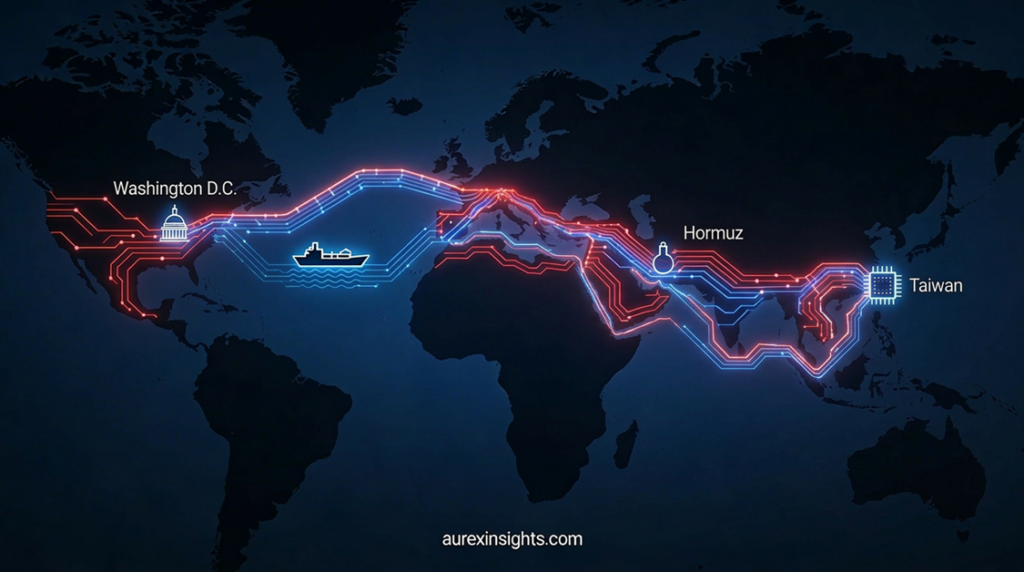
Economic warfare and fragile chokepoints are no longer a sideshow to conventional conflict; it is the main theatre where great‑power competition now plays out. Trade, sanctions, payment systems and supply chains have become weapons in their own right, turning key chokepoints like the Strait of Hormuz, Washington’s executive power, and Taiwan’s semiconductor fabs into the fragile arteries of the 21st‑century order. The last six weeks of war – and last night’s hurried, two‑week ceasefire between the US and Iran – have simply illuminated vulnerabilities that were engineered over decades of optimising for efficiency, scale and spectacle.
We spent the 21st century hard‑wiring three dangerous single points of failure into the system: energy flows through a handful of maritime straits, over‑centralised economic statecraft in a few capitals, and extreme concentration in advanced chips. The war with Iran, Russia’s sanctions resilience, and China’s parallel financial plumbing are not isolated shocks; they are live stress tests of an order that assumed markets would always stay open and apolitical.
1. Hormuz after the deadline: ceasefire as stress test, not solution
The Strait of Hormuz is now the clearest illustration of how badly we mispriced modern warfare and energy security. On one side sit US carrier groups such as the Gerald R. Ford: individual platforms in the low‑teens of billions of dollars, carrying jets priced in the tens of millions per aircraft. On the other are swarms of relatively cheap drones and fast boats that cost tens of thousands yet force those billion‑dollar assets to manoeuvre, defend, and fire interceptors that are themselves ruinously expensive. The cost‑exchange ratio favours the disruptor, not the hegemon. Al Jazeera explainer on the deal and its terms: US-Iran ceasefire deal: What are the terms, and what’s next? | US-Israel war on Iran News | Al Jazeera
Over the past six weeks, that asymmetry shut down one of the world’s main energy arteries. In normal times, Hormuz carries close to a fifth of global oil trade – around 20 million barrels per day of crude and products. During the worst of the fighting, flows collapsed as tankers diverted, waited at anchor or stayed in port under sky‑high war‑risk premiums. Gulf producers were forced to shut in millions of barrels per day; refiners in Europe and Asia scrambled to replace lost supply. Brent surged well above 100 dollars with violent intraday swings, reflecting both barrels taken offline and a structural risk premium for shipping through a corridor that suddenly felt permanently weaponised.
Last night’s ceasefire is best understood as a pressure valve, not a solution. In a deal brokered under intense time pressure, the US, Iran and Israel agreed to a two‑week pause in direct attacks and a commitment by Tehran to reopen the Strait of Hormuz to commercial shipping. The announcement landed less than two hours before President Trump’s self‑imposed bombing deadline on Iranian infrastructure. Markets exhaled on cue: oil prices fell back from their highs, equities and credit rallied, and volatility eased.
But the structure of the agreement underlines your “fragile arteries” thesis. The truce is short, conditional, and already leaky. Some rocket fire and drone launches have continued on the margins; shipping firms, insurers and traders are treating the reopening as a temporary, high‑risk reprieve rather than a return to normal. No one believes that a fourteen‑day ceasefire has removed the incentive – or the capability – for Iran and its proxies to use Hormuz as a lever again.
The deeper economic logic remains brutal. A war that was meant to weaken Iran’s leverage has, in practice, monetised its geography. Every day of elevated prices and disrupted flows has increased revenue for Tehran and other producers, while eroding real incomes and political capital in importing democracies. Even with the ceasefire, oil is now trading in a higher, more volatile band than before the war, and a persistent risk premium is being priced into every voyage through the Gulf.
2. Executive power as a strategic chokepoint
The second fragile artery is political rather than physical. Article II of the US Constitution was meant to define and constrain the presidency. Instead, over decades, Congress has surrendered large tranches of trade, sanctions and war‑making authority to the executive. Power that was designed to be dispersed is now funnelled through one office, filtered through a fractured governing party and a media environment optimised for outrage and speed.
The run‑up to this ceasefire is a case study. For days, the world watched as the US president escalated rhetoric on social media – threatening to “obliterate” Iran’s power plants, ports and bridges if Hormuz was not reopened by a fixed deadline. Each post moved markets, pushed up risk premia, and boxed negotiators into narrower corners. In the end, a late‑night, expletive‑laced ultimatum and back‑channel diplomacy produced a fourteen‑day pause that calmed traders but changed none of the structural incentives on either side.
The same state that once built long‑horizon architectures – the post‑war order, NATO, Bretton Woods -now responds to Ukraine, Iranian drones, the Red Sea and Taiwan with short bursts of coercion and symbolism. Instead of internalizing the lessons of the drone age and redesigning force structure, alliances and industrial capacity, Washington keeps reaching for the same toolkit: sanctions, carrier groups, emergency summits. The underlying asymmetry in cost and risk widens, while domestic appetite for sustained engagement shrinks.
The irony is stark. The US did more than any other power to design the post‑1945 operating system, yet it has spent the last two decades eroding its own guardrails – normalizing regime‑change rhetoric, expanding financial sanctions, and relying on ad‑hoc coalitions. Those same tools are now being studied, copied and repurposed by adversaries who understand that the West’s economic statecraft can be blunted or bypassed.
3. Taiwan and the semiconductor single point of failure
The most dangerous pressure point lies thousands of miles away, on a seismically active, politically contested island. By design and neglect, we allowed the world’s most advanced semiconductor manufacturing to concentrate in Taiwan and congratulated ourselves on “capital efficiency.” One firm now dominates leading‑edge chip production for AI data centres, smartphones, industrial control systems and modern weapons platforms.
The rough magnitudes are sobering. Depending on how you count, Taiwan accounts for the overwhelming majority of the world’s most advanced chips, and a very large share of total foundry output. Credible analyses suggest that a serious conflict or sustained disruption around Taiwan could wipe out something like a tenth of global GDP – trillions of dollars – through production stoppages, trade paralysis, financial contagion and a permanent repricing of geopolitical risk.
Crucially, Beijing does not need a Normandy‑style invasion to trigger such damage. The same cheap, high‑impact toolkit we have seen in Ukraine and the Gulf is available in the Taiwan Strait: missile “exercises” over shipping lanes, grey‑zone naval harassment, targeted cyberattacks that pause fabrication for 48–72 hours, or a partial blockade that forces insurers and shippers to reprice risk overnight. In a world already on edge after Hormuz, even a limited Taiwan scare would echo through markets and boardrooms.
From an economic perspective, this is what happens when markets optimise ruthlessly for efficiency and scale while systematically underpricing the option value of redundancy and resilience. Profitability, valuation and cost curves all looked superb – until we recognised that the very concentration that made them so attractive also made them systemically dangerous.
4. Economic warfare 2.0: trade, payments and data as weapons
What we describe as “chokepoints” in geography has clear analogues in finance, data and trade. Economic warfare has evolved from a supporting element of military strategy into a primary domain of conflict.
Trade has been weaponized. Export controls on advanced chips, restrictions on critical minerals, targeted tariffs and secondary sanctions are now front‑line instruments of power. The sanctions regime against Russia was meant to cripple its economy; instead, it produced a messy, partial decoupling, new trade routes via China, India and the Gulf, and a laboratory in which adversaries learned to live with – or work around – Western economic pressure.
The old free‑market settlement is eroding. Since Bretton Woods, Western economies assumed that open trade, a single dominant reserve currency and liberal capital flows would underpin both prosperity and security. That settlement is now contested. Adversaries have exploited globalization while building alternative systems – from Belt and Road logistics to digital currency frameworks and non‑Western payment networks. A growing share of Chinese cross‑border transactions now clears outside traditional Western rails, reducing exposure to dollar‑based sanctions and SWIFT. The US dollar and the renminbi are quietly becoming anchors for competing economic security architectures rather than purely neutral units of account. Goldman Sachs interview with Edward Fishman on economic chokepoints Global Institute Dialogues: Edward Fishman on Economic Chokepoints | Goldman Sachs
Supply chains themselves have become instruments of power. The F‑35 fighter programme famously relies on hundreds of thousands of components from thousands of suppliers across multiple jurisdictions. When a single jet depends on that degree of dispersed, politically exposed production, the line between economic competition and military advantage disappears. The same logic applies to advanced semiconductors in Taiwan, rare‑earth processing in China, or refined fuels routed through a handful of straits: supply chains are not neutral plumbing; they are levers of coercion and vectors of vulnerability.
In a digitalised, increasingly cashless world, data and payments form the circulatory system of this new battlefield. Control over transaction data, messaging networks and cross‑border clearing is now as strategically significant as control over sea lanes. Banks, shipping firms, trading houses, cloud providers and payment platforms have become front‑line actors in national security whether they wanted the role or not.
5. Canada and Ireland: supplier vs price‑taker in a weaponised energy world
Canada and Ireland illustrate how these dynamics land in very different ways across advanced democracies.
For Canada, the Iran war and the broader energy shock look like a stagflationary external shock with an upside. Higher global oil and gas prices and a structural risk premium around Middle East supply turn Canadian hydrocarbons and critical minerals into strategic assets. Canada is increasingly framed as a reliable, “values‑driven” exporter for allies seeking to diversify away from volatile chokepoints. Yet real constraints bite: limited pipeline capacity to tidewater, slow‑moving LNG export projects, and grid/infrastructure bottlenecks cap how much disrupted Gulf supply Canada can replace quickly.
On the macro side, higher energy and shipping costs risk re‑accelerating inflation and complicating the Bank of Canada’s disinflation path, at exactly the moment when households are already carrying elevated debt loads and facing mortgage resets. The result is a familiar trade‑off: lean into the opportunity to supply more and strengthen energy security for allies, while managing domestic tensions over prices, climate policy and Indigenous rights.
Ireland sits near the opposite end of the spectrum: a small, open, energy‑importing EU economy where shocks arrive mainly through prices, markets and confidence. On paper, as an IEA and EU member, Ireland maintains at least 90 days of oil stocks through its National Oil Reserves Agency and has contributed part of those barrels to the latest coordinated strategic release. In practice, the war‑driven price surge has been immediate.
Diesel and petrol prices spiked toward €2.30 per litre in late March, forcing the government to cut excise duty, suspend the NORA levy and enhance rebate schemes for hauliers and “green diesel” users. Road hauliers and farmers warn that high diesel costs threaten viability and feed through into food and logistics prices, prompting protests and calls for further relief. Officials insist that physical supply remains robust and that emergency stocks are intact, but the lived experience for households and firms is one of squeezed margins and heightened uncertainty. Legal obligations may be met; political and social resilience is another matter.
In both Canada and Ireland, the pattern is the same. Systems that look resilient in policy documents – strategic reserves, diversified suppliers, stress‑tested banks – feel very different when chokepoints are weaponised and prices move faster than policy.
6. Lessons from 1973 – and why this war remains a strategic folly
We have seen parts of this movie before. In 1973, the removal of roughly 4–5 million barrels per day -about 7% of global supply – through the Arab oil embargo was enough to quadruple prices, trigger recessions, and reshape the global economy. Then, as now, a relatively small physical disruption exposed enormous underlying fragilities in how advanced economies consumed, financed and politically managed energy.
Today’s shock is different in three important ways.
- The disruption has been larger in absolute volume and sits atop a far more leveraged and globally integrated financial system.
- The key arteries are more tightly clustered – Hormuz for oil, Taiwan for chips, a handful of financial and data rails for payments and information.
- Economic warfare is now explicit, not implicit: sanctions, export controls and payment‑system access are openly discussed as tools of coercion and deterrence.
Last night’s ceasefire does not change that basic calculus. It simply freezes an inherently unstable situation for fourteen days while all sides test how far they can push their demands under market‑friendly cover. The war with Iran may weaken a brutal regime at the margins, but judged against its stated Western objectives – stability, deterrence, affordable energy – it remains fundamentally self‑defeating. Each drone strike, tanker incident and social‑media ultimatum has tightened the noose around global growth, undermined political capital in democracies, and accelerated efforts by adversaries to build sanction‑proof alternatives.
This does not excuse Tehran’s behaviour; it highlights the strategic incoherence of responding to a geographically advantaged, economically asymmetric adversary with tools that amplify our own vulnerabilities. Economic security cannot be restored by doubling down on the very chokepoints and dependencies that made the system brittle in the first place.
7. Redesigning the operating system
If economic warfare is now a central domain of conflict, institutions and strategies must be redesigned accordingly. That entails at least four shifts.
- Treat economics as a core security domain. Defence and foreign‑policy thinking must integrate trade, finance, data and supply‑chain resilience as explicitly as they integrate air, land, sea, cyber and space. That includes revisiting alliance frameworks – such as NATO’s often‑ignored Article 2 on economic collaboration – as pillars of collective defence rather than footnotes.
- Invest in redundancy, not just efficiency. Resilience requires spare capacity, diversified routes and distributed decision‑making. That means alternative export paths that reduce dependence on any single strait, diversified semiconductor manufacturing beyond one island, and strategic reserves that are politically as well as legally credible.
- Build Economic Statecraft 2.0. Traditional tools – sanctions, tariffs, export controls – are necessary but insufficient. The next generation of economic statecraft will rely more on guarantees, shared financing vehicles and multilateral instruments that crowd private capital into defence‑relevant infrastructure: pipelines and LNG terminals, critical‑minerals projects, dual‑use technologies, resilient grid and data infrastructure. A dedicated multilateral “defence, security and resilience” finance platform would recognise that capital allocation is now part of deterrence.
- Re‑balance executive power with institutional guardrails. Democracies need to relearn how to constrain and support their executives in decisions on sanctions, war and economic coercion. That means stronger parliamentary oversight, clearer legal frameworks for emergency economic measures, and more transparent coordination with allies and private‑sector actors who carry front‑line risk.
The thread that runs from Hormuz to Ottawa to Dublin to Taipei is simple: we optimised for efficiency and treated redundancy as waste. The next operating system will have to invert that logic, treating spare capacity, diversified routes and distributed authority as strategic assets rather than inconvenient costs. The ceasefire buys the world fourteen days. What we do with that time will tell us whether we are serious about redesigning the system – or simply waiting for the next shock.
About Aurex Insights
Aurex Insights is an independent economic and public‑policy consultancy founded by Dr Brian O’Donnell, DBA, working with SMEs, NGOs, sectoral bodies and public institutions across Ireland, the EU and Canada.
If your organisation needs to understand what this global oil shock 2026 means for your budget, business model or policy choices, I offer a free initial consultation to scope the options. You can book a free consultation here: https://aurexinsights.com/contact/#Booking-form