What the 2008 Rescue Still Teaches Us About Money, Credit and the Risks Behind Headline Prosperity
By Dr Brian O’Donnell | Founder, Aurex Insights | 20 July 2026 | 12-minute read
On the night of 29 September 2008, the Irish State guaranteed the liabilities of six domestic financial institutions. It was an extraordinary act: the State placed its own credibility behind a banking system that had become dangerously exposed to a property boom already turning to collapse.
The decision was made under immense pressure. A disorderly banking failure would have endangered deposits, payments, wages and the day-to-day functioning of the economy. But the guarantee also exposed a truth that Ireland has never fully absorbed.
I was a new Senator at the time. I remember the week clearly: an all-night sitting, emergency legislation and the sense that delay itself might make the panic worse. The information presented to legislators was stark. Without decisive action, we were told, confidence could evaporate, deposits could be imperilled and cash machines could run dry. In that atmosphere, the guarantee was presented not as one difficult option among several, but as the necessary act to keep the banking system functioning.
Looking back, it is important to be fair about the conditions of that night. The fear of disorderly failure was real, and the potential consequences for depositors, payments and ordinary businesses were grave. But later official inquiries made clear that the State’s assessment of the banks’ position was profoundly incomplete. Ireland was not dealing only with a temporary liquidity panic at otherwise sound institutions. It was confronting a banking system with much deeper solvency problems, heavily exposed to a collapsing property market and dependent on fragile wholesale funding.
The State did not merely rescue banks. It converted a private-credit crisis into a public risk.
Ireland paid twice: first through a credit boom that directed too much finance towards land, development and existing property; then through the fiscal and social costs of stabilising the banking system after that boom failed.
That is the double bill.
Nearly eighteen years later, Ireland is not facing a replay of 2008. Banks hold more capital, household balance sheets are healthier, and the State’s headline fiscal position is far stronger than it was before the crash. But the underlying lesson remains current: headline strength is not the same as resilience.
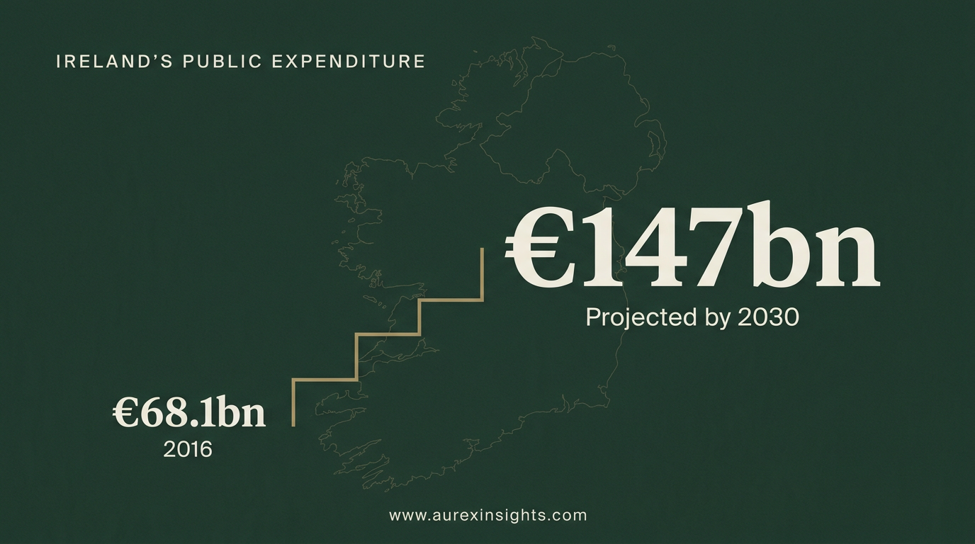
In 2008, the vulnerability sat mainly in bank balance sheets and property-backed credit. In 2026, the more immediate vulnerability lies in the public finances: a State increasingly dependent on exceptionally concentrated corporation-tax receipts while building large and durable spending commitments.
The next Irish crisis, if one comes, may start somewhere else.
The Aurex Insight
Ireland’s banking crisis began with excessive private credit, overwhelmingly concentrated in property, and became a sovereign crisis when the State absorbed banking losses.
Ireland’s immediate risk is different. The banks are more resilient, but public finances are increasingly exposed to highly concentrated corporation-tax receipts and spending plans that may outlast exceptional revenue.
The policy test is simple: would today’s permanent commitments still be affordable if exceptional corporation-tax receipts fell sharply for several years?
Money Is Mostly Bank Money
Most money that households and businesses use every day exists as deposits in commercial-bank accounts. Commercial banks create these deposits when they extend credit.
When a bank approves a mortgage or business loan, it normally creates a deposit in the borrower’s account at the same time as it records a matching loan asset on its balance sheet. In this operational sense, loans create deposits; banks do not merely lend out a fixed pool of prior household savings.
That is not a fringe proposition. It is the standard description given by the Bank of England and recognised in modern central-bank analysis.
But it must not be overstated. Banks cannot create money freely or without consequence. Their lending is constrained by borrower creditworthiness, profitability, capital requirements, liquidity and settlement needs, collateral, regulation, funding conditions, macroprudential rules and monetary policy.
Cash and bank reserves are different: they are central-bank money. Bank reserves are used mainly by banks to settle payments with each other. Deposits are commercial-bank money, supported by a wider institutional system that includes regulation, central-bank liquidity, deposit protection and the fiscal capacity of the State.
That system works because the public expects a euro in a bank account to remain a euro. In a crisis, preserving that confidence becomes a matter of public policy.
The Irish Credit Mistake
Ireland’s crisis was not caused principally by ordinary public expenditure. It began as an extreme private-credit and banking crisis, rooted in an overgrown banking system, a property-centred lending model, weak prudential oversight and reliance on unstable wholesale and international funding.
As property values fell and international funding markets froze, Irish banks faced pressure on both sides of their balance sheets. Their assets were deteriorating just as their ability to refinance themselves disappeared.
The subsequent Banking Inquiry concluded that the Central Bank and Financial Regulator had not intervened decisively enough to protect the State.
Yet it would also be wrong to portray fiscal policy as irrelevant. Ireland’s public revenues had become heavily exposed to property-related activity during the boom, and public expenditure had grown rapidly. When the boom broke, revenues fell sharply just as banking support and recession increased the demands on the State.
The more accurate account is therefore uncomfortable but clear. Ireland suffered a private-credit crisis that became a sovereign crisis because the State guaranteed the banks, absorbed losses, lost cyclical revenues and entered a severe recession.
The Double Bill
The guarantee was not costless reassurance. It made the Irish sovereign inseparable from the banks’ solvency.
Gross State support for the banking system reached roughly €64 billion, although that figure is not the final net cost to the Exchequer. It excludes the complexity of recoveries, guarantee fees, dividends, bank-share disposals, financing costs and the evolving value of remaining State holdings.
The Comptroller and Auditor General estimated the net cost of measures to stabilise the banking system at €45.7 billion at the end of 2021, using the information and valuation assumptions available then.
The public cost was therefore not confined to a single balance-sheet number.
It included lost employment, business closures, emigration, reduced household incomes, distressed mortgages, delayed investment and years of fiscal retrenchment. The fiscal rescue was the visible bill; the economic damage of the boom and collapse was the first bill.
This is why the question of money creation matters. If banks create much of the economy’s purchasing power through lending, then the social consequences depend on where they direct that credit.
Credit that funds new housing supply, enterprise, innovation, energy security and productive investment can expand real capacity. Credit that mainly bids up existing land and assets can make balance sheets look stronger while leaving the economy more exposed to a reversal.
Credit Is Not Neutral
An economy does not become healthier simply because banks are lending more. It becomes healthier when finance supports productive capacity.
Imagine a town with a factory, a builder and a bank. Lending to the factory may fund machinery, training and new output. Lending to housebuilding may be equally valuable when it increases supply. But lending predominantly against existing property can inflate asset prices without generating equivalent increases in productive capacity.
This is not an argument against mortgages, builders or housing ownership. Ireland needs considerably more housing supply and finance is essential to delivering it.
It is an argument for recognising a distinction that public debate often misses: lending against an existing asset is not necessarily the same as financing a new productive asset.
That distinction is especially important for small and medium-sized firms. In the first quarter of 2026, outstanding Irish bank lending to SMEs was €14.6 billion, down 2.1 percent year on year, although new lending rose and net lending turned slightly positive after a prolonged decline.
This does not establish that Ireland faces an SME credit crisis. It does establish that the availability, price and structure of enterprise finance deserve more attention than they often receive.
Irish firms need a wider financing ecosystem: competitive bank lending, properly designed credit guarantees, growth equity, long-term patient capital, co-lending arrangements and public development-finance capacity. Press conferences asking banks to “do more” will not substitute for policies that alter the underlying risk and return calculation.
The Risk Has Moved
The central lesson of 2008 is not that Ireland should expect another banking collapse. It is that public debate should identify risks before they become visible in headline fiscal numbers.
Ireland’s current fiscal position looks strong at first glance. But the Irish Fiscal Advisory Council’s June 2026 assessment warns that this strength masks an increasingly vulnerable underlying position.
Excluding excess corporation-tax receipts, the Council forecasts an underlying deficit of €11 billion in 2026 -equivalent to 3 percent of modified gross national income, or .
It also warns that only around €1 of every €6 of corporation-tax receipts is being set aside under the Government’s plan, with the other €5 supporting spending commitments.
That does not mean public expenditure should be cut indiscriminately. Ireland faces genuine demands for investment in housing, water, energy, transport, health capacity, education and climate resilience.
It means that permanent commitments should not rest on the assumption that unusually large and unusually concentrated tax receipts will continue indefinitely.
Ireland’s Corporation-Tax Receipts: Strong Growth, Rising Concentration and a Volatile Base
In 2024, corporation tax was Ireland’s largest tax head. Excluding the once-off Apple State-aid judgment, net CT receipts were €28.1 billion.
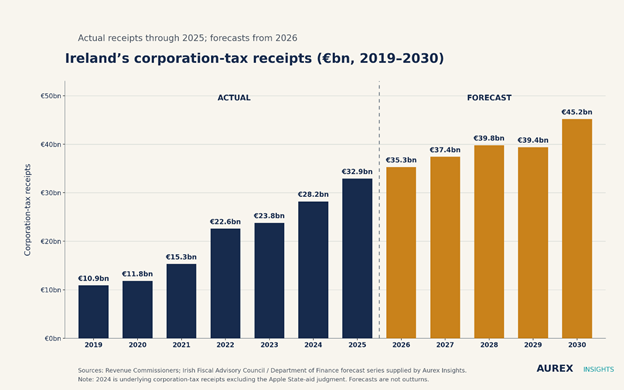
The ten largest companies accounted for 57 percent of underlying CT receipts. Foreign-owned multinationals accounted for 88 percent.
This is not an argument against multinational investment. It is an argument for treating highly concentrated revenue as a source of fiscal strength and fiscal risk.
The concentration is striking. Revenue’s analysis found that just 249 companies paying more than €10 million each accounted for €22.7 billion of underlying 2024 corporation-tax receipts.
A country may be wealthy and still exposed. The issue is not whether corporation tax is welcome – it plainly is. The issue is whether the State treats an exceptional revenue stream as permanently available for recurring commitments.
A Better Test for Policy
Ireland needs a clearer public language for banking, money and fiscal sustainability.
First, most everyday money is created by commercial banks through lending, subject to real constraints.
Second, the quantity of credit is not enough. Its destination matters. Credit that raises productive capacity has different consequences from credit that mainly increases the price of existing assets.
Third, banking crises and fiscal crises are often linked but they are not the same thing. Ireland’s 2008 crisis began in private credit and bank balance sheets before becoming a sovereign and fiscal crisis.
Fourth, a healthy headline budget balance is not, by itself, proof of sustainable public finances. Policymakers must examine the underlying balance, the quality and concentration of revenues, the durability of spending commitments and the economy’s productive capacity.
A useful discipline would be to apply one test to every major permanent spending decision:
Would this commitment remain affordable if exceptional corporation-tax receipts fell sharply for several years?
If the answer is no, then the commitment should be funded differently, phased differently, or matched with stronger savings and contingency arrangements.
That is not austerity. It is risk management.
The Lesson Ireland Cannot Ignore
Ireland has made substantial progress since the banking collapse. The financial system is more resilient than it was; the policy framework is stronger; and the State has greater fiscal capacity.
But the essential lesson of the rescue remains.
Economic resilience does not come from a single strong number. It does not come from GDP alone, a budget surplus alone or rising asset values alone. It comes from the interaction of productive capacity, sound credit allocation, resilient public revenues, adequate fiscal buffers and institutions willing to confront risks before markets force them to do so.
In 2008, Ireland discovered too late that private credit could become public risk.
In 2026, the responsibility is to ensure that exceptional public revenue does not become permanent fiscal exposure.
The next crisis may start somewhere else. That is why the time to prepare is now.
About the author
Dr Brian O’Donnell is Founder and Principal of Aurex Insights, an independent economic-policy and strategic-advisory practice working between Ireland and Canada. A former member of the Irish Senate and holder of a Doctorate in Business Administration, he specialises in enterprise policy, industrial strategy, fiscal analysis and legislative engagement.
Sources and Endnotes
- Bank of England, “Money Creation in the Modern Economy,” Quarterly Bulletin, Q1 2014. Explains that commercial banks create the majority of broad money through lending, while noting the constraints on lending and the role of central-bank money.
- Bank of England, “Money in the Modern Economy: An Introduction,” 2014.
- Houses of the Oireachtas, Report of the Joint Committee of Inquiry into the Banking Crisis, 2016. The inquiry found that the Central Bank and Financial Regulator had failed to intervene decisively to protect the State.
- Comptroller and Auditor General, reporting on measures taken to stabilise Irish banks. Its end-2021 estimate placed the net cost at €45.7 billion; later developments can alter the ultimate figure.
- Central Bank of Ireland, Bank Lending to Irish SMEs, Q1 2026. Outstanding SME lending was €14.6 billion, down 2.1 percent annually; new lending and net transactions showed improvement.
- Irish Fiscal Advisory Council, Fiscal Assessment Report, June 2026. The Council forecasts a 2026 underlying deficit of €11 billion excluding excess corporation tax and says that only about one-sixth of CT revenue is planned to be saved.
- Revenue Commissioners, Corporation Tax: 2024 Payments and 2023 Returns, revised 7 April 2026. This is the principal source for the 2024 CT figures, Apple adjustment and concentration data.
- Department of Finance, Annual Progress Report 2026, April 2026. This contains the Government’s macroeconomic and fiscal forecasts through 2030; projections should be treated as forecasts rather than facts.
- Regling, Klaus and Max Watson, A Preliminary Report on the Sources of Ireland’s Banking Crisis, 2010.
- Nyberg, Peter, Misjudging Risk: Causes of the Systemic Banking Crisis in Ireland, 2011.