The latest Irish budget, unveiled on 7 October, left one thing more glaringly absent than any tax break or spending line: a long-term vision. For all the ministerial talk about prudence, Ireland is now among the only EU states presenting a lone one-year fiscal projection, leaving the landscape after 2026 engulfed in fog. In an EU where multi-year frameworks are the expected norm and most governments map fiscal plans for three to five years – sometimes longer – this “blind corner” is not just unusual. It is perilous.
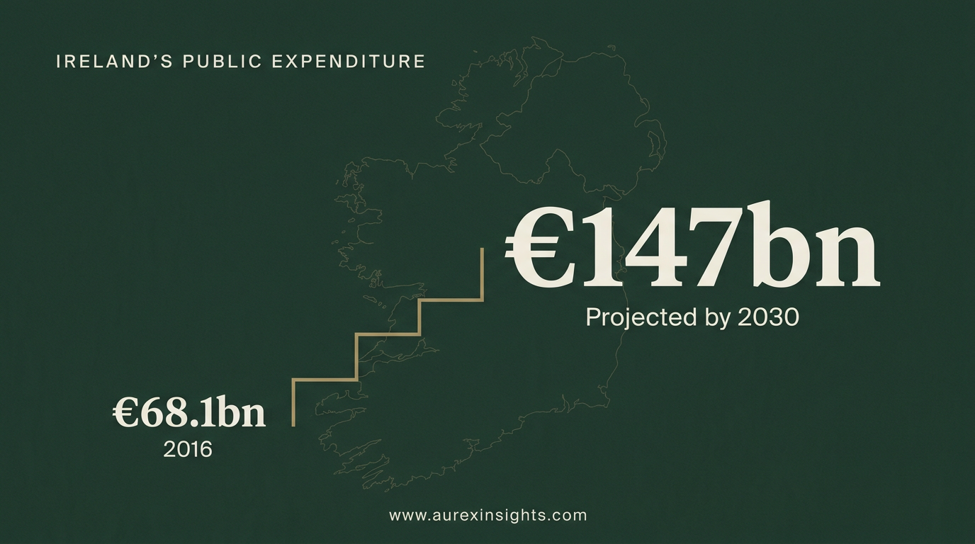
At a top level, the budget package was deeply expansionary: €9.4 billion split between €1.3 billion in taxation measures and €8.1 billion in fresh spending commitments. Total government spending next year will hit a record €147 billion – doubling over the past decade and up a whopping €60 billion since 2019. This fiscal expansion has been baked into largely permanent spending underpinned by what most experts view as windfall, cyclical corporate tax receipts. The government appears, in effect, to be betting the future on the continued largesse of a handful of multinationals.
The contrast with Ireland’s own past is sharp. After the 2008 crash, strict multiyear spending rules, independent fiscal oversight, and annual roadmaps were put in place to ensure future governments could resist both departmental wish lists and short-term electioneering. These safeguards are being quietly swept aside, replaced by political discretion and, all too often, budgetary improvisation.
Ireland’s fiscal fortunes are shifting. The exchequer surplus is €10.2 billion this year – but is set to shrink to €5.1 billion in 2026. Beneath the headline numbers, today’s surpluses are overwhelmingly dependent on multinational-driven corporate tax windfalls. If these evaporate, a steep fiscal cliff will emerge.
Every economist worth their salt can spot the irony. Then, as now, the government used windfall receipts – first from property, now from corporate taxes – to fund permanent spending, ignoring volatility in a narrow tax base. Should these receipts dry up, the lack of a credible fiscal buffer would quickly be exposed.
Budget composition and business impact:
This budget, at €147 billion, looks like the government is throwing money at everything. Yet, it has left unresolved some of Ireland’s most pressing underlying challenges – inflation, competitiveness, value for money, public service outcomes, and energy costs (now the second highest in the EU). The 9% VAT for food/hospitality – costing €232 million (in 2026), not kicking in until July 2026 – remains a point of hard-fought relief for a key sector, but emblematic of piecemeal fixes across a budget still wrestling with deeper competitiveness and cost issues.
Meanwhile, the minimum wage rises from €13.50 to €14.15 (a 4.8% increase), effective January 2026, with auto-enrolment for pensions arriving the same month. For Ireland’s SMEs, which make up over 99% of active firms, the cost implications are stark: in 2025, a minimum wage worker costs an employer €30,468 (including €3,090 in PRSI), but by 2026, that figure climbs to €32,318 as higher pay, higher PRSI (€3,207), and pension auto-enrolment (€430) take hold – a €1,850 annual jump before other, broader wage pressures are taken into account.
Why Long-Term Projections Matter
Multi-year projections are not bureaucratic box-ticking. In Germany, the Netherlands, and the Nordics, public budgets come with multi-year ceilings and rolling forecasts – safeguarding against overextension and helping prioritise investments in housing, health, and infrastructure. EU rules and the new economic governance framework explicitly require credible medium-term plans and the empowerment of fiscal watchdogs. Ireland now stands out for the wrong reasons: lack of transparency, weak guardrails, and an increasing reliance on good fortune.
Specific Policy Examples
The 2026 budget restores the reduced 9% VAT rate for food and catering parts of hospitality businesses from July – a targeted relief costing €232 million but slow to arrive for struggling SMEs. While the budget maintains the 9% VAT on domestic energy until 2030, it stops short of the deep, targeted action needed to reduce Irish energy prices, now the second highest in the EU. Beyond these, the VAT rate on completed new apartments falls to 9% until December 2030, €5+ billion in capital investment targets housing in 2026, and core social welfare rates rise by €10 per week. The Rent Tax Credit is renewed, Mortgage Interest Relief continued, and spending ramps up for public transport, education, climate, and health.
For business, government boosts the R&D tax credit to 35% and expands the Special Assignee Relief Programme, but the headline reality – rising minimum wage, PRSI, and auto-enrolment costs – means that for most domestic firms, this was not an unqualified “pro-business” budget.
Implications for Ordinary Citizens
For the average household, the absence of multi-year planning clouds the long-term outlook for housing supply, hospital beds, and supports like school meals and public transport. With so much spend now permanent and underpinned by cyclical revenues, public confidence in “new entitlements” is fragile – and cost-of-living and services risks persist.
The Road Ahead
With EU neighbours tightening frameworks and building buffers, Ireland cannot afford to coast on good luck and multinational largesse. The case for strict, transparent oversight; medium-term planning; and prudent use of surpluses has never been stronger. Without it, the country’s next fiscal cliff will be visible – and this time, there will be no excuse for missing it.
While ministers tout investments in housing, public services, and ‘resilience,’ this vision rings hollow without the fiscal guardrails EU peers enjoy. Only decisive action to restore credible long-term oversight can ensure today’s surpluses become tomorrow’s legacy – rather than the seedbed for Ireland’s next bust.