By Dr. Brian O’Donnell, Founder, Aurex Insights | January 17, 2026
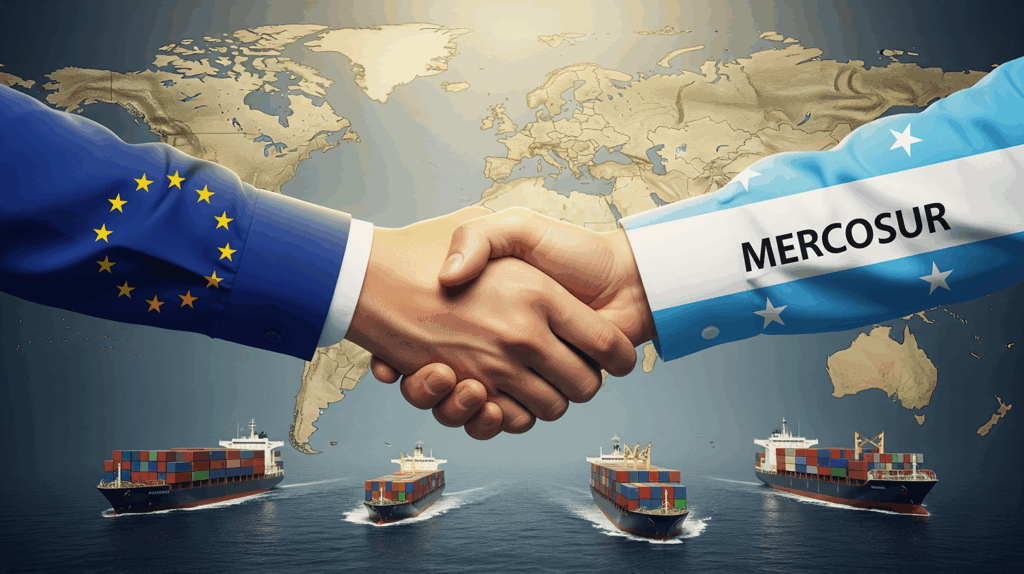
Signed moments ago in Asunción’s Gran Teatro José Asunción Flores – birthplace of Mercosur’s 1991 treaty – the EU-Mercosur pact crowns 26 years of brinkmanship, forging a free-trade zone for 750 million people and one-fifth of global GDP. Ursula von der Leyen declared it “fair trade over tariffs,” yet for Europe’s farmers, it’s a retroactive bill: quotas unlock South American protein amid protests from Paris to Warsaw.
The deal’s core mechanics limit Mercosur’s market access through carefully calibrated quotas: 99,000 tonnes of beef enter at a 7.5% tariff – equivalent to just 1.5% of total EU production – while chicken shipments ramp up to 180,000 tonnes over six years, pork to 25,000 tonnes, and corn or sorghum gain a million-tonne annual quota at zero duty. Soybean meal flows in duty-free on top of the 13.3 million tonnes already supplied by Brazil and Argentina, which cover 60% of EU needs; safeguards kick in to restore tariffs if imports surge by 8% or prices fall 5%, and Italy extracted €45 billion in early farm subsidies from the 2028-34 budget to ease the transition. This phased rollout over a decade softens immediate disruptions, balancing openness with protection.
Ireland’s government switched at the last minute amid fears of political unraveling – exposing Taoiseach Micheál Martin’s weak leadership on domestic fronts – joining France and Poland in no votes, their farmers’ lobbies decrying threats to local livelihoods, while Italy switched sides only after securing those agricultural concessions. Donald Trump’s 2025 tariffs – hitting Brazil with 40% duties – served as the spark, pushing the EU to diversify away from volatile US and Chinese dependencies; meanwhile, Mercosur’s leaders, from Argentina’s Javier Milei and Brazil’s Luiz Inácio Lula da Silva to Paraguay’s Santiago Peña and Uruguay’s Yamandú Orsi, showed rare unity in Asunción, sidelining Venezuela’s long suspension.
Economically, the EU reaps outsized rewards as Mercosur slashes tariffs on cars (from 35%), dairy (28%), wine (27%), and machinery (14-20%), unlocking €4 billion in annual savings, a 39% export surge, and 440,000 new jobs – mechanical engineering up 2.7%, chemicals 3.1%, autos 3.2% per Germany’s ifo Institute. The European Commission forecasts a €77.6 billion GDP lift for the EU and €9.4 billion for Mercosur by 2040 (0.05-0.25% bumps); consumers might notice 1-2% cheaper beef and poultry where quotas bite, though EU beef/lamb output dips 1.2% and sugar 1% per LSE models.
Canada inked a major agricultural export pact with China this week – centering on soy and canola – to sidestep Trump’s punishing US tariffs, much like the EU’s Mercosur pivot, leaving Western farmers to square off against low-cost Asian giants while locking in vital new markets.
Households might trim a few euros yearly from protein bills if cheaper beef and poultry from Mercosur gain traction – though quotas cap volumes at 1-2% price dips on affected meats, and many discerning shoppers favor local or premium labels over Brazilian imports – easing some grocery strain amid persistent inflation. Rural jobs face upheaval regardless, with 50,000-100,000 at risk in France, Ireland, and Poland unless farmers upskill rapidly, while food processors thrive by leveraging 344 protected EU geographical icons like Parmigiano and Champagne for fresh Mercosur market access.
This deal quietly counters China’s chokehold on critical minerals through easier lithium and copper access – Brazil’s export taxes halved – while mandating deforestation-free goods after 2025, thrusting Paraguay into a geopolitical spotlight as a rules-based hub. It sidelines US influence in Latin America following tense Greenland maneuvers and sparks joint EU-Mercosur green tech in biofuels to cut Russian energy leverage; Canada’s parallel China play amplifies the pattern, as the West forges supply chains that shrug off US dominance. Farmers must chase premium niches or sustainability – or consolidate; Brussels needs bold subsidy strikes.
Will Brussels turn trade into triumph, or hand farmers the bill for revolt?