By Dr. Brian O’Donnell, Founder, Aurex Insights | February 2026
Canada’s economy has entered what economists call “stall speed.” After scraping zero growth in late 2025, the country begins 2026 suspended between motion and drift. But this isn’t cyclical turbulence – it’s structural fatigue.
While headline GDP appears deceptively stable, much of the late 2025 uptick stemmed from temporary rebounds in services following the resolution of provincial strikes in retail, health, and education. Beneath that surface, the nation’s productive core is eroding.
Manufacturing’s Retreat
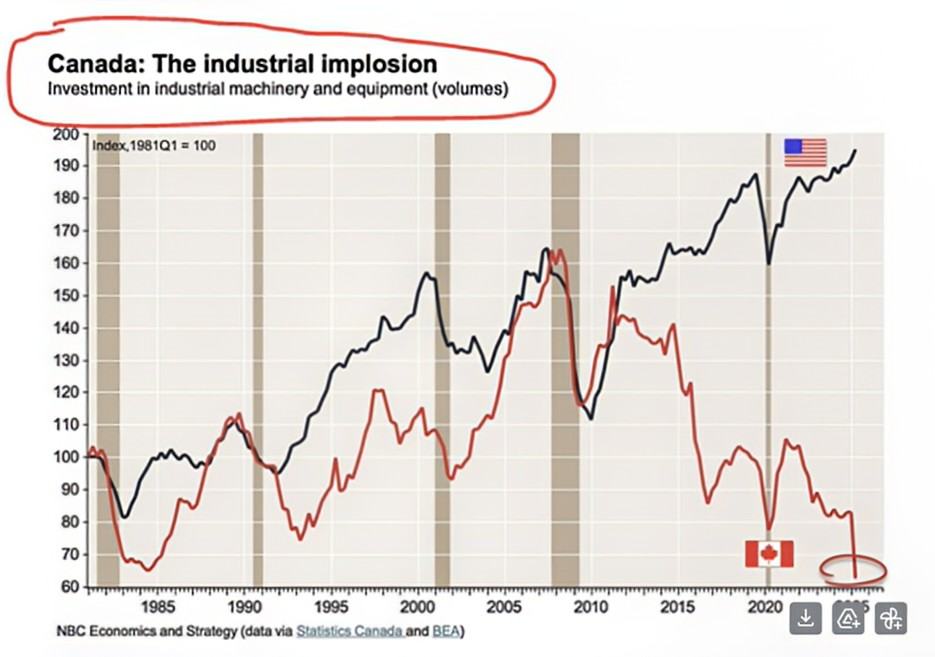
Durable goods manufacturing – autos, machinery, and equipment – has slumped to its weakest level since 2011. StatCan’s latest data show a 1.3% monthly production drop in November and an annual decline tracking toward 2.5%, the sharpest contraction since the global financial crisis.
Capital formation in plant and equipment has fallen to its lowest point since the early 1980s. Meanwhile, U.S. industry is investing aggressively, buoyed by industrial policy tailwinds. Canada’s integration into U.S. value chains – once a strength – is now a vulnerability. With CUSMA (USMCA) renegotiations looming and tariff diplomacy reemerging, Canadian suppliers face exposure without leverage.
A Consumption-Heavy Economy
Canada’s household debt remains the highest in the G7, hovering between 175% and 180% of disposable income – nearly double the U.S. level. This imbalance reflects a deeper truth: Canada is funding consumption, not production. A nation that spends more than it builds inevitably loses industrial momentum.
The Bank’s Balancing Act
On January 28, the Bank of Canada held its policy rate at 2.25%, caught between inflation control and growth anxiety. Markets welcomed the pause; manufacturers saw little relief. Monetary policy can ease debt burdens, but it cannot substitute for an enterprise strategy.
TD Economics projects just 1.1% growth for 2026 – stagnation dressed as recovery.
Internal Trade: Canada’s Domestic Frontier
The IMF estimates that dismantling interprovincial trade barriers could lift real GDP by nearly 7% – a $210 billion annual gain. These self-inflicted frictions, equivalent to a 9% tariff, disproportionately hurt small manufacturers. While provinces have made progress on goods movement, services remain locked behind regulatory walls, stifling innovation and productivity.
Ground Truth from the Front Lines
Across Canada, small and medium-sized enterprises report thin margins, delayed projects, and persistent labor bottlenecks. Families juggle record debt as real incomes stagnate. Entrepreneurs see opportunity abroad but face bureaucracy at home. Canada’s famed stability now reads more like stasis.
Carney’s Davos Vision – and the Execution Gap
At Davos, Mark Carney offered a compelling narrative: Canada as a principled middle power navigating global fragmentation. The message resonated – moral leadership and sustainability are vital. But beneath the rhetoric, the speech sidestepped the hard levers of competitiveness: tax reform, permitting timelines, and internal trade harmonization.
Vision inspires. Execution revives.
From Posturing to Production
Canada’s policy choice is stark:
- Rebuild the industrial base: Align corporate tax rates with U.S. levels, accelerate environmental assessments to six months, and scale advanced skills programs in manufacturing and energy.
- Unshackle internal trade: Mandate mutual recognition of credentials and standards by 2027, prioritizing services.
- Reframe monetary goals: Anchor policy not just to inflation, but to real economy metrics – output, productivity, and investment.
- Prepare for CUSMA turbulence: Position Canada as the resilient hub of North American supply chains, not their casualty.
The global economy is fragmenting fast. Canada has precious little time to decide whether it will produce – or merely consume – its way through the storm.
Dr. Brian O’Donnell is Founder of Aurex Insights, advising on economics, public policy, and industrial strategy. Reach him at brian@aurexinsights.com or follow @BrianODomhnaill on X.