Why America’s AI edge at 250 will be decided as much in alliances and supply chains as in algorithms.
By Dr. Brian O’Donnell | Aurex Insights | July 4, 2026

Today the United States turns 250. When the founders signed the Declaration of Independence in 1776, they were thinking in parchment, muskets and mercantilism, not GPUs and generative models. Yet a quarter of a millennium later, America has become the gatekeeper of frontier AI -and that is reshaping how Europe, Ireland and Canada must think about competitiveness and growth over the next fifty years.
The past half‑century, from the bicentennial in 1976 to this semi quincentennial, was the age of containerisation, offshoring and the internet. The next half‑century, up to 2076, will be shaped by compute, data and models. For America’s allies, the central question is not whether the US will remain the world’s most innovative economy. It is how to thrive in an AI world where the leading models, the biggest data‑centres and much of the capital sit under US jurisdiction.
That question is often discussed in the language of “competitiveness”. But competitiveness, as a concept, has become so elastic that it risks meaning everything and nothing. One global framework lists more than 1,200 factors. No policymaker can optimise over 1,200 levers. Economists therefore tend to fall back on a simpler anchor: productivity. Economies that produce more value per unit of labour and capital can sustain higher wages and living standards without resorting to zero‑sum thinking.
There is an even more practical proxy: productive investment.
Investment as the real test of competitiveness
Companies invest where they expect to be most successful – and where they trust that the framework conditions, from energy and infrastructure to skills and regulation, make investment both possible and worthwhile. In that sense, gross investment is a measure of a country’s current competitiveness: if investors are willing to bet money on an industry in a location, that industry is winning the contest for resources.
Net investment – after accounting for depreciation – tells us whether an economy is actually adding to its productive and innovative capacity. It is a leading indicator of future competitiveness. Even if some projects fail, economies that invest more in plant, equipment, software, R&D and skills tend, over time, to reap higher productivity and output.
Previous research finds that investments in tangible assets (infrastructure, machinery) and intangible assets (R&D, software, organisational capital) together account for up to 80 per cent of productivity growth. Economies with more productive capital per worker are more productive because better equipment, systems and technologies enable each worker to create more value. Higher output then finances more investment, creating a virtuous cycle of capital deepening and prosperity.
For much of the post‑war period, advanced economies rode this loop. The US, Europe and Japan invested heavily, built up capital stocks and enjoyed decades of rising productivity and incomes.
Over the past two decades, that engine has stalled.
The stalled engine in advanced economies
Outside the current AI boom, investment in many advanced economies has been anaemic. Net investment as a share of GDP has fallen, particularly in Europe, Japan and South Korea. The United States has done somewhat better, but even there net investment peaked around the turn of the millennium and has since settled into a lower band.
The 2008 financial crisis was a turning point. While emerging economies such as China continued to invest heavily, many rich countries shifted towards more cautious fiscal and financial regimes. Net investment in the US fell sharply after 2008 and has hovered around 3–4 per cent of GDP since, dampening growth. In the EU‑27, net investment is now consistent with a future in which productive capacity grows at roughly 1 per cent a year. In Germany, the implied rate is closer to 0.5 per cent. Japan’s current investment trajectory is consistent with no growth at all.
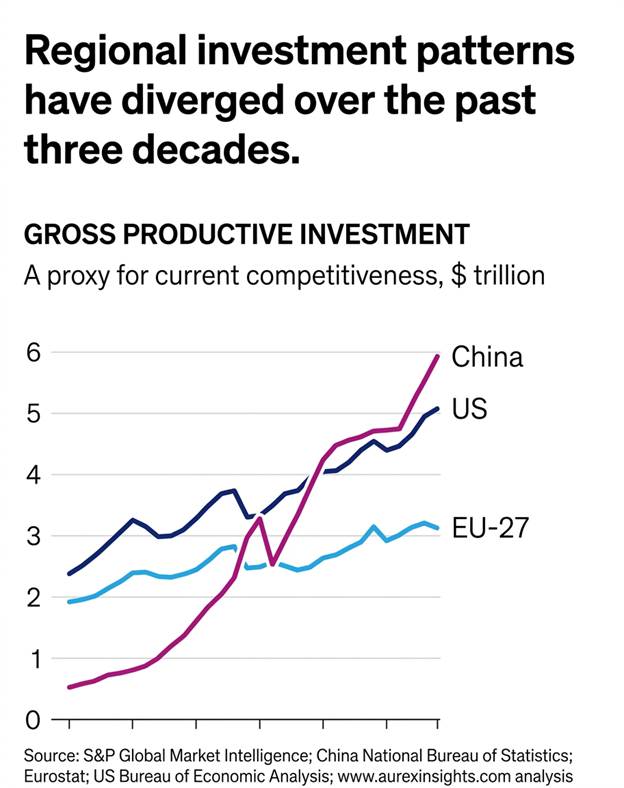
China, by contrast, invests more than 30 per cent of GDP annually – around $5.9 trillion a year, compared with about $5.1 trillion in the US and $3.1 trillion in the EU. It is building capacity across almost every manufacturing sector and is now ramping up investment in professional services. That investment has already translated into a higher share of global manufacturing output; on current trends, it will extend China’s lead.
The chart below illustrates the divergence: over the past three decades China’s gross productive investment has surged to nearly $6 trillion a year, the US has plateaued just above $5 trillion, and the EU‑27 has drifted down to about $3 trillion. Net investment tells an even starker story about future growth paths.
Investment, in other words, is redrawing the map of the global economy. It is also exposing a glaring contradiction in advanced economies’ rhetoric. Western governments talk about economic security, resilience and competitiveness. But they have under‑invested for years in exactly the sectors they now deem strategic: energy infrastructure, semiconductors, defence industrial bases, digital networks and AI.
America’s AI boom: a narrow surge in a flat landscape
The most vivid exception to this investment malaise is AI. The race to build AI data‑centres and frontier models has unleashed a wave of capital spending centred on the United States. A handful of AI‑related “hyperscalers” have increased their combined capital expenditure and R&D almost 50‑fold over two decades, from around $15 billion in 2005 to close to $750 billion in 2025. Projections suggest their investment could approach $1 trillion by the end of 2026.
In the three years since the launch of ChatGPT, US investment in data‑centre structures has roughly tripled. Broader technology investment is up by around 50 per cent. Silicon Valley optimists argue that AI and robotics will trigger a broad investment revival by slashing costs across the economy, reviving traditional manufacturing and services, and making the gap in capital spending between China and the West less relevant.
As the chart below shows, US investment in data‑centre structures has risen by about 200 per cent since the launch of ChatGPT, even as total productive investment remains flat relative to GDP. This is a powerful but narrow wave, not yet a broad‑based investment renaissance.
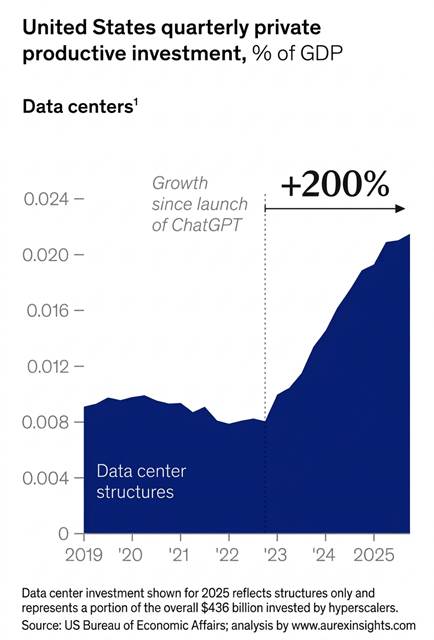
So far, that revival has not materialised. When we step back from the AI headlines, total productive investment in the US, as a share of GDP, is essentially flat. Many non‑tech investments – particularly in traditional manufacturing and infrastructure – have declined relative to the size of the economy. One estimate suggests that reducing critical import dependencies in US manufacturing would require roughly $2 trillion in additional investment, equivalent to about 6 per cent of GDP. That sits uneasily alongside a trillion‑dollar AI boom that has yet to lift the broader investment trajectory.
From a competitiveness perspective, this matters for two reasons.
First, it means the US is deepening its lead in information and communications technology and certain high‑value industries, while leaving other sectors under‑capitalised. Second, because so much of the cutting‑edge AI infrastructure is concentrated in a small number of US‑domiciled firms, under US law, access to the most powerful models can be – and has already been -treated as a strategic lever.
AI as leverage: from chips to models
The recent export‑control episode involving Anthropic made this leverage explicit. Washington ordered the company to suspend foreign access to its most advanced models on national‑security grounds. For a brief period, foreign governments, firms and researchers found themselves locked out of top‑tier general‑purpose AI not because of market failure, but because of a policy decision in one capital.
From a purely American perspective, this is not unprecedented. The US has long used export controls to manage nuclear technology, cryptography and advanced semiconductors. What is new is the target: models that sit at the heart of everything from enterprise productivity tools to scientific research and creative industries.
For allies – including Ireland, Canada and the wider EU – this raises uncomfortable questions. If your companies rely on US‑hosted models and data‑centres for AI‑driven productivity gains, and if your universities and start‑ups build on these models, then your growth strategy is partially contingent on decisions taken in Washington. In AI, interdependence can quickly shade into dependence.
Ireland, Canada and the EU: the investment choice
What should Europe and its transatlantic partners do?
The instinctive answer is ‘build your own’. Proponents of a more ambitious European AI strategy have called for nothing less than the most far‑reaching peacetime economic agenda Europe has attempted: a coalition of AI ‘middle powers’; a four‑fold increase in Europe’s share of global compute; deep capital‑market reforms to mobilise pension and sovereign funds; and a re‑think of labour and energy policy to make large‑scale digital infrastructure viable.
Ireland is already grappling with this. It has become the European nerve centre for US tech firms, hosting vast data‑centres and corporate headquarters. The AI revolution is likely to intensify this role. But the same infrastructure that anchors US firms in Ireland also binds Ireland, and by extension the EU, more tightly to US corporate and regulatory decisions. Irish policymakers therefore face a dual task: continue to attract and steward US investment, while investing themselves in domestic and European capacity that reduces vulnerability to single points of failure.
Canada faces a different configuration of choices. It combines world‑class AI research, abundant clean energy and deep integration with the US economy. It could position itself as North America’s trusted AI infrastructure hub – supplying power, land and governance for an AI ecosystem that spans the border. Yet without robust domestic AI and data regulation, Canada risks entering future trade negotiations as a rule‑taker rather than a rule‑maker.
For the EU‑27 more broadly, the numbers are unforgiving. Net investment trajectories imply future GDP growth of around 1 per cent, far below stated ambitions. Investment in pharmaceuticals and automotive remains healthy, but in many other manufacturing sectors Europe is investing at only half to three‑quarters of the global average. Unless this changes, Europe will lose output share and technological footing in exactly the sectors it wants to defend.
The next 50 years: independence, interdependence and stewardship
Looking ahead to 2076, the year of America’s tricentennial, the choices we make now about investment, AI and alliances will have compounded for half a century. The US is currently investing in ways consistent with long‑run GDP growth of about 2 per cent. The EU is investing in ways consistent with 1 per cent, Japan with zero. China is investing in ways that all but guarantee further gains in output share.
Against this backdrop, debates about “competitiveness” only make sense if grounded in investment. The priority for Europe, Ireland and Canada is not to match China’s investment rate or America’s AI spend asset‑for‑asset. It is to ensure that their own investment patterns align with the growth, resilience and autonomy they say they want.
That means:
- Raising net investment in both tangible and intangible assets, particularly in energy infrastructure, digital networks, semiconductors and AI.
- Using AI as a complement to broad‑based capital deepening, not as a substitute for it. AI can raise productivity, but only if it is embedded in capital‑intensive sectors – manufacturing, logistics, health, education – where its effects can scale.
- Designing interdependence consciously, recognising that access to models and compute will be governed as much by politics as by prices.
On America’s 250th birthday, it is tempting to retell familiar stories of independence won and freedom secured. Yet the economic story of the next fifty years will be less about independence than about interdependence managed well – or badly. The founders understood that political liberty required institutional checks and balances. In the AI era, economic liberty and prosperity will require a different kind of stewardship: investment decisions that build productive capacity at home, while shaping a transatlantic AI order that is resilient, fair and open enough to sustain growth for another half‑century.
If there is a single lesson from the past fifty years, it is that investment drives prosperity, and prosperity enables investment. The AI boom does not change that; it magnifies it. For Europe, Ireland and Canada, the task now is to ensure that AI is not just another wave that lifts American boats, but a catalyst for their own long‑overdue investment renaissance.
Dr. Brian O’Donnell is the founder and principal of Aurex Insights, an independent public policy, economic and legislative strategy practice specialising in enterprise policy, industrial strategy and fiscal analysis, working between Ireland and Canada.