The Illusion of Prosperity
Published by Dr. Brian O’Donnell | Aurex Insights | January 2026
The U.S. economy’s headline metrics paint a picture of invincibility – near 4% GDP growth this quarter, soaring corporate earnings, and historically low unemployment. Yet, beneath this vibrant surface lies a fragile reality: prosperity is narrowly concentrated, masking deepening inequality and vulnerability that threaten longer-term stability for the broader society.
Wealth Concentration Distorts the Economic Landscape
- The richest 10% of U.S. households account for nearly half of all consumer spending.
- Mega-cap U.S. stocks eclipse the entire Chinese stock market in valuation gains since 2021, amplifying wealth disparities.
- Such skewed concentration distorts economic narratives, raising urgent questions around fairness and sustainability.
Ireland’s Corporate Tax Concentration: A Fiscal Time Bomb in 2025
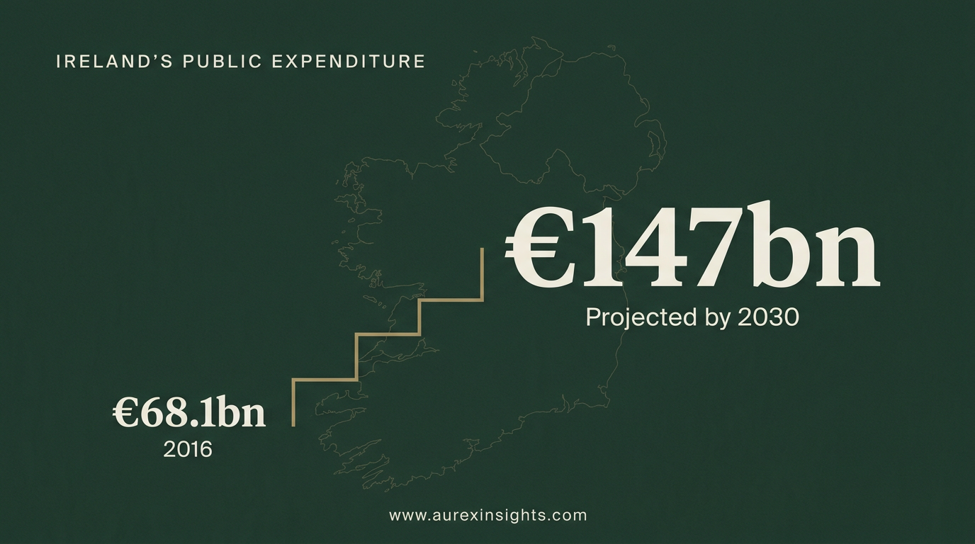
Ireland’s public finances have never been more heavily reliant on corporate tax receipts from a narrow base of foreign multinationals, predominantly U.S.-headquartered tech and pharmaceutical giants.
- In 2024, just ten corporate groups contributed approximately 56% of all corporation tax revenues, with three firms alone accounting for 38% of receipts in 2023.
- Foreign multinationals generate 88% of Ireland’s corporation tax receipts, dwarfing domestic SME contributions.
- This concentration risk is heightened by the implementation of OECD Pillar II global tax reforms, which may increase corporate tax revenues but will also exacerbate fiscal dependence on a handful of firms.
Irish Fiscal Advisory Council and ESRI experts warn this situation mirrors Ireland’s 2007 property bubble risk – vast revenue reliance on factors largely outside government control. July 2025 brought an unprecedented €1.2 billion surge in corporate tax receipts—a rare spike in what is typically a quieter month. However, by the end of August, corporation tax collections were only about €177 million (just over 1%) ahead of the same period in 2024, reflecting volatility and underscoring the inherently unstable nature of relying heavily on a concentrated tax base.
Key risks:
- Decisions shaping Ireland’s public revenues are effectively made in a few U.S. boardrooms, not Irish policymaking chambers.
- Sudden corporate restructuring, global tax or trade rule changes, or market shocks to dominant multinationals could cause large, unpredictable revenue fluctuations.
- Irish SMEs struggle to scale amid this imbalance, posing challenges to broad-based economic growth and social equity.
The Irish government is prudently channeling surplus funds into stabilizing mechanisms like the Future Ireland Fund and emphasizing economic diversification to mitigate risk.
Canada’s Broader and More Balanced Economic Model
In contrast, Canada maintains a more diversified and arguably more sustainable economic structure, though not without challenges.
- Canada’s trade with the U.S. remains robust – exceeding C$800 billion in 2024 – largely energy-driven, creating vulnerabilities to tariff changes and geopolitical shifts.
- The 2025 Canadian government prioritizes trade diversification and SME support to reduce reliance on a narrow export base and enhance economic resilience.
- Unlike Ireland’s extreme fiscal dependence on a few corporations, Canada’s economic model spreads activity and risk across multiple sectors, including natural resources, manufacturing, and services.
- Canadian policy pivots are focused on building supply chain resilience and indigenous innovation, positioning the country to better absorb global shocks and sustain inclusive growth.
Economic Realities for Households
Despite robust headline growth figures in both nations, middle- and lower-income households face increasing economic pressures:
- Rising mortgage delinquencies, escalating healthcare costs, and shifts toward lower-cost consumer goods signal distress.
- Indicators such as production slowdowns and increased social service demand reveal widening fissures beneath macroeconomic stability.
AI’s Double-Edged Impact
Artificial Intelligence drives a substantial portion of recent economic growth, attributed to nearly 40% of U.S. GDP uplift last year, with global AI investments forecast to exceed $3 trillion by 2028.
Yet, these gains are unevenly distributed – concentrated in large corporations and tech hubs – potentially widening inequality further unless Ireland, Canada, and their policymakers consciously foster inclusive opportunities.
The Waning American Dream and Social Mobility Challenges
- Realizing upward mobility now costs upwards of $5 million in the U.S., almost twice median career earnings.
- Only about 7% of households fit the dual-income, college-educated profile that approaches this aspirational threshold.
- Canada and Ireland face parallel struggles with rising costs and social mobility retention amid tightening economic conditions.
Path Forward: Policy and Economic Resilience Imperatives
The intertwined economies of Ireland, Canada, and the U.S. must heed these structural risks and opportunities:
- Ireland’s urgent need to diversify its economic base and reduce corporate tax reliance, safeguarding fiscal stability through saving mechanisms and SME empowerment.
- Canada’s focus on broader sectoral diversity and trade partner diversification, reinforcing economic resilience and promoting indigenous enterprise.
- Both nations must leverage AI-driven growth inclusively, ensuring technological advancement benefits a wider cross-section of society.
- Addressing rising inequality, housing affordability, and social safety nets is paramount to maintain stable, sustainable growth.
Conclusion: Seeing Beyond the Headlines
The dazzling figures of GDP growth and budget surpluses mask significant economic fragilities for Ireland and Canada in 2025. The contrast between Ireland’s concentrated tax revenue reliance and Canada’s diversified trade-dependent economy underscores the importance of prudent fiscal management and diversification.
Harnessing innovation while building inclusive, resilient economic ecosystems is essential to navigating the volatility ahead – ensuring prosperity extends beyond the elite few to the many.
Stay Informed and Ahead
For authoritative analysis, aligned strategies, and insights shaping Ireland-Canada economic futures, follow Aurex Insights on LinkedIn and Twitter/X. Your partner in economic clarity and impact.