A small state, a big moment, and the future of European order
Dr. Brian O’Donnell | Aurex Insights | 25 June 2026
Europe was built from wreckage. After 1945, its central promise was not only peace, but discipline: the discipline of rules over force, institutions over impulse, and shared economic structures over the old habits of continental rivalry. The European project mattered because it turned power into process and interdependence into stability. For small countries on the edge of the continent, that mattered most of all.
Ireland’s prosperity was shaped inside that settlement. The long arc from accession to the single market, from structural funds to foreign direct investment, from peripheral status to strategic relevance, rested on a simple assumption: that the wider system would hold. The system was never perfect. It was frequently unequal, often bureaucratic, and always political. But it was broadly intelligible. Markets opened. Rules endured. Trade expanded. Institutions mediated.
That era is ending.
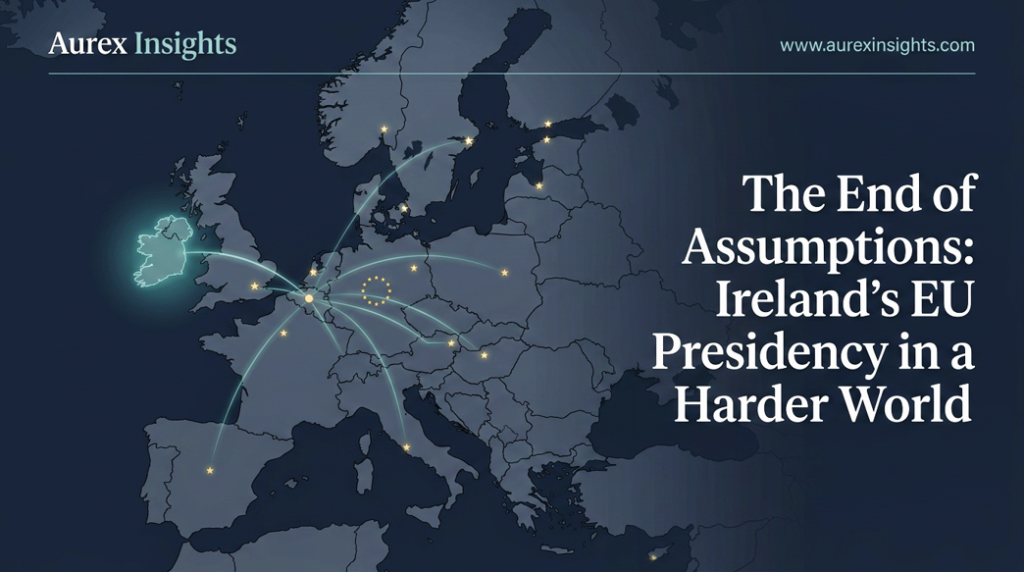
On 1 July 2026, Ireland assumes the Presidency of the Council of the European Union for the eighth time, with an agenda built around competitiveness, values, and security. In the final days before the Presidency formally opened, Canada’s Prime Minister Mark Carney arrived in Dublin – the first Canadian prime ministerial visit to Ireland in nearly a decade – to sign a partnership framework with Taoiseach Micheál Martin anchored in precisely the language of rules-based trade, economic resilience, and shared strategic interest. That visit was not coincidental. It was a reminder that the anxieties driving Ireland’s European agenda are felt across the Atlantic too, and that the world both countries built their prosperity inside is the world both now feel slipping.
In normal times, the three Presidency themes might sound familiar, even routine. They are not routine now. They are the language of a continent adjusting to a world in which security has returned to the centre of economic life, global rules have become less reliable, and states are rediscovering that resilience has a price.
This is why Ireland’s Presidency matters.
Not because a six-month chairmanship can remake Europe. It cannot. Nor because Dublin will somehow dictate the next phase of European integration. It will not. It matters because Ireland takes the chair at a moment when Europe is being forced to decide what kind of power it is. A market with a flag is no longer enough. A regulatory superpower without strategic depth is no longer enough. The age of assumptions is over, and the Union is now being tested on harder terrain: defence, energy, industrial capability, budgetary choices, technological sovereignty, migration, and the political legitimacy required to hold all of that together.
For Ireland, the challenge is larger than administration. The task is not simply to manage the machinery of Brussels efficiently, host meetings competently, and move files through the system. The task is to help Europe think clearly in an era where clarity is in short supply.
The post-war Europe that made Ireland possible
The EU did not emerge as a trade arrangement with some political accessories attached. It began as a civilisational response to collapse. The post-war settlement bound former rivals into common institutions because economic integration was understood as a precondition for peace and a restraint on nationalism. Over time, that logic widened. Integration became not merely a peace project, but a prosperity model: pooled sovereignty, common rules, legal certainty, and access to a scale no small national economy could generate alone.
That model transformed Ireland. The country that joined the European Communities in 1973 was still marked by underdevelopment, outmigration, and structural dependence. The country that emerged over the following decades was one of Europe’s most globalised economies: export-oriented, investment-intensive, deeply embedded in European law and global value chains, and able to use the single market as both shield and springboard. The same basic logic applied, in different institutional settings, to other small open economies. Canada built its prosperity not from scale but from access to frameworks it helped design and had reason to maintain. The post-war international economic architecture – multilateral trade rules, legal certainty, stable monetary frameworks – was the shared infrastructure on which both countries ran their economic models.
The institutions of European integration did not do all the work, but they created the operating environment in which Ireland could move from the margins to the mainstream. That is why debates about Europe are too often flattened. The Union is frequently discussed either as a technocratic irritant or a permanent fact of life. It is neither. It is a political achievement sustained by economic architecture. And like any architecture, it can decay if neglected or overloaded.
For much of the post-Cold War period, Europe lived off inherited advantages. American security guarantees underwrote peace. WTO-era trade norms supported open markets. Cheap energy assumptions held longer than they should have. China’s rise was treated more as commercial opportunity than systemic challenge. Enlargement reinforced the idea that the European model was spreading outward, and history was bending in a benign direction.
That confidence has now run into reality.
The long unravelling
The world Europe grew comfortable in no longer exists. It has not disappeared in one dramatic break; it has frayed through overlapping shocks. The global financial crisis damaged confidence in economic governance. Brexit punctured the myth of irreversible integration. The pandemic exposed supply-chain fragility and strategic dependency. Russia’s invasion of Ukraine shattered the illusion that large-scale war on the continent belonged only to history. US political volatility has raised persistent doubts about the durability of transatlantic assumptions. China’s rise has moved from the realm of trade policy to that of systemic rivalry.
None of these shocks stands alone. Together, they mark a deeper transition: from a period in which economics was often treated as separable from geopolitics, to one in which geopolitics now shapes the economics. Energy is no longer just an input cost. It is a security question. Semiconductors are no longer just components. They are strategic infrastructure. Supply chains are no longer just efficiency systems. They are exposure maps.
That is the true significance of the current moment. Europe is not merely facing a series of policy challenges. It is confronting the exhaustion of a worldview. For decades, the governing instinct across much of Europe was to believe that interdependence would soften political conflict and that rules-based frameworks, once established, would deepen almost automatically. That instinct delivered real gains. But it also produced complacency. Europe became highly competent at regulating markets it no longer fully controlled, dependent on security arrangements it did not command, and vulnerable to shocks in domains where it had underinvested for years.
The new world is less forgiving. It rewards scale, speed, state capacity, and strategic patience. It punishes fragmentation, dependency, and political self-deception. This is the setting in which Ireland assumes the Presidency.
From market Europe to strategic Europe
The official Irish Presidency programme is built around competitiveness, values, and security. That triad is revealing. In an earlier era, those themes could be separated. Competitiveness belonged to market reform and productivity. Values belonged to treaty language and diplomatic posture. Security belonged mainly to foreign ministers, military alliances, and crises elsewhere.
No longer. Today, competitiveness without security is fragile. Security without competitiveness is unaffordable. And values without either are rhetorical. The real story of Europe in 2026 is that these categories have collapsed into one another.
A continent that wants to remain prosperous must now think strategically. That means asking harder questions than Europe has often liked to ask: Where are the vulnerabilities in energy, cloud infrastructure, critical minerals, digital payments, pharmaceutical inputs, and defence supply chains? Which sectors require scale, redundancy, or public support? How should fiscal rules adapt when resilience, deterrence, and decarbonisation all demand sustained investment? What is the balance between openness and economic security in a world where trade can be weaponised and technological dependence can become political leverage?
These are not theoretical questions. They sit behind real policy files now moving through the European system: the “One Europe, One Market” Roadmap signed by the three EU institutions in April 2026, regulatory simplification, the AI and digital agenda, energy resilience, migration governance, enlargement, and the next long-term EU budget. Each one reflects the same deeper transition. Europe is moving, unevenly but unmistakably, from being primarily a rules-based market project to becoming a more strategic political economy.
The budget is the real argument
If there is one place where Europe’s future orientation becomes concrete, it is the Multiannual Financial Framework for 2028–2034. The MFF is never merely an accounting exercise. It is the Union’s strategic autobiography written in numbers. It shows what Europe really values when rhetoric is converted into ceilings, envelopes, and instruments.
The European Commission has proposed a €2 trillion budget over seven years – roughly 1.26% of EU gross national income – with almost half directed to regional cohesion and €409 billion for competitiveness, research, and innovation. But the political negotiation is already fractured along familiar lines. A “frugal” northern European camp wants to spend less; a larger majority wants to spend more on defence, competitiveness, and strategic investment. One diplomat from the frugal camp has already criticised the latest draft as a “nostalgia” budget, clinging too closely to the Common Agricultural Policy and regional development funds designed for a quieter era.
During Ireland’s Presidency, this negotiation moves into its most contested phase. Ireland’s Minister of State for Europe, Thomas Byrne – who will play a hands-on role in the budget talks – has said that any deal will require countries to “undraw” red lines: “If we’re doing a good job, people will be giving out about us in Brussels at various points, many will be giving out about us at home, but we’ve a specific role to do here, which is to be the honest broker around the table.”
That is precisely the right framing. A serious Presidency must recognise that the fiscal question is now strategic. Europe’s budget is no longer mainly about dividing resources fairly. It is increasingly about whether the Union can remain economically viable and politically credible in a harsher world. The case for a more modern EU budget is practical: Europe needs more flexibility when crises hit, investment vehicles capable of supporting clean technology and supply-chain resilience, and the ability to mobilise public and private capital more intelligently.
Yet every member state enters MFF negotiations with its own red lines. The danger for the Irish Presidency is not that Ireland will have priorities – any government would – but that it becomes trapped inside them. A Presidency that allows the debate to narrow into a struggle over ring-fencing, tax sensitivities, and narrow sectoral protections will have chaired the argument without shaping the future.
Small states and the test of seriousness
Ireland’s size is often discussed as a limitation in European affairs. In some respects, it is. Small states do not impose outcomes by force of weight. They influence by judgement, coalition-building, credibility, and timing. But in moments of systemic transition, those qualities matter more than usual.
A small state that understands the system can often see its pressures more clearly than a larger one insulated by scale. Ireland knows what open markets mean because it has benefited from them. It knows what legal certainty means because it has depended on it. It knows what institutional reliability means because it has used Europe not as a decorative affiliation, but as the framework within which national development became possible. That should be a source of seriousness – not self-congratulation, but obligation.
The purpose of the Presidency is to steward a collective agenda at a moment when the collective interest is becoming harder to define and easier to distort. Europe is entering a phase in which every member state will face pressure to treat strategic autonomy as a cover for domestic exception-seeking. Every sector will discover a new geopolitical rationale for subsidy. Every lobby will claim that its preferred protection or carve-out is essential to resilience. If strategic Europe becomes simply a collection of national vetoes wrapped in the language of resilience, then Europe will become more expensive without becoming stronger.
That is why Ireland’s Presidency should bring a particular discipline to the table. A small state that has prospered from openness should be among the first to say that strategic capacity is necessary, but must not become a euphemism for every form of special pleading. Europe will need investment, protection in some domains, and harder-edged economic policy. But it will also need restraint, prioritisation, and institutional integrity.
Competitiveness must mean more than friction reduction
One of the most overused words in contemporary European debate is competitiveness. It is often deployed as shorthand for deregulation, tax caution, or administrative tidiness. Those things may matter, but they are not enough.
The clearest proof is Mario Draghi’s 2024 report on European competitiveness – itself endorsed by every member state and the European Parliament. One year after publication, the independent Draghi Observatory found that of 383 recommendations, only 43 – just 11.2% – had been fully implemented, with nearly a quarter untouched entirely. In clean technologies, digitalisation, and energy, progress had been slowest: precisely the areas that will define the next cycle of growth and power. The EU, as the Observatory noted, continued “churning out world-class bureaucratic cages and regulatory mazes” rather than backing the productive capacity it already had.
That is the real competitive challenge facing the Irish Presidency. Regulatory simplification – the centrepiece of the “One Europe, One Market” roadmap – is a means, not a strategy. The larger task is to ensure that the European economy can actually generate and retain high-value activity. That requires investment, not just less friction. It requires linking productivity, capital formation, and strategic coordination in the same conversation. And it requires that smaller firms are not left behind. SMEs experience geopolitical change differently – through compliance burdens, supply-chain volatility, financing constraints, and market uncertainty. An Irish Presidency that speaks credibly about competitiveness must connect grand strategy to the lived economics of firms trying to trade, invest, hire, and adapt.
Security runs through the economy
The old vocabulary of European policy placed security and prosperity in separate rooms. That separation is collapsing – and Ireland is confronting it in its own backyard.
In the days before the Presidency launch, EU foreign affairs chief Kaja Kallas visited Dublin. Her visit coincided with mounting concern over revelations that an Irish-based refinery had continued shipping aluminium to Russia throughout Moscow’s full-scale invasion of Ukraine. The episode is not a story about Irish negligence; it is a story about how deeply embedded the economic and security questions now are. A supply chain running through Ireland, processing materials ultimately reaching a country at war with a European neighbour: this is exactly what it means when analysts say that security now runs through the economy.
It runs through electricity grids and subsea cables. It runs through data centres, AI infrastructure, and payments systems. It runs through supply of medicines, satellite systems, industrial inputs, and food chains. Russia’s war on Ukraine has already fundamentally reshaped European defence and security priorities, and Ireland’s Presidency will operate in that context. The €90 billion loan to Ukraine, long delayed by Hungarian obstruction, has now cleared – with Ireland invoking special constitutional provisions to participate, the first time it had done so.
Ireland has a useful role here precisely because it is not a classic hard-power state. It can help frame security in broader strategic-economic terms without surrendering to a militarised caricature of European renewal. Thomas Byrne, Ireland’s Minister for Europe and Defence, has been explicit: the distinction between mutual assistance and mutual defence is not semantic, and Ireland’s contribution to European security will be substantive without abandoning the constitutional framework within which it operates. That balance may prove more valuable than many assume.
The enlargement test
If the budget is the fiscal test of the Presidency, enlargement is the values test – and the two are inseparable.
Ukraine and Moldova opened the first cluster of formal accession negotiations in June 2026, following Hungary’s lifting of its long-running veto. Montenegro, currently the frontrunner among candidate countries, could close all of its negotiating chapters during the Irish Presidency if it maintains current progress – a historic outcome that would mark the EU’s first accession since Croatia in 2013.
The scale of what Ireland is being asked to steward is considerable. As Minister of State Neale Richmond has put it: Ukraine’s accession presents “the largest challenge of an individual member state since perhaps the Spanish accession – before any consideration that Ukraine is currently at war.” Managing these accession files, maintaining political momentum, and preventing spoiler tactics from derailing what would be the Union’s most significant enlargement in a generation are tasks that will run alongside – and interact with – the budget and competitiveness agendas throughout the six months.
The Ireland-Canada lesson: not a parallel, but evidence
Ireland is not alone in reckoning with this moment. When Prime Minister Mark Carney arrived in Dublin in mid-June 2026 – days before the Presidency officially opened – both leaders spoke explicitly about what small and mid-sized open democracies owe to the rules-based frameworks that made their prosperity possible. Canada is the only non-European country to have joined the EU’s Security Action for Europe instrument. CETA – the Canada-EU trade agreement, whose 10th anniversary falls during the Irish Presidency – was cited by both leaders as the kind of durable institutional architecture that cannot be replaced once lost.
The Canada-Ireland bilateral relationship (bilateral trade up nearly 150% in a decade; Irish and Canadian companies employing tens of thousands on each other’s shores) is not a diplomatic curiosity. It is evidence for the essay’s central argument: the world in which small open economies can leverage rules-based frameworks to generate prosperity far above what their scale would otherwise allow is the world that is now under strain. Canada feels this from within a North American strategic environment. Ireland feels it from within the European Union. The underlying logic is identical: small democracies prosper when the wider order works and pay the price when it doesn’t.
That is not nostalgia. It is the strategic case for doing the hard work – on the MFF, on enlargement, on competitiveness, on security – that makes the order worth preserving.
Where Europe goes next
The last week of June is the right time to say this plainly: Ireland is taking the chair of the Council at a hinge moment in European history.
The post-war settlement is not over in the dramatic sense sometimes imagined by declinists. Europe remains wealthy, institutionally dense, scientifically capable, and politically more resilient than many of its critics admit. But the assumptions that once made European progress feel almost self-executing are gone. Cheap certainty is gone. Strategic innocence is gone. The belief that globalisation would steadily dissolve power politics is gone.
What comes next cannot be improvised. Europe needs a clearer economic narrative: one that links competitiveness to capability, fiscal policy to resilience, security to infrastructure, and openness to strategic judgement. It needs a budget fit for a riskier era – not a nostalgia document, but a framework that can finance clean energy, digital infrastructure, defence readiness, and enlargement simultaneously. It needs to defend the rule of law and democratic values not as decorative ideals, but as the political foundation of a functioning market order.
That is the real significance of Ireland’s Presidency. This is not a ceremonial interval. It is a test of whether a small European country that benefited profoundly from the old settlement can help articulate the terms of the next one. The measure of success will not be whether every communiqué is neatly worded or every meeting smoothly staged. It will be whether Ireland uses its moment to push Europe beyond managerial habits and toward strategic seriousness.
The Union was built after catastrophe because Europeans understood that peace, prosperity, and legitimacy had to be constructed together. That lesson has not expired. But it does need to be renewed for a more dangerous century.
Ireland should begin its Presidency with that in mind.
Dr. Brian O’Donnell is the founder of Aurex Insights, a strategic advisory focused on European political economy, enterprise, and the intersection of geopolitics and business. He writes in a personal capacity.