Published by Dr. Brian O’Donnell | Aurex Insights | March 2026
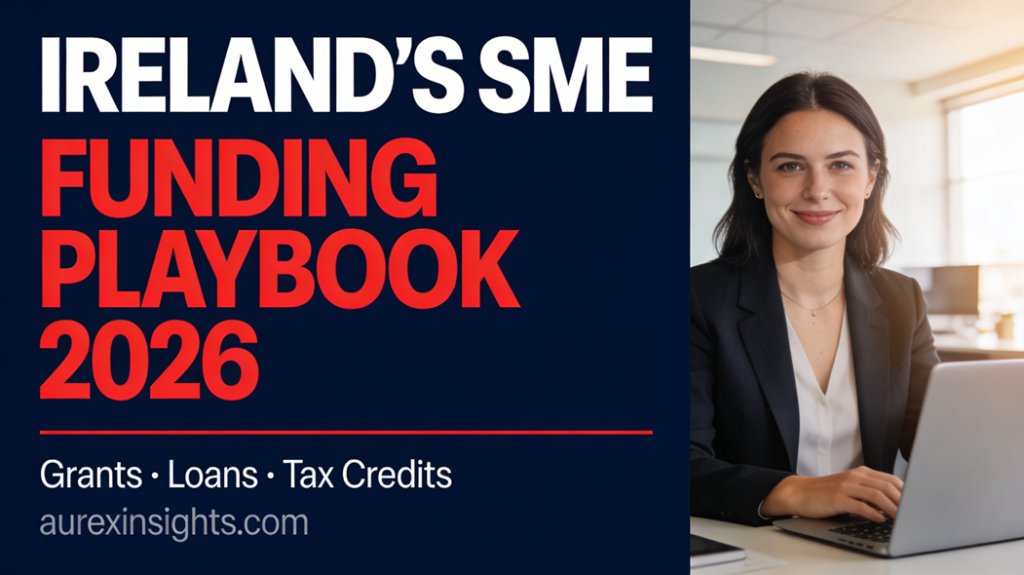
Starting or scaling a business in Ireland in 2026 is genuinely exciting – and genuinely hard. Costs are high. Margins are tight. Competition is real. But there is something that changes the equation significantly for businesses that know where to look: Ireland operates one of the most structurally developed Ireland SME grants 2026 and funding ecosystems in the European Union, with hundreds of millions of euro in grants, subsidised loans, tax credits, and advisory supports available right now – for businesses at every stage, from idea to established enterprise.
The problem is not eligibility. The problem is navigation.
The supports are spread across multiple agencies – Enterprise Ireland, the Local Enterprise Office network, the Strategic Banking Corporation of Ireland, Údarás na Gaeltachta, the Western Development Commission, the LEADER Programme, and the Revenue Commissioners – each with its own criteria, application cycles, and language. For a business owner already managing operations, staff, and cash flow, piecing together the landscape is genuinely difficult. That fragmentation means a significant share of available funding goes unclaimed every year – not because businesses were rejected, but because they never applied. Industry data from late 2025 found that 62% of Irish SMEs said Budget 2026 fell short of addressing their rising costs – yet many of those same businesses had not accessed supports the State had already fully funded on their behalf.
As an economist and business consultant working with SMEs, start-ups, NGOs, and community organisations across Ireland, the EU, and Canada, I see this gap repeatedly. Businesses that are investing, hiring, decarbonising, or simply trying to survive a difficult cost environment are routinely missing supports they qualify for – because nobody has sat down with them and mapped it out.
This post is a practical map of the landscape. Ireland SME Grants 2026 does not cover every scheme – that would require a document several times this length – but it covers the pillars most likely to be relevant to growing Irish SMEs in 2026, with verified figures. If something here looks relevant to your situation, the next step is a conversation.
The map below gives you the full picture at a glance – the sections that follow break each pillar down in detail.
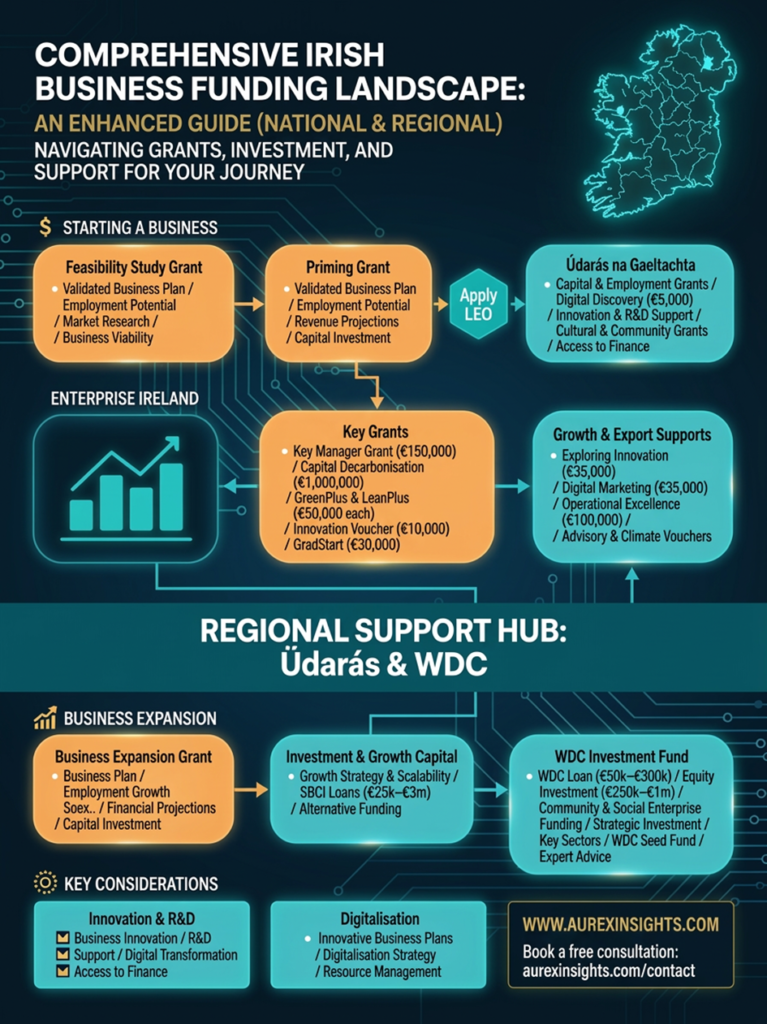
Enterprise Ireland – For Growing and Export-Ready Businesses
Enterprise Ireland (EI) is Ireland’s primary state agency for indigenous businesses with the ambition and capacity to grow, scale, and compete internationally. Its 2026 grant portfolio is substantial, and covers a wide range of business needs across the growth journey:
| Ireland SME Grants 2026 | What It Covers | Maximum |
| Key Manager Grant | Salary costs of a strategic management hire | €150,000 |
| Capital Investment for Decarbonisation | Carbon-reducing technologies | €1,000,000 |
| Operational Excellence Grant | Equipment, process improvement, training | €100,000 |
| GreenPlus Grant | External environmental expert | €50,000 |
| LeanPlus Grant | External lean process coach | €50,000 |
| Enterprise Emissions Reduction Fund | Manufacturing companies, 10+ FTE, 5+ years sales | €50,000 |
| Digital Marketing Grant | Digital marketing agency engagement | €35,000 |
| Exploring Innovation Grant | Technical feasibility of an R&D project | €35,000 |
| GradStart | Up to 3 graduates on 24-month contracts | €30,000 |
| Employment Funding Support | Min. 3 new hires | €15,000 per employee |
| Innovation Voucher | Time with an expert on a product or technical challenge | €10,000 |
| Advisory Grants | Sustainability, IP, strategic challenge, new technology | €5,000 |
| Climate Action Voucher | Sustainability training and advisory | €1,800 |
| Cyber Security Review Grant | Cyber risk assessment | €3,000 |
A few things worth knowing about Enterprise Ireland supports: they are not exclusively for large exporters. Many of these schemes are accessible to ambitious SMEs at earlier growth stages. The application process, while structured, is navigable – and a well-prepared application to a single EI scheme can return multiples of the advisory cost in grant funding secured. The key is framing your business correctly in the language EI responds to: growth, employment, sustainability, and international ambition.
Grant scheme caps and eligibility criteria are reviewed by Enterprise Ireland between rounds. We recommend confirming current figures directly at enterprise-ireland.com before submitting any application – or simply book a free consultation and we will do that groundwork for you.
SBCI – Competitive Finance When You Need to Invest
The Strategic Banking Corporation of Ireland (SBCI) does not issue grants – it provides access to competitively priced loan finance through participating banks and credit providers, typically at rates well below standard commercial lending. If your business has a capital investment need in 2026, exploring SBCI finance before going directly to your bank is always worth doing.
Growth and Sustainability Loan Scheme
- Loans of €25,000 to €3,000,000 for SMEs, farmers, and fishers
- Loans of up to €500,000 available unsecured
- Terms of up to 10 years
- Available for working capital, investment, and sustainability purposes
- Operating until 30 June 2026 or until fully subscribed — this is a genuinely time-sensitive opportunity
This scheme is backed by €500 million in funding and is delivered through AIB, Bank of Ireland, PTSB, and other participating lenders. If you are planning capital investment in the second half of this year, the case for moving on this in Q2 is strong.
Local Enterprise Offices – Your First Stop If You Are Starting Out
The Local Enterprise Office (LEO) network is one of Ireland’s most underutilised support structures – and one of the most accessible. Every county has one, the supports are available at local level, and the team in each office exists specifically to help people at the earlier stages of the business journey. If you have been thinking about starting a business, this is where to begin.
Key LEO Supports:
- Priming Grant – up to €150,000 for micro-enterprises within the first 18 months of start-up; covers capital items, salary costs, and consultancy. This is specifically designed for people who have recently taken the leap, or are about to
- Business Expansion Grant – up to €150,000 for businesses in the growth phase; standard maximum is typically €80,000, with the higher ceiling available for projects with a clear export or scaling trajectory
- Feasibility Study Grant – up to €15,000 for researching market demand for a new product or service
- Trading Online Voucher – up to €2,500 for developing or improving an e-commerce presence
- R&D Supports – for research, development, and technological innovation
- Subsidised Mentoring and Training – access to experienced business mentors and structured management development
The Priming Grant window – the first 18 months of operation – creates a genuine incentive to move from planning to action. The funding is there. The office is there. What you need is a credible concept and the right framing.
Údarás na Gaeltachta – For Gaeltacht-Region Businesses
If your business is located in or connected to a Gaeltacht area – stretching across Donegal, Galway, Mayo, Kerry, Cork, Waterford, and Meath – Údarás na Gaeltachta offers a dedicated suite of enterprise supports that operates alongside, not instead of, national schemes. Eligible businesses can potentially access supports from both simultaneously.
The scale of the Údarás ecosystem is often underappreciated: in 2025, client companies supported 9,716 jobs across seven counties, recorded over €1 billion in sales for the second consecutive year, and created 681 new jobs – a track record that reflects the seriousness of the investment available.
Key Údarás Financial Supports:
| Support | Detail | Maximum |
| Capital Grant | 50% of eligible costs for land, buildings, equipment | €200,000 |
| Digital Process Innovation Grant | Large-scale digital or AI implementation | €150,000 |
| Consultancy Grant | Strategic SME advisory (50% funded) | €35,000 |
| Digital Discovery Grant | AI readiness and opportunity assessment | €5,000 |
| Employment Grant | Linked to wage costs of jobs created; phased payments | Wage-linked |
| R&D Grant | Salary costs of R&D employees and directly related materials | Project-specific |
| Climate Action Voucher | Sustainability and decarbonisation planning | €1,800 |
| Community Enterprise Grant | For Gaeltacht community groups and committees | €3,000 |
Importantly, you do not need to be an Irish speaker to qualify. The primary requirements are that your business operates within designated Gaeltacht boundaries and contributes to regional economic development. Údarás also has the capacity to make equity investment in start-ups and expanding enterprises of strategic importance to the region.
Western Development Commission – For Businesses Across the West
The Western Development Commission (WDC) is a statutory development agency focused exclusively on the economic and social development of seven western counties: Clare, Donegal, Galway, Leitrim, Mayo, Roscommon, and Sligo. Unlike most other agencies, the WDC provides investment finance – loans and equity – rather than traditional grants, filling the gap for businesses that need more than grant funding can offer, or that have already exhausted grant options.
WDC Investment Finance:
- Business Loans – €50,000 to €300,000 for SMEs across sectors including technology, creative industries, food, and professional services
- Equity Investment – €250,000 to €1,000,000 for businesses with significant growth potential and a compelling value proposition
- Community and Social Enterprise Loans – €50,000 to €250,000 (up to €1,000,000 for strategic projects)
- Creative Industries Fund – micro-loans and the WRAP Fund (up to €200,000) for film, TV, animation, and games
The impact data speaks for itself: in independent assessments, 96% of SMEs and 100% of social enterprises confirmed that WDC backing was significant to their survival and growth. The Commission invested over €6 million in businesses and communities in 2025 alone, bringing total investment in the western region to over €100 million. Its 2025–2030 strategy targets a further €50 million investment and the creation of 5,000 jobs.
If your business is in the western region and has needs beyond what grants cover, WDC finance is a genuinely powerful tool that most businesses in the region have never explored.
LEADER – For Rural Businesses and Community Organisations
The LEADER Programme, delivered through Local Action Groups across Ireland, provides EU co-funded grant support for rural development – including rural businesses, community enterprises, agri-food initiatives, tourism projects, and social enterprises. Eligible activities and maximum grant levels vary by Local Action Group area, but LEADER is a consistently underutilised source of funding for organisations and businesses outside major urban centres.
The current 2023–2027 programming cycle is open.
The R&D Tax Credit – The Most Consistently Overlooked Support
The R&D Tax Credit was enhanced significantly in Budget 2026: the relief rate rose from 30% to 35%, and the threshold for first-year cash refunds increased to €87,500 – a deliberate move to make the credit more accessible for smaller projects and earlier-stage businesses.
The credit allows businesses undertaking qualifying R&D to claim back 35% of total eligible costs – either as a cash refund from Revenue or offset against their corporation tax bill. The most persistent misconception is that it only applies to technology or pharmaceutical companies. The reality is different: the definition of qualifying R&D is broad, covering any systematic investigation aimed at advancing knowledge or developing new or improved products, processes, or services. Businesses in manufacturing, agri-food, professional services, creative industries, and construction regularly qualify – without realising it.
If your business is innovating in any form and you have never looked at this credit, you are almost certainly leaving money behind.
Thinking About Starting? The System Is Designed for That Moment
One of the least-discussed aspects of Ireland’s enterprise support landscape is this: a significant share of the available funding is specifically designed for people who have not yet started – or have just started – rather than established businesses. The LEO Priming Grant, the Feasibility Study Grant, Enterprise Ireland’s Innovation Voucher, and LEADER funding are all accessible at the planning or early-launch stage.
If you have been thinking about a product, a service, a social enterprise, or a community initiative – and cost or complexity has been the barrier – that barrier is almost certainly smaller than you think. What you need first is not money, but a clear concept, a credible narrative, and an application that speaks the language of the funder.
This is precisely where good preparation and the right advisory support make the difference between a funded project and a missed opportunity.
The Bigger Picture
The Irish State has made a deliberate policy choice to support business growth through grants, subsidised finance, and tax incentives rather than through direct transfers alone. That architecture exists. It is funded. It is waiting to be used.
The businesses that will grow fastest in the next five years will not necessarily be the ones with the best products or the most capital. They will be the ones that understood the system well enough to use it.
It is also worth noting: this blog highlights only a selection of the supports available. There are additional schemes at sectoral level – in agri-food, tourism, creative industries, fintech, medtech, and others – plus EU-funded programmes, Skillnet Ireland supports, Science Foundation Ireland co-funding, and county-level incentives that go well beyond what any single post can cover comprehensively. The National Enterprise Hub at neh.gov.ie is a useful searchable directory. But identifying which schemes represent the best return on application effort for your specific situation – that requires a conversation.
How I Can Help
Navigating this landscape takes time, knowledge, and the ability to frame your business in the terms that matter to funders. What I offer includes:
- Funding scoping – identifying which schemes you are eligible for and which represent the best return on application effort
- Economic development – framing the narrative of your business story, defining the economics of your growth plans, or your project in the language funders respond to
- Application preparation – drafting, structuring, and reviewing applications from start to submission
- Business planning – developing the underlying plans and financial projections that strong applications require
- Post-award support – managing reporting obligations and positioning for follow-on funding
I work with established SMEs, early-stage start-ups, NGOs, community organizations, and economic development bodies – across Ireland, the EU, and Canada. If you are an SME owner, a founder at the starting line, a community group with an idea, or a business planning its next growth phase – I would welcome a conversation about what is available for your specific situation. I am happy to investigate the best grant, loan, or funding option for your specific venture, sector, or project – just get in touch.
Book a Free Initial Consultation
If you are unsure where to start, or simply want to know what you are eligible for, the best first step is a conversation. I offer a free initial consultation – no obligation, no sales pitch. In 30 minutes, I can give you a clear picture of what is available for your specific situation and a realistic path to securing it.
📅 Book directly: aurexinsights.com/contact
📧 brian@aurexinsights.com
📞 Ireland: +353 86 821 8084 | Canada: +1 343 202 2596
All figures in Ireland SME Grants 2026 are correct as of March 2026. Grant scheme caps, eligibility criteria, and deadlines are subject to change; always verify current terms directly with the relevant agency before making any application.
Aurex Insights provides independent economic, public policy, and strategic advisory services. Dr Brian O’Donnell, DBA is available for consulting engagements with SMEs, start-ups, NGOs, community organisations, and public bodies.