Why Canada’s Housing Crisis is a Decade-Long Structural Trap
Published by Dr. Brian O’Donnell | Aurex Insights | March 2026
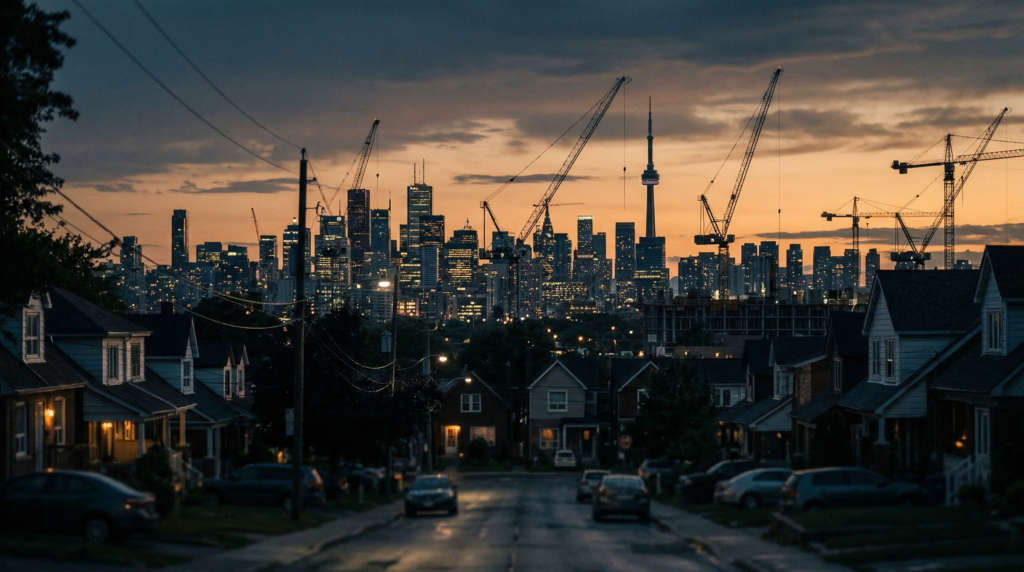
Arriving in Canada from Ireland, one is immediately struck by a profound macroeconomic paradox. Look at the skyline of any major Canadian city, and you will see cranes. Listen to the political rhetoric, and you will hear promises of a market “correction” and impending affordability. Yet, if you look at the underlying economic data in early 2026, a much darker reality emerges.
Canada’s housing market is not experiencing a standard cyclical dip. It is caught in a structural deadlock – a trap of its own design that is fundamentally decoupling from headline statistics. What is currently playing out is a transition from a housing-led economy to a housing-burdened one, with severe implications for productivity, social mobility, and intergenerational wealth.
In the coming weeks, I will be publishing a deep-dive comparative analysis on the Irish housing crisis on Aurex Insights, exploring the parallel failures in Western housing policy. But for now, our focus is squarely on the Canadian structural trap.
| 176.7% Household Debt-to-Income Statistics Canada, Q3 2025 | 53.2% RBC Affordability Measure Share of pre-tax income needed for ownership costs nationally |
| 92.8% Vancouver Affordability RBC Economics, 2025 – effectively impossible on a median single income | 30–50% Real-Time Building Drop CIBC estimate of actual new project starts vs. CMHC headline data |
| 4.2M Homes Needed by 2035 Oxford Economics estimate to return to sustainable affordability | 31% First-Time Buyers Needing Family Help CIBC, 2024 – average family gift: $115,000 |
SECTION 1
The Anglosphere Planning Deficit
To understand the Canadian supply freeze, we must first look at how the country permits building. A chronic issue runs across English-speaking nations – the UK, Canada, Ireland, Australia, and New Zealand – all of which share a reliance on discretionary planning systems.
Unlike the “as-of-right” zoning models common in much of continental Europe – where a developer can simply pull a permit and build if their project meets the pre-established code – Canadian developments are treated as bespoke negotiations. Every new project is subject to public consultations, municipal pushback, and localised NIMBY (Not In My Back Yard) obstructionism.
This creates a massive hidden tax of time and risk. When the timeline to get a shovel in the ground takes years rather than months, the carrying costs for developers skyrocket. This rigid focus on preserving low-density zoning has resulted in a 40-year self-inflicted supply shortage, making the economics of building affordable housing nearly impossible.
Planning System Comparison
| Discretionary (Anglosphere) | As-of-Right (Continental Europe) |
| Every project negotiated case-by-case | Permit issued automatically if building code is met |
| Public consultations add 1–3 years | Months from application to shovel in ground |
| NIMBY veto power at local level | Community input at code-writing stage, not project stage |
| Development charges fund municipal services | Municipal revenues decoupled from new development |
| Carrying costs kill affordable-housing economics | Predictable timeline enables affordable projects |
| Outcome: 40-year supply deficit | Outcome: Stable, functional supply pipelines |
SECTION 2
The CIBC Trap – Too High to Buy, Too Low to Build
This planning friction feeds directly into the economic trap identified by CIBC Capital Markets in their report Anatomy of a Correction. The Canadian housing market is currently broken at both ends of the spectrum simultaneously.
Buyers are sidelined: despite recent rate adjustments, the absolute cost of housing remains too high for average incomes to qualify for mortgages. Builders are paralysed: because of the exorbitant costs of land, labour, materials, and municipal development charges, developers cannot lower their prices to meet buyers without taking a substantial financial loss. When the math does not pencil, builders simply stop building.
The Ghost Data Problem
Official housing starts tracked by the Canada Mortgage and Housing Corporation (CMHC) record a “start” only when a foundation reaches grade. The relatively stable headline numbers we see today are ghosts of financing decisions made in 2023 and 2024. CIBC estimates that actual, real-time new project activity is 30% to 50% lower than the headlines suggest. The pipeline has already gone cold – it simply has not shown up in the official statistics yet.
RBC Affordability by City (2025) – Share of Pre-Tax Income for Ownership
| City | Affordability % | Trend | Status |
| Vancouver | 92.8% | Worsening | Crisis |
| Toronto | 84.3% | Worsening | Crisis |
| Victoria | 78.1% | Stable | Severe |
| Hamilton | 71.4% | Slight improvement | Severe |
| Ottawa | 58.2% | Stable | Stressed |
| Montreal | 47.8% | Slight improvement | Elevated |
| National Average | 53.2% | Worsening | Stressed |
SECTION 3
The Local Reality – Ottawa’s Hidden Carrying Costs
To ground this macroeconomic data, we need only look at the microeconomic reality here in Ottawa. Beyond the mortgage, the hidden carrying costs of Canadian real estate are quietly suffocating household liquidity. In Ottawa, residential property taxes sit roughly at 1% of assessed market value. For a young professional or family stretching to buy a modest $750,000 home, they are immediately hit with an annual property tax bill of approximately $7,500 – paid with after-tax dollars.
The City of Ottawa’s recently approved 2026 budget includes a 3.75% property tax hike, alongside increased fees for water, waste, and a 2.5% jump in transit fares. Municipalities, legally unable to run deficits, rely heavily on property taxes and development charges to survive – creating a perverse incentive where cities need expensive housing to fund basic services, ultimately passing the cost directly to the end user.
True Cost of a $750,000 Home in Ottawa – Year One Estimate
Monthly and annual carrying costs, excluding utilities. Based on 2026 rates.
| Cost Item | Annual (CAD) | Monthly |
| Downpayment (20%) – one-time | $150,000 | — |
| Mortgage (P&I, 4.5%, 25-year amortisation) | $40,020 | $3,335 |
| Property Tax (~1% of assessed value) | $7,500 | $625 |
| Maintenance (1% rule of thumb) | $7,500 | $625 |
| Total Cash Outlay (excl. utilities) | $55,020 | $4,585 |
When $5,240 per month is required simply to keep a roof over your head – before groceries, childcare, utilities, or transport – entrepreneurial risk-taking and discretionary spending evaporate. The broader economic drag follows directly.
SECTION 4
The Macro Drain – Household Debt and the Consumption Squeeze
According to Statistics Canada’s latest figures, the national household debt-to-disposable income ratio sits at a staggering 176.7%. For every dollar a Canadian earns, they owe roughly $1.77. This debt burden leaves the economy incredibly fragile to payment shocks.
The Bank of Canada notes that roughly 6% of all mortgage holders face a payment jump of over 40% at their upcoming renewal. As homeowners funnel all available capital into servicing debt to avoid losing their homes, the wider economy starves.
| “CIBC models that the resulting negative wealth effect will sap $5,000 in annual consumption per household. Multiply that across millions of households, and you have the recipe for a lost decade of GDP and productivity growth.” – CIBC Capital Markets, Anatomy of a Correction |
SECTION 5
The Youth Penalty – A Neo-Feudal Wealth Divide
Perhaps the most damaging aspect of this structural deadlock is its impact on social mobility. Housing in Canada is no longer just shelter – it is the primary dividing line in the nation’s wealth gap. The data on intergenerational inequality is jarring.
According to Statistics Canada, individuals born in the 1990s whose parents were homeowners are twice as likely to own a home themselves compared to children of non-homeowners. If the parents own multiple properties, that likelihood nearly triples.
A recent CIBC report found that 31% of first-time homebuyers in 2024 required financial help from family -and the average size of that tax-free gift has soared to $115,000. We have effectively created a neo-feudal housing system. Access to homeownership – and the wealth accumulation it provides – is increasingly dictated not by an individual’s education, work ethic, or salary, but by the property equity of their parents. For young Canadians without family wealth, the ladder has been pulled up.
THE IRISH & EU PARALLEL
Canada and Ireland: Two Crises from the Same Blueprint
The Irish housing crisis is in many respects a mirror of the Canadian one – driven by the same discretionary planning failures, the same reliance on a small number of large developers, and the same political reluctance to confront the interests of existing homeowners at the expense of future ones.
| Canada | Ireland |
| Median house price: ~$700,000 CAD in major centres | Average Dublin house price exceeds €550,000 |
| Household debt at 174% of disposable income | An Bord Pleanála approval routinely stretches 2–5 years |
| Discretionary planning adds 2–4 years to projects | Viability gap on social housing requires €80,000+ per unit in state subsidy |
| Municipal charges embedded in development costs | Shared ownership schemes addressing symptoms rather than supply constraints |
| Young professionals priced out | Generation Rent unable to accumulate deposits at pace of price growth |
The EU offers a counter-model: German mietpreisbremse (rent brake) laws, Viennese social housing at 60% of the population, and Dutch land-value recapture policies that fund infrastructure from density gains. The structural difference is not demand – it is how the state relates to land, planning permission, and municipal financing.
A forthcoming Aurex Insights analysis will examine what Ireland and Canada can – and should – adopt from the European model.
SECTION 6
The 2035 Horizon – Why There Is No Quick Fix
When does the math normalise? According to top-tier economic forecasting, not anytime soon. A recent RBC Economics housing report from late 2025 notes that affordability improvements are slowing significantly as interest rates stabilise and incomes fail to keep pace with carrying costs. Their national aggregate affordability measure indicates an average household currently needs 53.2% of pre-tax income to cover ownership costs – 92.8% in Vancouver.
Oxford Economics has released a sobering long-term model. Factoring in median incomes, prices, and 30-year amortisations, their Housing Affordability Index predicts that the Canadian market will not return to sustainable affordability levels until 2035. To achieve even that, Canada must build an estimated 4.2 million new homes over the next decade.
Given CIBC’s data showing a 30–50% real-time drop in building activity, we are currently moving backward.
SECTION 7
Policy Prescriptions — Changing the Paradigm
If today’s housing crisis is the direct result of yesterday’s popular policy choices, how do we break the deadlock? Canadian politicians are currently offering fragmented solutions. The Federal Liberals are using the Housing Accelerator Fund to incentivise municipalities to allow density. The Conservatives promise to cut red tape and financially penalise municipal gatekeepers. The NDP wants a National Housing Secretariat for better intergovernmental alignment.
While each touches on a symptom, a true economic recovery requires a shift in fundamental paradigms.
1. Dismantle Discretionary Planning
Canada must shift toward European-style as-of-right zoning. If a developer meets the building code and density requirements, the permit should be issued automatically – removing the localised veto power that delays projects by years and inflates costs by hundreds of thousands of dollars per unit.
2. Reform Municipal Financing
We must decouple municipal revenues from new housing. Cities should not be financially reliant on levying massive development charges on new builds just to keep property taxes artificially low for existing, older homeowners. The current structure is a regressive wealth transfer from young to old.
3. Shift Real Estate Taxation
We need to rebalance the tax code to reward productive economic investment – business creation, technology, manufacturing – over passive land speculation. The current system overwhelmingly favours capital parked in primary residences. A vacant land tax, a capital gains reform for investment properties, and a municipal land value capture mechanism would collectively reorient incentives.
| THE AUREX INSIGHT The next decade will be defined by structural reform – or structural stagnation. Canada’s housing market is not waiting for a crash. It is already living through a slow, painful grind. The transition out of this structural trap will require immense political courage to tell existing homeowners that the era of double-digit, tax-free equity gains must end for the wider economy to survive. As policy consultants and economic observers, our job is not to panic but to plan. The next decade will require businesses, policymakers, and young professionals to navigate an environment where capital is scarce, debt is expensive, and structural reform is the only way forward. A forthcoming Aurex Insights analysis will examine what Ireland – facing near-identical structural constraints – can learn from both the Canadian experience and the European counter-model. |